





Beyond Banking: How Revolut, Monobank, N26 & Monzo Build Financial Super-Apps





How four neobanks turn everyday banking into broader financial ecosystems. For fintech founders, product leaders, CTOs, and designers researching how leading financial products expand beyond everyday banking.
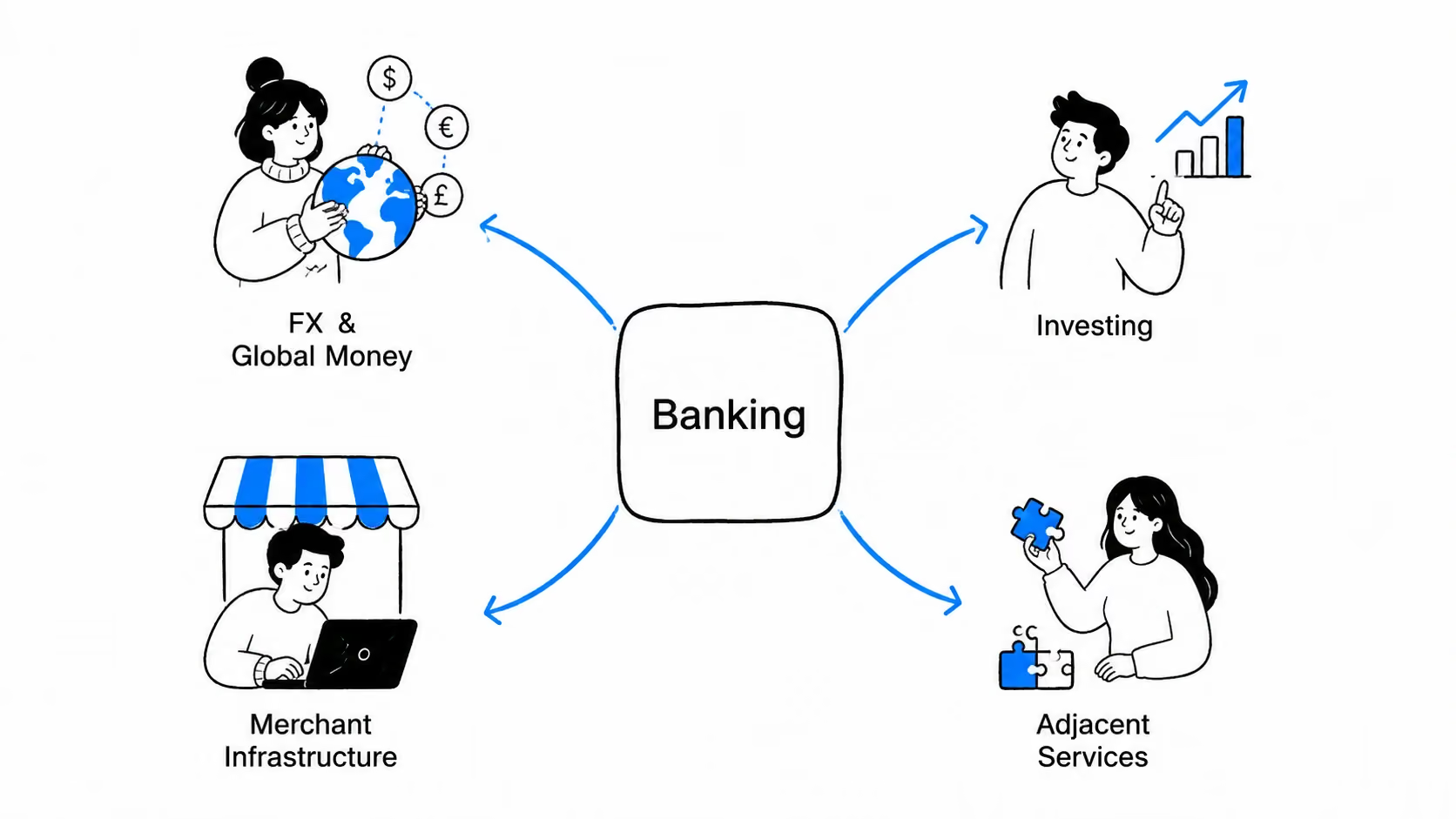
Daily banking is where a neobank earns the habit. In Part 1 of this series, we looked at how Monobank, Revolut, Monzo, and N26 compete for that habit: sub-accounts, automation, payment gestures, card customization, and the small interactions that make a banking app worth opening every day. But once a financial product owns that relationship, a bigger question appears:
What else should happen inside the same product?
That is where the four banks take very different paths.
Revolut expands horizontally into foreign exchange, investing, crypto, trading, travel, and merchant payments. Monobank expands into government bonds, merchant infrastructure, eSIM, insurance, commerce, and government services. N26 uses partnerships to add financial products without building every underlying capability itself. Monzo has historically been more selective, extending its core banking experience into savings and investing without trying to become everything at once.
The interesting question is therefore not which bank has the most features. It is how each bank decides what belongs inside the product.
TL;DR
- Revolut treats global money as the center of gravity. Multi-currency balances, FX, investing, crypto, trading, and travel all reinforce the same promise: make money work across borders.
- Monobank expands from financial utility into financial infrastructure. Government bonds, merchant acquiring, Tap to Phone, payment APIs, eSIM, insurance, and commerce turn the banking app into a broader operating layer.
- N26 takes a modular approach: own the customer experience, partner for regulated infrastructure. Its investment stack — 5,000+ stocks and ETFs via Upvest, hundreds of cryptocurrencies through Bitpanda — shows how a bank adds capability through partners while keeping the interface and the relationship.
- Monzo is the selective builder: its investment offering has grown to 15 investments, with Seccl providing custody, order management and ISA infrastructure — yet the product deliberately stays focused on long-term investing instead of becoming a trading platform.
- The strongest super-app strategies do not start with a list of services. They expand from a behavioral center of gravity.
- For product teams, the lesson is simple: feature expansion is not product strategy. Coherent expansion is.
01 — From Daily Banking to a Financial Operating System
A banking app starts with a relatively small set of jobs: receive money; store money; spend money; transfer money; understand what happened to money.
The strongest neobanks gradually move beyond those jobs. The progression looks roughly like this:
Bank account, money management, financial products, financial infrastructure, adjacent services
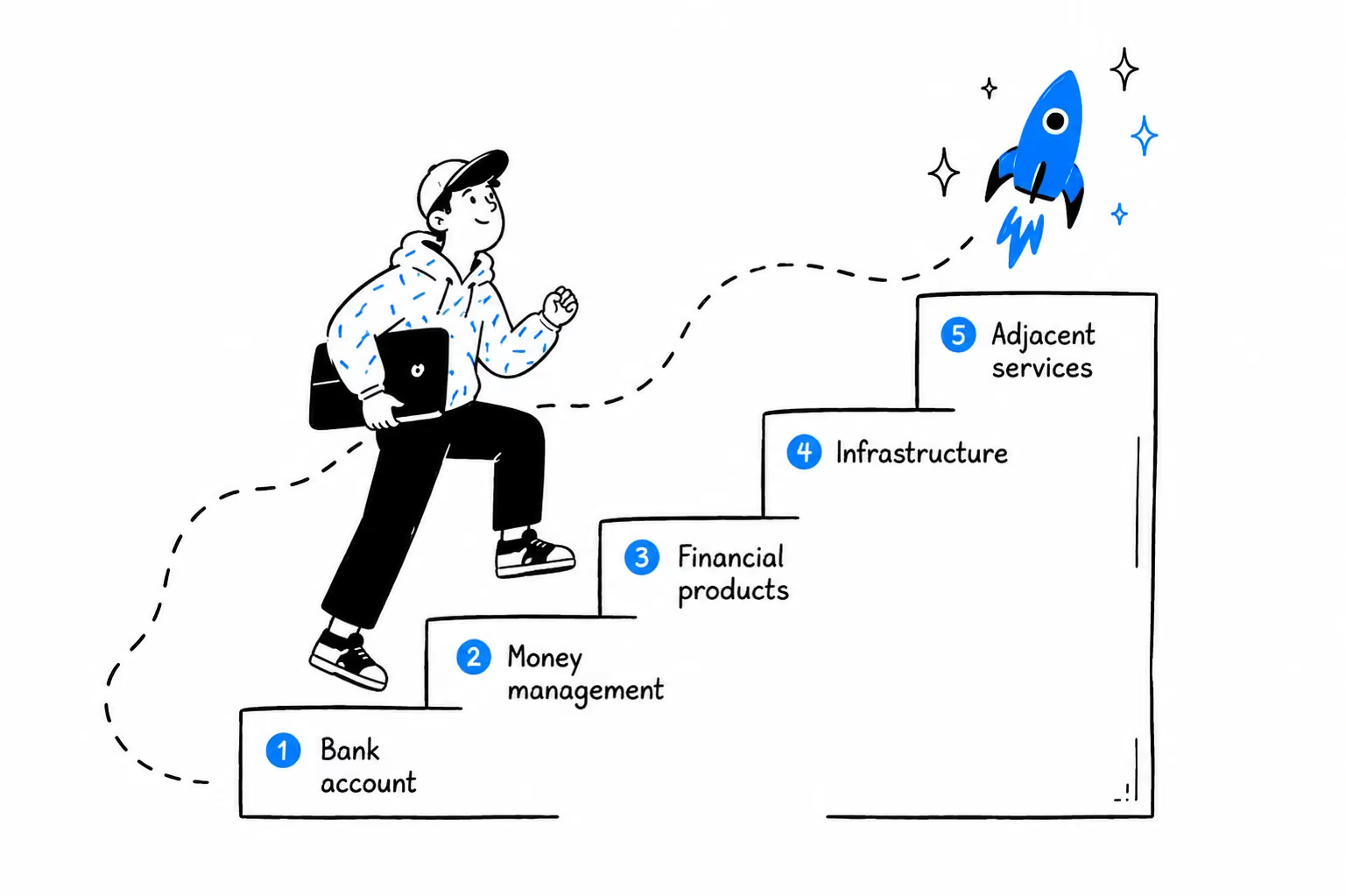
But there is a major product-design risk in every step. Every new feature adds navigation, cognitive load, permissions, compliance, support requirements, new transaction states, new terminology, and new failure modes. A bank can therefore become more useful while simultaneously becoming harder to use.
That is why the interesting comparison is not feature count. It is architectural coherence.
The four products are not simply at different stages of the same roadmap. They represent different theories of what a modern financial product should become.
02 — Multi-Currency UX: When FX Becomes Product Architecture
Foreign exchange is easy to describe as a feature: "The user can exchange currencies." But the interesting design question is what happens before, during, and after the exchange. Revolut's model is fundamentally different from the simpler "spend abroad" approach used by banks that do not maintain multiple currency balances.
Revolut: currency as a routing layer
Revolut allows customers to hold balances in multiple currencies. When a card transaction occurs, the system can use the matching currency balance; when the required currency is not available, a conversion can take place.
That changes the mental model. The user is no longer thinking "Which currency will my card use?" They are thinking "Where should my money live before I spend it?"

That is a product-level shift. The FX feature becomes part of the account architecture rather than a separate utility.
Revolut's current Portugal pricing provides a useful example of how usage can become the upgrade mechanism. Standard customers have a €1,000 monthly fair-use threshold, Plus €3,000, while Premium, Metal and Ultra have no additional exchange fee. Weekend exchange markups are 1% for Standard and 0.5% for Plus, with no additional weekend fee on Premium and above (Revolut Portugal Help Centre). Conditions vary by market and jurisdiction — figures current as of publication.
The important design lesson is not the exact percentage. It is that usage becomes the upgrade mechanism. The product can let a user experience the core value first and then monetize the intensity of that behavior.
The contrast
Monzo and N26 take a much narrower approach. Neither is built around maintaining a large portfolio of user-held currency balances. Their international spending experience solves a different job: allowing customers to use their existing account abroad without excessive friction.
Monobank is different again. Its currency products are much more closely connected to the Ukrainian user's desire to hold foreign currency as a store of value. Three products can therefore offer "foreign currency" while solving three different problems:
The lesson: do not design "multi-currency" because competitors have multi-currency. First decide whether your customer needs global spending, currency storage, FX trading, or currency risk management. The interface follows the job.
03 — The Investment Layer: Build, Partner, or Stay Focused
Once a bank becomes the place where money accumulates, another question appears: Why should the user leave the app to invest it? This is where Revolut, N26, Monobank and Monzo make particularly different choices.
Revolut: build the financial stack
Revolut has moved furthest toward owning the investment experience. Its offering spans stocks, ETFs, other investment products, crypto and the separate Revolut X trading environment. The most strategically interesting part is not the number of instruments. It is the attempt to own increasingly sophisticated layers of the investment workflow.
Revolut X now exposes a REST API for market data and trading, including order-book access and authenticated order placement. The API documentation even supports trading through the CLI and compatible AI assistants. (Revolut X REST API documentation).
That is a significant architectural signal. A consumer banking company is not simply adding an "Invest" tab. In our reading, it is building toward a financial platform that can serve different levels of user sophistication — the product can offer simple banking, simple investing, active trading, programmatic trading without forcing the customer to leave the broader ecosystem.
N26: own the customer experience, partner for regulated infrastructure
N26 took a modular approach: own the customer experience, partner for regulated infrastructure. N26 now offers stocks, ETFs, ETCs and ready-made funds inside the same banking experience, with more than 5,000 instruments available and investments starting from €1. Its equities and ETF execution and custody are provided in partnership with Upvest, while N26 owns the customer-facing product layer. (N26 Stocks & ETFs).
On the crypto side, N26 Crypto offers hundreds of cryptocurrencies through Bitpanda, with assets held in cold storage managed by the partner. Fees are transparent: 1.5% on Bitcoin, 2.5% on other cryptocurrencies, 3.5% on low-liquidity coins — with Metal-tier discounts to 1% and 2%. (N26 Crypto).
This is not simply outsourced crypto. N26 systematically uses partners as the infrastructure layer for investments while keeping the interface, the brand and the customer relationship. This is a classic fintech build-vs-buy decision. The bank does not need to own every technical and regulatory layer to own the customer experience.
The trade-off is obvious: partnering buys speed and reduces infrastructure burden. But partnering also limits how much of the underlying product can become proprietary differentiation. That can be a very good decision when the financial capability is important to users but is not the company's primary strategic moat.
Monzo: the selective builder
Monzo offers a useful counterexample — not "build almost nothing," but "build enough, and deliberately stop there."
Monzo has expanded its investment offering beyond its original narrow fund proposition. Its current Investments product includes 15 investments, including BlackRock's iShares range and other funds, with Seccl providing custody, order management and ISA infrastructure. (Monzo Investments; Monzo — BlackRock & Seccl partnership). But compared with Revolut's increasingly broad trading and crypto stack, Monzo remains deliberately focused on long-term investing rather than trying to become a full trading platform.
That focus is itself the design decision. Monzo does not need to become a brokerage to make investing useful to its existing customers. Its investment layer answers a narrower question: "How can we help an existing banking customer put long-term money to work?" — a fundamentally different product ambition from Revolut X.
Monobank: use the financial system itself
Monobank's investment story is unusual because part of its differentiation comes from the financial environment in which it operates.
The app makes Ukrainian government bonds (DGBU) available to retail customers — purchasable directly in-app in UAH, USD or EUR, with automatic crediting of payouts and no commission on war bonds (Monobank Government Bonds). Under Article 165.1.2 of Ukraine's Tax Code, interest income from Ukrainian government securities is excluded from an individual's taxable income (Tax Code of Ukraine, Article 165). As of 24 June 2026, individuals held a record ₴153.6 billion in domestic government bonds (Ministry of Finance of Ukraine).
The important design decision is not simply "Monobank sells bonds." It is: a complex government-backed investment instrument is brought into the same consumer interface where the user's everyday money already lives. The distance between "I have money" and "I can invest it" becomes dramatically smaller.
That is the real UX opportunity.
Four investment philosophies

The lesson is not that one model is superior. It is that the investment layer should reflect the company's strategic identity.
04 — Monobank's B2B Layer: When the Bank Becomes Infrastructure
The most interesting part of Monobank's expansion may not be consumer-facing at all. It is the infrastructure underneath the consumer product.
Monobank's acquiring platform exposes APIs and payment functionality that allow businesses to accept and manage payments programmatically. Its acquiring API documentation includes payment creation and status, payment links, webhooks, tokens, 3DS flows, merchant information and a test environment — not marketing copy, but a real technical layer. (Monobank Acquiring API documentation).
The broader business stack includes online acquiring, QR payments, payment links, mobile acceptance and API/CMS integrations. Its ecosystem also connects with fiscalization and POS infrastructure, including Checkbox. For a small business, that shifts payment setup from an integration project toward configuration. This changes the role of the bank. It is no longer simply the place where a business keeps its money. It becomes part of the infrastructure through which the business gets paid. And that creates a much stronger relationship.
The ladder starts at the simplest possible action
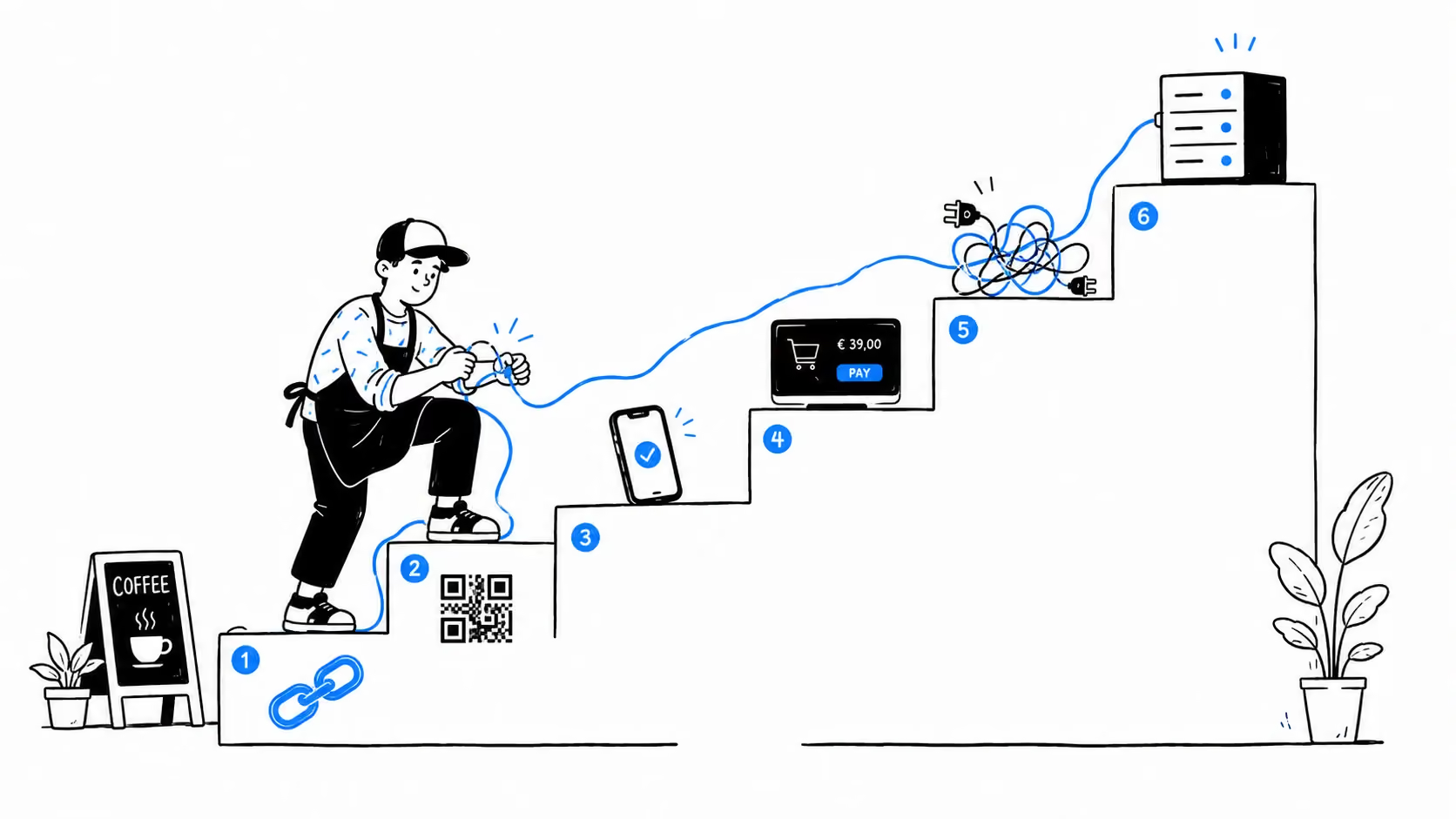
One of the strongest patterns in fintech infrastructure is reducing the minimum viable setup. A small business may not have a developer, a website, a POS terminal, a technical team, or a payment integration project. The product therefore needs to offer progressively more sophisticated entry points:
Payment link → QR → Phone as terminal → Hosted checkout → API integration → Embedded payment infrastructure
We can read this as a product ladder: a company can enter at the bottom and move upward as it grows. That is strategically more interesting than simply having "an API."
05 — Revolut Shows the Same Pattern at a Different Scale
Revolut Business follows a similar principle, but with a much broader merchant ecosystem.Its current business payment offering includes Revolut Pay, card acceptance through Revolut Reader, online payment gateway/API integrations, payment links, invoices, QR payments and Tap to Pay. (Revolut Business payment solutions).
The difference is not capability alone. It is positioning. Revolut connects merchant infrastructure to its consumer network: businesses can accept Revolut Pay from Revolut customers while using the same broader financial ecosystem for business operations. That creates a potential two-sided loop: consumer adoption → merchant demand → merchant acceptance → more consumer utility.

One structural difference is worth noting: in the EEA, Revolut Business requires an incorporated company — sole traders are excluded from eligibility. Monobank's merchant ecosystem can start at a much lower level of technical complexity, including businesses that may not have a dedicated development team. Both products can create a two-sided network effect — the difference is who gets to climb aboard, and at which rung.
The same mechanism is visible in Monobank, although the local market structure and product architecture are different. This is where banking starts behaving less like an app and more like a network.
06 — From Bank to Super-App: Two Different Doors

The term "super-app" can become meaningless if it simply means "an app with lots of features." The more useful question is: What behavioral center makes all those features belong together? Monobank and Revolut provide a particularly good comparison.
Monobank: expand into errands
Monobank's expansion has repeatedly moved toward things users already need to do: buy and manage eSIMs; arrange insurance (OSAGO, Green Card); access government-related services; buy or sell goods; manage business payments; invest in government bonds. (Monobank eSIM; Monobank Insurance).
The bank becomes a place where financial and administrative tasks converge. The underlying logic is: The money is already here. Put the adjacent task here too. That creates convenience through consolidation.
Revolut: expand around global lifestyle
Revolut takes a different path. Its strongest adjacent categories reinforce its original global-money proposition: foreign exchange, investing, crypto, travel, accommodation, airport lounges, merchant payments.
The user who travels internationally already has a reason to use Revolut. Travel becomes another layer around the same behavioral moment. The logic is: The user is already using us abroad. Let us own more of the trip. That is much more coherent than adding random services.
07 — The Super-App Test: Does the New Feature Belong?
A useful test for any fintech product considering expansion:
- Does it happen near an existing financial behavior? If yes, the feature has a natural entry point.
- Does the existing account make the new experience materially easier? If not, why should it live inside the bank?
- Does the feature reinforce the brand's reason to exist? If not, it risks becoming product clutter.
- Can the same identity, trust and payment infrastructure be reused? If yes, the economics may become attractive.
- Does the feature create a new recurring behavior? If yes, it can strengthen retention.
This produces a much better definition of a financial super-app:
A financial super-app is not a banking app with more features. It is a financial product that successfully extends its existing behavioral center into adjacent jobs.
08 — Four Banks, Four Expansion Strategies
A note on framing before the table: the "Product identity" row is our reading — the interpretation we make as product designers — rather than the banks' own positioning.
There is no universal winner. And that is exactly the point. The best fintech products are not necessarily the ones with the largest roadmap. They are the ones where the roadmap makes sense.
09 — What Founders Should Take From This
1. Decide your center of gravity before your roadmap. Do not begin with "What financial features should we add?" Begin with "What financial behavior do we want to own?" Revolut owns global money. Monzo owns personal financial organization. Monobank increasingly owns a broader layer of everyday financial life. The product roadmap follows.
2. Build, buy, or partner deliberately. N26's investment infrastructure (Upvest, Bitpanda) shows that a fintech does not need to own every technical layer. Revolut's trading infrastructure shows the opposite strategy. Both can work. The mistake is accidentally becoming a partner-led product because building was difficult — or building infrastructure that never becomes a differentiator.
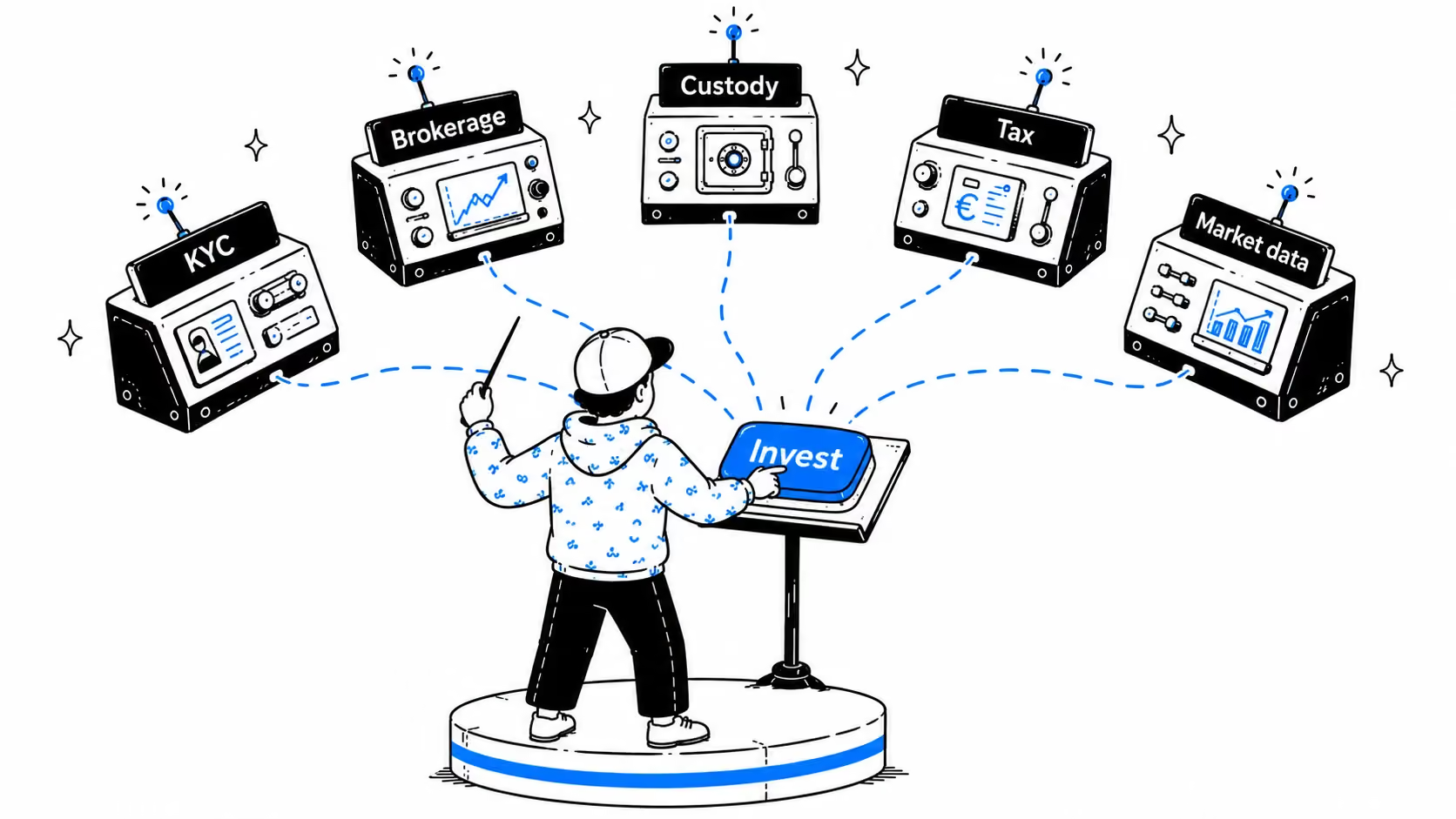
3. The interface can hide enormous infrastructure complexity. The best financial UX often looks simple precisely because the complexity has been moved behind it. A user sees "Invest." Behind that button may sit identity, suitability, regulatory checks, brokerage, custody, settlement, tax reporting, market data, and transaction states. A product team should therefore treat simplicity as an architectural outcome, not a visual treatment.
4. The best entry point is often the smallest one. Monobank's merchant ecosystem demonstrates the power of a low-friction first step. Payment link. QR. Phone. API. Enterprise integration. The same principle applies to consumer fintech: do not force users to understand the whole system before they can get value from it.
5. Expansion should compound the original behavior. The strongest additions make the existing product more useful. FX makes Revolut better for travel. Travel makes Revolut's FX more valuable. Investing gives Revolut's account a reason to hold more money. Merchant payments extend the same ecosystem into business. That is compounding. A feature that creates an isolated destination inside the app is different.
10 — The Product Design Implication
The most important pattern across these four products is not a particular feature. It is the relationship between product surface and product architecture.
As a financial product grows, the number of things users can do increases. But the number of concepts users need to understand should not grow at the same rate. That is the real design challenge.
A mature fintech product needs to continuously answer: What should be visible? What should be automated? What should be delegated to partners? What should be separated into a dedicated experience? What should remain outside the product entirely? That is where product design stops being screen design. It becomes product architecture.
The Verdict
If the question is who has built the broadest global-money architecture, our answer is Revolut. If the question is who has turned banking into broader everyday financial infrastructure, Monobank is the most interesting case to us. If the question is who demonstrates the strongest build-vs-buy approach, N26 provides one of the clearest examples. And if the question is who demonstrates the value of restraint, Monzo remains an important counterexample.
But the deeper conclusion is more useful than a winner:
The best financial products do not win by adding the most features. They win by making more of the user's financial life feel like the same product.
That is the difference between a banking app and a financial operating system.
What This Means for Fintech Product Teams
When we analyse products like these, we are not looking for features to copy. We are looking for the underlying decisions:
- What user behavior does the product own?
- Where does friction disappear?
- Which complexity is automated?
- Which capabilities are built internally? Which are delegated to partners?
- Where does compliance become visible?
- What makes users trust the product with more of their money?
- What should the product become next?
That is the same thinking we apply when auditing and shaping financial products. A product audit is not just a review of screens. It is an analysis of the system behind them — user journeys, product architecture, interaction patterns, business logic, and the opportunities hidden inside them.
If you are building, scaling, or rethinking a financial product, this is the analysis we start with: Product Audit & Discovery. More of our fintech product design work and research.
Part 2 of our neobank product design series.
Part 1 — Neobank UX Patterns explores the everyday layer: sub-accounts, automation, payment gestures, card customization and gamification.
Part 2 — Beyond Banking looks at what happens next: FX, investing, financial infrastructure and the expansion from bank to financial operating system.

Frequently Asked Questions
What is a financial super-app?
A financial super-app is a financial product that expands beyond core banking into adjacent services while keeping those experiences connected through a shared account, identity, payment infrastructure, or behavioral context. The important distinction is not the number of features, but whether the expansion forms a coherent product system.
How is Revolut different from a traditional bank?
Revolut combines banking with a broader set of financial services including multi-currency accounts, FX, investing, crypto, trading and merchant payments. Its product strategy is centered on making the same financial relationship useful across borders and across increasingly sophisticated financial behaviors.
How does N26 add investment products?
### How does N26 add investment products?
Does Monobank offer government bonds?
Yes. Ukrainian government bonds are available to retail investors directly in the Monobank app, in UAH, USD and EUR, with automatic payout crediting and no commission on war bonds. Under Article 165.1.2 of Ukraine's Tax Code, interest income from Ukrainian government securities is excluded from an individual's taxable income.
What makes Monobank's fintech infrastructure interesting?
Monobank extends beyond consumer banking into merchant and payment infrastructure, including acquiring APIs, payment links, webhook-based integrations, and connections to fiscalization and POS infrastructure such as Checkbox. Its public acquiring documentation demonstrates a real technical layer, making the bank relevant as both a consumer product and a business infrastructure layer.
Should a fintech build or buy its infrastructure?
There is no universal answer. Build when the capability is strategically differentiating or central to the product's long-term moat. Partner when infrastructure is complex, regulated, expensive to build, or not itself a differentiator. The important decision is to make the trade-off deliberately rather than accidentally.
