





Meta's Arena and the Real Prediction Market Business Model






Prediction markets don't make money only on trading fees – the aggregated positions themselves form a real-time map of what people expect and want. Meta's Arena app makes this explicit: no real money, points instead of bets, Llama generating and resolving markets. Sports already drives 89% of Kalshi's revenue, and a DOJ case has confirmed that demand data is valuable enough to trade on illegally. For product teams, prediction mechanics are becoming a new class of data product.
A prediction market is a platform where users trade on the outcome of future events – and the aggregated positions form a real-time signal of collective expectation. That second half of the definition is the part most coverage skips, and it is exactly the part Meta's new Arena app is built around. Arena launches without real money at all, which exposes what a prediction market actually sells.
What Is a Prediction Market and How Does It Make Money?
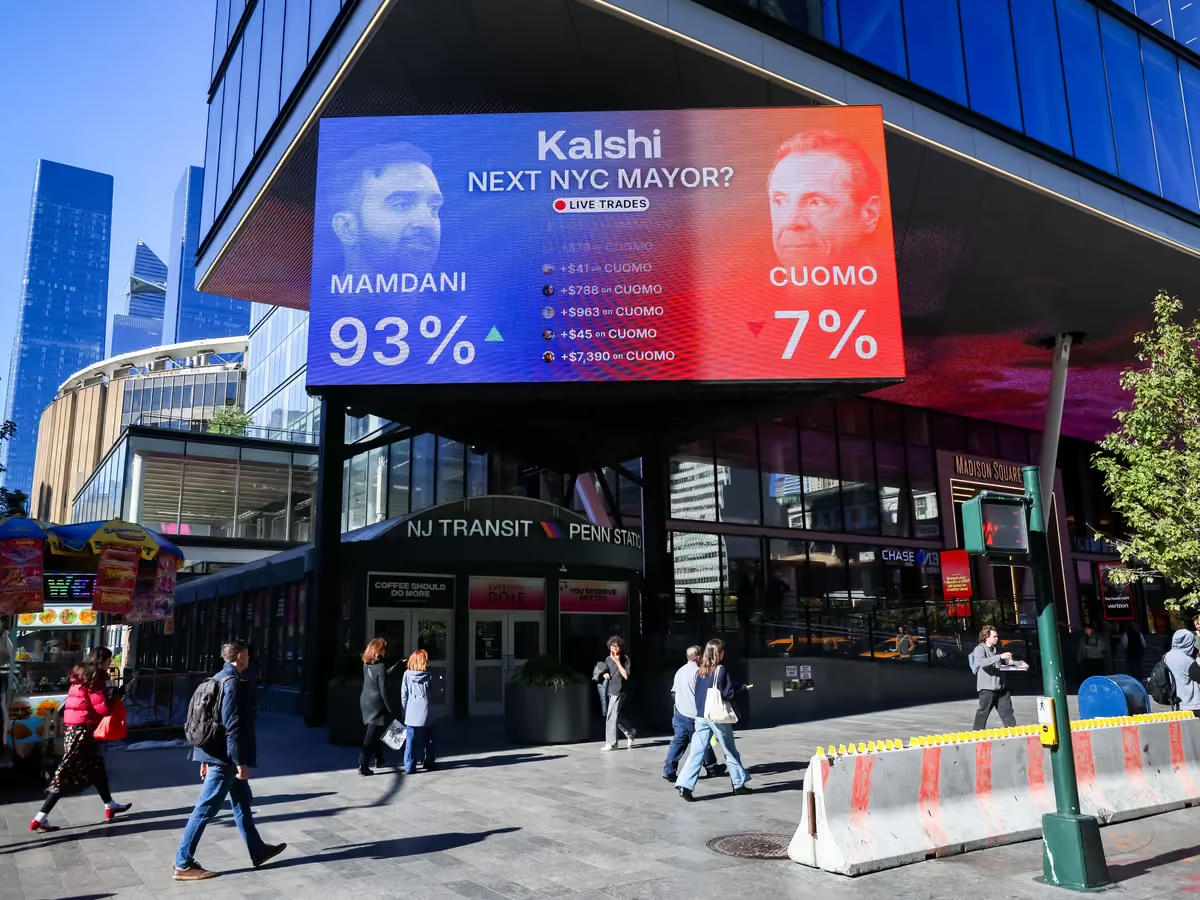
The visible business model is transactional. Kalshi, the first CFTC-regulated event exchange in the US, charges trading fees on contracts priced between $0.01 and $0.99, where the price doubles as the market's implied probability. Polymarket runs the same mechanic on crypto rails. In June 2026 alone, Kalshi, Polymarket, and Polymarket US generated a combined $44.8 billion in trading volume – up 75% from May, driven largely by the 2026 World Cup (The Block).
The category has also outgrown its political image. Sports brought Kalshi 89% of its 2025 revenue ($234.6 million of $263.5 million). Kalshi is currently valued at $22 billion following a spring funding round and is reportedly raising at up to $40 billion (Yellow.com).
But fees are only the visible layer. The less visible one is what the trading activity produces: a continuously updated dataset of revealed preferences.
Why Is Meta Launching a Prediction Market Without Money?
Meta's answer is Arena – a standalone app, separate from Facebook, Instagram, WhatsApp, and Messenger, targeted at users aged 18–34 with an internal goal of 100 million monthly active users. There is no cash. Users receive a fixed amount of virtual currency daily, place predictions, and Meta's AI resolves outcomes in near real time. Llama generates the questions from trending topics and acts as the oracle that decides what happened.
The backstory makes the strategy clearer. Zuckerberg explored acquiring Kalshi outright before the talks collapsed; Meta then struck a partnership instead, integrating Kalshi markets directly into Threads in March 2026 – and assigned an internal team to build Arena. This is also Meta's second attempt: Forecast, launched in 2020, died two years later largely because manually curating questions was too expensive to operate. AI removed that cost.
Here is the detail worth sitting with: if there is no money, there are no fees – and yet Arena is described internally as a top priority. The product's output is not revenue per trade. It is a behavioral demand map across a user base of 3.56 billion daily actives, plus a legal position that sidesteps the CFTC entirely. The absence of money is not a compromise. Every competitor requires financial onboarding – crypto deposits on Polymarket, bank transfers on Kalshi, a brokerage account on Robinhood. Arena removes all of it: one tap from Instagram, zero setup. The friction it deletes is precisely the friction that limits how much demand data the incumbents can collect.
How Do Prediction Markets Work as Demand Signals?
A poll records what people say. A market position records what they commit to. That difference is why prediction market prices are treated as probability feeds even by people who never trade – visitors reference Kalshi prices the way they used to reference polling averages.
The demand loop works in five steps:
- A market opens on a future event.
- Users take positions – each one a revealed preference, not a stated opinion.
- Positions aggregate into a price, which is a live probability estimate.
- The entity that controls the outcome reads the price as measured demand.
- The outcome shifts toward what the market revealed – and the prediction partially fulfills itself.
A thought experiment makes step four concrete. Imagine a market: "Will Marvel introduce a new three-armed hero by year-end?" If thousands of users pile into "yes," that is no longer a forecast – it is quantified, timestamped audience demand for a specific type of character. A studio watching that market has a business case handed to it. The prediction stops describing the future and starts commissioning it.
This is not hypothetical value. In May 2026, the US Department of Justice charged a Google software engineer with commodities fraud, wire fraud, and money laundering – alleging he used confidential Google search analytics to place roughly $2.75 million in Polymarket positions on markets tied to that data, profiting about $1.2 million (DOJ press release). The charges are allegations, not a conviction. But the case itself is the point: knowing what people are interested in, before the market does, was worth $1.2 million – enough for federal prosecutors to treat demand data as inside information.
What We Learned Designing a Political Prediction Market
The thesis above is general – it applies to sports, entertainment, macro events. Our own proof case comes from the vertical where demand signals are at their most visible: politics, where every market price is effectively a live alternative to polling.
We designed Prediction Edge, a political prediction platform covering US elections and primaries – race pages with volume and price charts on Kalshi-sourced data, candidate pages with policy position breakdowns and fundraising analytics, and an interactive US map spanning 128 races. An AI layer runs through the product: news summaries per candidate, market summaries that connect price movement to endorsements and media cycles, and a fundraising–momentum correlation that flags when donation surges historically precede price jumps by two to three days. The same pattern Meta is now building with Llama – AI turning raw market data into readable signal – is the pattern we shipped.
The project also taught us where the value actually sits. The initial brief centered on the candidate page. Data and navigation analysis showed the market page carried more user value – users came for the aggregated signal, not the biography – and the product architecture changed as a result. The market is the product; everything else is context around it.
Full case: flatstudio.co/work/prediction-edge
What Does This Mean for Product Teams?
Prediction mechanics are leaving the gambling category and entering the product toolkit. A points-based prediction layer – Arena's model – needs no gambling license, no financial onboarding, and produces engagement plus first-party demand data in one loop. Kalshi's integration into Threads shows the direction: market prices as a native UI element inside social products.
The design problems, however, are specific: odds states that update in real time, market pages that stay readable under data density, resolution logic users trust, AI-generated questions that don't feel random. If a prediction mechanic is already in your product and engagement or conversion isn't moving, the cause is usually architectural, not visual – in Prediction Edge, it was the information architecture, not the interface polish. A structured product audit answers that in one to three weeks with a prioritized, Jira-ready roadmap instead of guesswork: Product Audit & Discovery.
What Are the Risks of AI-Resolved Markets?
An honest read of the category includes the friction. Kalshi faces legal challenges in more than a dozen states arguing its sports contracts constitute unlicensed gambling (The Block); Arizona filed criminal charges in March 2026. US Sen. Richard Blumenthal has criticized Meta's Arena plans, pointing to the proposed Prediction Markets Security and Integrity Act. And the regulatory line is thin: the CFTC's June 2026 rule (Federal Register) illustrates it with a literal example – a contract on whether Iran starts a war is prohibited, while a contract on oil volume through the Strait of Hormuz is permitted as a commercial indicator, even if war is what moves it.
AI adds its own layer. When Llama both generates the questions and resolves them, the oracle problem becomes a trust problem. And AI is no longer just infrastructure – in the Prediction Arena benchmark (arXiv:2604.07355), autonomous AI agents traded on Kalshi and Polymarket with real $10,000 deposits; the best model hit a 71.4% settlement win rate, another earned +6.02% in three days of trading. AI now writes the questions, decides the answers, and profitably trades the spread in between. Any team building in this space is designing for that triangle.
Who Should Build This
Prediction products sit at the intersection of real-time data visualization, odds-state UX, regulatory constraints, and domain-specific content – political, sports, or financial. It is a domain where a generalist team learns at your expense: betslip logic, market page hierarchy, resolution trust, and live data states have failure modes that only show up in production. Our team has shipped across this exact perimeter – Prediction Edge in political markets, Azuro across decentralized betting protocols, Bookmaker.XYZ in Web3 sportsbooks. Whether you are validating a prediction concept from scratch or scaling a live product, a dedicated product team embeds in 7–14 days and scales with 14-day notice.

Frequently Asked Questions
What is Meta's Arena app?
Arena is a standalone prediction market app Meta is developing, separate from its social platforms. Users predict real-world outcomes using a video-game-style points system. Llama generates questions from trending topics and resolves outcomes. It targets users aged 18–34, with an internal goal of 100 million monthly active users.
Is Meta Arena real money?
No. Arena launches with virtual points only – users receive a daily allowance of virtual currency instead of wagering cash. Meta has not ruled out real-money features later, but the points model currently keeps Arena outside CFTC regulation and US gambling law.
How do prediction markets make money?
Regulated platforms like Kalshi charge trading fees on event contracts; Polymarket operates on crypto rails. The second, less visible asset is the data itself: aggregated positions form a real-time demand signal that is valuable to media, brands, and the platforms' own products.
Are prediction markets legal?
It depends on the model and jurisdiction. Kalshi is CFTC-regulated federally but faces challenges in over a dozen US states arguing its sports contracts are unlicensed gambling. Points-based products like Meta's Arena avoid this by removing real money entirely.
What team do you need to build a prediction market?
One with domain experience in real-time data UX, odds states, market page architecture, and regulatory constraints – prediction products fail in production details, not in mockups. We've shipped Prediction Edge, Azuro, and Bookmaker.XYZ in this space; a dedicated team model typically starts in 7–14 days.
