







Let’s be honest: the design market is oversaturated. Every other studio is "dynamically evolving," and freelance platforms have turned into a race to the bottom—who can do it cheaper in five minutes.
But at Flatstudio, we don’t spend a cent on advertising. We’ve never hunted for leads on Upwork, and we don’t do RFPs or traditional pitches. (Okay, there was one—but not really a pitch: we were invited to design the system for Lisbon’s transport network, TML).
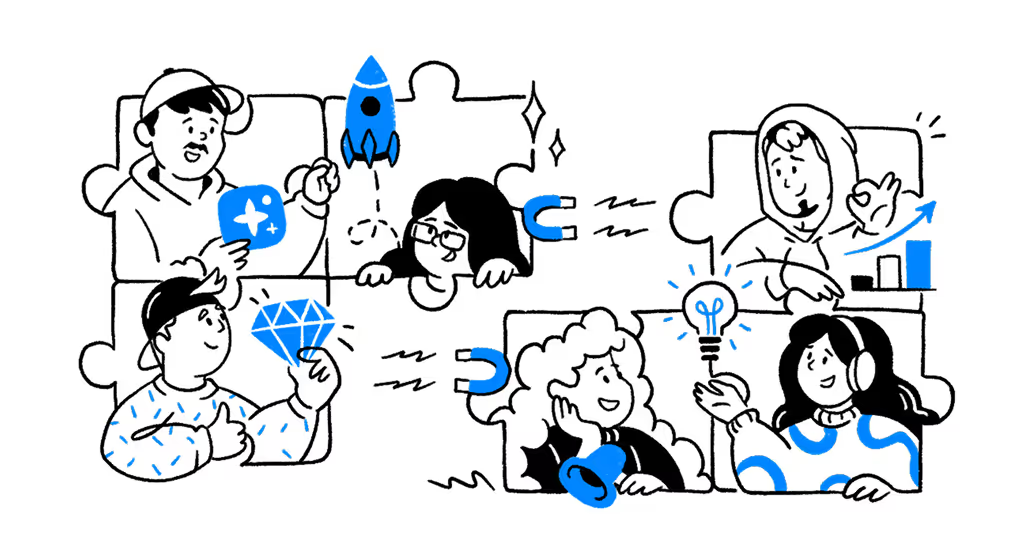
So, how does it work? Why do clients find us on their own? I think I have a pretty short and simple answer. It all comes down to one thing that’s easy to say but hard to pull off: you become a partner, not just a pair of hands.
This article is an analysis of how we got here. I want to share the four principles that, in my view, helped us build a culture where clients come to us. This is a story about how working with us stops being a "budget expense" and starts being "company capital."
Principle One: "Treat it like your own" isn’t a metaphor, it’s a strategy
When we take on a complex interface system, we don’t just draw buttons. We literally "get under the hood" of the business through meetings, deep-dive briefs, and researching the product, the industry, and the competition. For us, being more obsessed with the product’s success than the client is is just the baseline.
If we see that a client’s requested approach will kill the conversion rate, break the user logic, or is just plain unnecessary—we say it straight. Even if it’s uncomfortable. Even if we aren't getting paid extra for that analysis. That kind of bluntness and focus on the endgame is what builds real trust. The CTO of Outlier put it perfectly in his Clutch review:
“We sometimes disagree and get pushback from them, but we ultimately trust them as the design experts.”
That trust translates into real numbers. After our launch, Outlier saw a 20%+ conversion rate into paid subscribers. An app that costs $20/month pulled in a thousand paid users in the first six weeks without any ads. Projects like StavkaTV, Mollybet, or Outlier stopped being "gigs" for us a long time ago. As Viktor Titov, CEO of StavkaTV, noted:
“Our numbers have grown to 1,000,000 MAU and 3,000,000 sessions. We consider that it became possible including through Flatstudio work and support.”
Principle Two: We don’t do contests—we fix things
We never do free "test tasks" for pitches. But at Flatstudio, we have a different practice—one I started myself at 18, sitting at my first Toshiba laptop.
When we use a product and see that it’s clunky, our hands literally start to itch. We build concepts just to get the ideas out of our heads (it’s like journaling so you can sleep better at night) and show them to the world—to inspire others or share solutions with fellow devs.
Here are a few of our concepts you might find interesting:
- Google Play – Rethinking navigation architecture (2016 – right when Material Design was new).
- Microsoft – A new take on enterprise marketing sites.
- Rewind – Interacting with sports data via AI (this was 2019, back when GPT-2 just launched).
- Football PS5 game – Reimagining the UX of a game interface (we needed a project to push our limits in complex graphics).
I’m planning to write a deep dive on each of these—process, details, and takeaways—once we hit 10,000 views (kidding).
Principle Three: When the agency is stronger than the in-house team
In complex interfaces—massive dashboards, analytical panels, or betting platforms—the devil is in the logic and the tiny details.
When you do slightly more than what you were paid for, you stop being an "external vendor." You become company capital—the one who actually notices and polishes the details that matter.
We’ve had cases where major clients launched strategic projects with us instead of their own internal teams. Even more, they’ve asked us to run masterclasses for their in-house designers and managers. We teach teams how to build design systems that don’t just look pretty in Figma, but act as a living bridge to the code in React or Vue.
This saves developers hundreds of hours and saves the business thousands of dollars and euros on endless rounds of revisions.
Principle Four: Design is about intellect, not just Figma
To build structures that stand head and shoulders above the industry, you have to be multifaceted. Knowing the trends isn't enough.
The more you know about the world—from urban planning to behavioral psychology—the more non-obvious ideas you bring to the table. Clients, especially startup founders, sniff this out instantly. They want a partner they can talk to about scaling into new markets, not just the background color of a landing page.
At the end of the day, people buy from people. Being approachable, being open, and having a genuine drive to make the complex simple works better than any targeted ad. Clients feel that. And they tell their partners, friends, and family about you.
Beyond the "Bottom Line"
You could call these principles a marketing strategy, but for us, it’s just the only way to work without losing interest.
When you stop being a "provider" and become part of the success—when you're grabbing dinner, playing FIFA or CS with the client’s team, or even showing up at their wedding—the work stops being just work. It becomes a drive, knowing your decisions actually move the needle in the real world.
P.S. I’m sitting on the sofa right now finishing this, Mac Miller playing in the background. My dog, Biril, is lying next to me, paws tucked against my leg, snoring softly. I’m typing these last lines and realizing: we have a new site, strong cases, the experience, and a killer team.
Maybe now, with the world changing so fast, it’s time for us to change too? To start telling our story a bit more? We’ll see.




Frequently Asked Questions
What is Flatstudio?
Flatstudio is a product design and engineering studio based in Lisbon. Since 2014 we design, build and evolve digital products for iGaming, sports analytics, fintech and B2B SaaS – product design, web app engineering and brand strategy in one team.
What services does Flatstudio offer?
Four services – product & interface design, brand identity, web app engineering, and marketing design – delivered through five solutions: Pitch Deck & Product Concept, MVP Design & Development, Product Audit & Discovery, Product Rebuild & Redesign, and Dedicated Product Team. One team covers design, development, and long-term product evolution.
How long does a typical project take?
A product audit takes 2–4 weeks. An MVP or full redesign is scoped during discovery and is measured in months, not weeks – the number of states and integrations defines the timeline. Dedicated team engagement is ongoing.
How do I start a project with Flatstudio?
The first step is a 30-minute discovery call where we learn about your product stage, goals and constraints, then propose the engagement model that fits. You can book it via the Contact page.
What industries does Flatstudio work with?
Our deepest experience is in iGaming, sports analytics, fintech and B2B SaaS – data-dense, compliance-heavy products. We have also worked in GovTech and MedTech, where the same interface and compliance patterns apply.
How does Flatstudio use AI in its process?
We use AI where it removes manual work – research synthesis, turning call transcripts into briefs, coded prototypes and design QA – inside isolated environments, with no client data in third-party tools. It can be disabled per task or entirely on request. The team stays senior; AI shortens the path from requirement to shipped interface.
How is "Engineering Design" different from a regular creative agency?
Regular agencies optimise for “wow” moments and campaigns. We optimise for systems and product performance. We treat design like code: modular, scalable and logic‑driven. Instead of drawing standalone screens, we build design systems, patterns and documentation that your developers can implement without guessing. That’s why our solutions always combine product & interface design, brand identity, web app engineering and marketing assets into one coherent system.
Who are your services best suited for?
Our deepest experience is in iGaming, sports analytics, fintech and B2B SaaS products with complex logic, high-load dashboards, internal tools or betting products that need a consistent design and engineering partner rather than a one-off creative studio. We have also worked in GovTech and MedTech.
