




Trigger, Ease, Desire, Reward: How Habits Actually Form — and Why "21 Days" Is a Myth





Written for those who have already tried to "just force themselves" — and kept sliding back into old patterns. This article covers my personal experience with habit formation, a synthesis of ideas from James Clear's "Atomic Habits" and BJ Fogg's "Tiny Habits," a breakdown of common myths about the 21-day rule and willpower, plus the 4 elements of every habit (trigger, ease, desire, reward) and concrete tools that actually work in everyday life.
Two years ago I started having trouble sleeping — because of my thoughts, which at the time were many and completely unstructured. It all culminated in a shoulder injury from overtraining at the gym: when the pain became unbearable, doctors diagnosed tendinitis and told me to take a break.
I went to a family friend — kinesiologist Karimov, who runs several clinics in Portugal and is remarkably good at helping people where doctors offer grim prognoses. After just the second session I felt better physically, but not psychologically. Because he told me: my physical problems were a consequence of stress that comes from the head. And he advised me to sort out my thoughts — at the very least, to write them all down on paper.
I didn't take it too seriously, but my trust in Karimov did its work. I wrote my thoughts down first in my notes, then transferred them onto a wall — and structured them into several columns: "Family and Friends," "Body and Mind," "Work," "Rest and Hobbies." Only now do I realize how much that helped. Little by little I started closing items in each column, and the two main ideas that changed my life were: start meditating and read or listen to one book a month. I was especially drawn to books about meditation, habits and addictions — and Frank Herbert's "Dune." But this article is about habits, so let's focus on those.
For two years I researched the topic of habits, and the best ideas and tools, in my view, are concentrated in two books: James Clear's "Atomic Habits" and BJ Fogg's "Tiny Habits." Similar titles — slightly different approaches. The first is a practical, popular opus for a broad audience. The second is a behavior design method from a scientist, the founder of Stanford University's Behavior Design Lab. Together, they paint a complete picture of how to improve your life by building useful behavioral patterns.
I would summarize the main takeaway from both books like this: to reliably form a habit, the process has to be noticeable, desirable, pleasant, and require minimal effort. You literally need to trick your lazy brain.
TL;DR
- A habit forms in neither 21 nor 66 days — the real range is 18–254 days (Phillippa Lally's study, UCL, 2010).
- Repetition without a positive emotion immediately after the action doesn't lock in a habit — the brain encodes behavior through an emotional marker.
- Every habit consists of 4 elements: trigger, ease, desire, reward. If even one fails — the habit doesn't form.
- The most effective strategy: shrink the action to a 30-second version, attach it to an existing routine, and celebrate immediately after completing it.
Why Willpower Doesn't Work: The "1 in 7" Story
Back to 2024. Karimov, knowing my passion for research, told me about the work of Harvard professor Robert Kegan. Kegan cites cardiologists' observations: patients after complex heart surgery are told bluntly — "either you change your lifestyle, or you die." And only roughly one person in seven actually changes their behavior. The rest return to their old habits — with sad consequences.
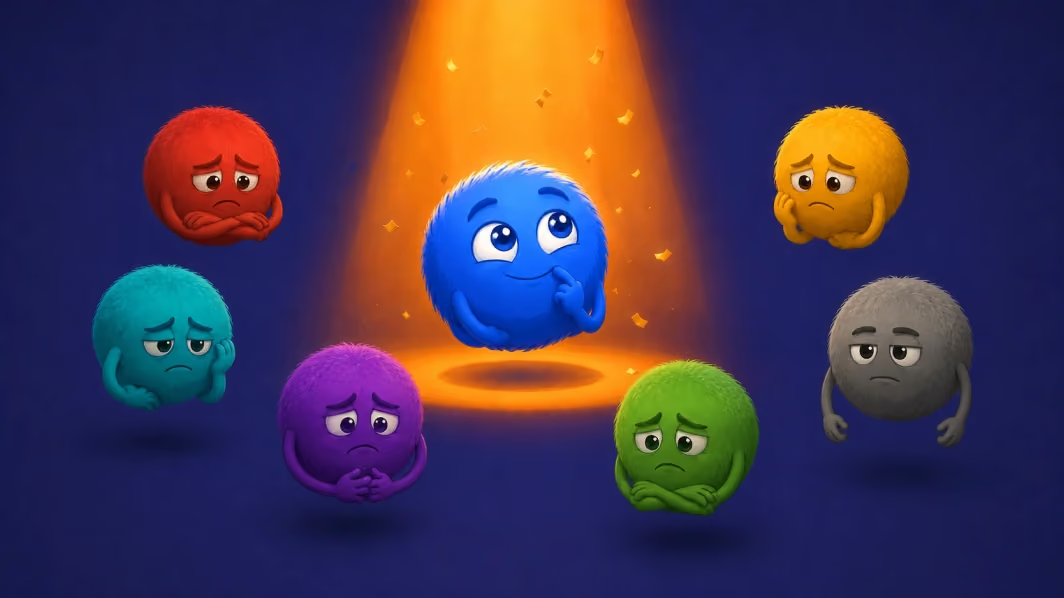
I, of course, hadn't had heart surgery — but I had a shoulder injury and a pile of other physical problems: pain in my neck and back, sometimes my knee, and a finger on my hand from a teenage injury back when I played handball. Problems I could keep downplaying — or finally deal with. I was 29, and I decided to be that one person in seven — and started looking for tools that would work specifically for me. After two years of searching and experimenting, I understood three things:
- Useful behavior rarely becomes fully automatic. Conscious effort is still required — but it can be made significantly easier.
- Constant self-control and coercion guarantee only breakdowns. My own experience and observing family and friends showed me this. What's needed are convictions and a system that make the new behavior possible.
- Building habitual behavior is the best way to create a new version of yourself.
But before we get to the tools, let's sort out the concepts and the common myths.
Myth 1: A Habit Forms in 21 Days (or 66 Days)
I believed this for years. While preparing this article, I wondered for the first time: where did this idea even come from? Is it true at all? Definitely not from books — it goes back to childhood, probably from parents or acquaintances. Something like: "Make your bed for 21 days and it'll become a habit." And only now, after literally five minutes of research, did I learn where this number actually comes from.
The "21 days" figure has nothing to do with habits. It became famous thanks to plastic surgeon Maxwell Maltz: back in the 1960s he observed that patients needed roughly 21 days to get used to their changed appearance after surgery.
The "66 days" figure is more accurate, but it's only an average. It comes from the study by Phillippa Lally and her colleagues at University College London, published in 2010 in the European Journal of Social Psychology. The actual numbers in the study ranged from 18 to 254 days. Honestly, that spread didn't surprise me: I already had a feeling that different habits take different amounts of time to "rewrite." It all depends on the person, the specific habit, and the context in which it forms.
Myth 2: Habits Form Through Repetition
Repetition is necessary — but not sufficient. You can repeat a behavior for months and it still won't become automatic if the brain doesn't get a signal that this is worth remembering. You need a positive emotion immediately after the action.
BJ Fogg puts it bluntly: it's emotions that create our habits, not repetition. Without an emotional marker, the brain doesn't encode the behavior as valuable. That's exactly why people can do morning exercises for weeks and then quit: they repeated — but got nothing pleasant in return.
Myth 3: Bad Habits and Addictions Are the Same Thing
These are different phenomena, and confusing them is a mistake with practical consequences.
A habit weakens or disappears when the environment (the context) changes. For a child, eating a marshmallow lying on the table is a familiar, pleasant action. But if the candy isn't there, the child may not even think of it.
An addiction is a pathological behavioral pattern with hyperactivation of the dopamine system. Its key signs: continuing despite recognized harm, loss of control, and severe discomfort upon stopping. Addiction doesn't disappear when the context changes. Changing the environment can help, but it's often not enough — with addiction (smoking, eating disorders in adults) professional help is frequently required.
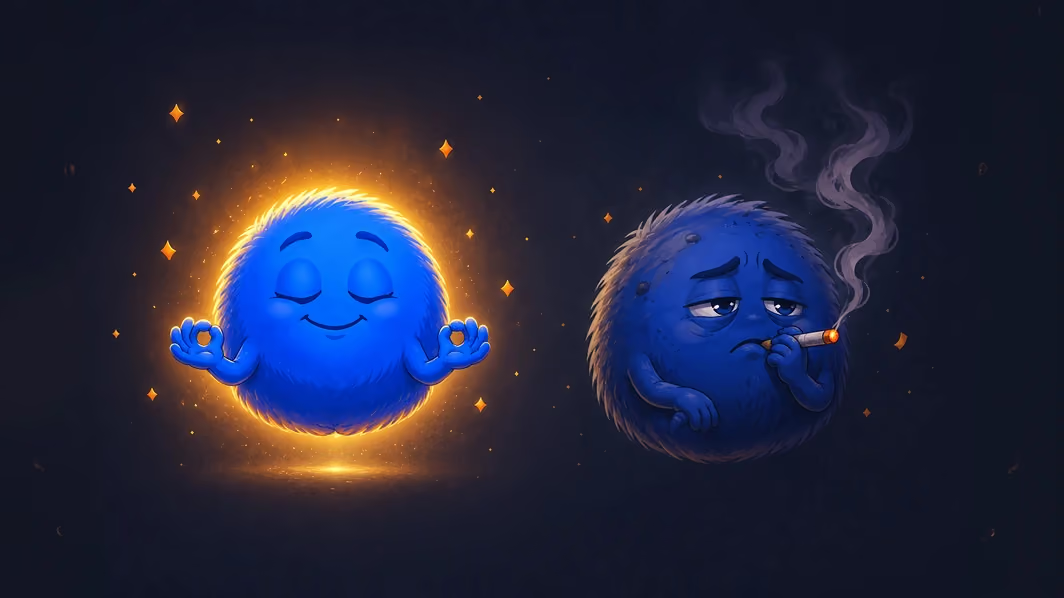
Much of what I know about the nature of addiction comes from Gary Wilson's book "Your Brain on Porn: Internet Pornography and the Emerging Science of Addiction." The title promises a book strictly about porn addiction, but it's actually one of the best books on the mechanics of addiction in general. The main thing I took away: addictions come in three types — behavioral, psychological, and physical — and each has its own logic of formation. That understanding alone solves half the problem: behavioral addiction can be tackled by changing the environment and patterns, while physical addiction almost always requires a specialist's support.
And one more important point: most of what we call habits aren't habits in the scientific sense. The scientific definition: a habit is an automatic behavioral pattern triggered by a contextual cue from the environment, without conscious intention. "Going to the gym three times a week" is not a habit — it's complex goal-directed behavior: it relies on planning, motivation, circumstances. But drinking a glass of water in the morning or switching on the kettle in the evening — that happens automatically.
There's a fitting joke about the gym: the hardest exercise at the gym is opening the front door of the sports complex. Once we're in, starting a workout is much easier. I use this consciously: when I really don't feel like going to the gym, I tell myself — "let's just show up, warm up a bit, see the gym friends, and head home." Or with a book: "let's read one paragraph — and we'll stop there if we don't feel like it." Nine times out of ten I stay for a full workout — or finish a whole chapter. This distinction is critical: tools that work for habits may not work for complex behavior — but they work brilliantly as entry points into it.
What a Habit Is Made Of: The 4-Element Formula
If we gather everything we've covered, it turns out that most habit advice is either oversimplified or plain wrong. We wait for "the right moment," or force ourselves through sheer will, or simply repeat the action hoping it will stick on its own. And we return to the old patterns again and again.
A habit is not a question of willpower. It's a question of a system built on an understanding of human nature.
Clear, in "Atomic Habits" (incidentally, one of the best-selling nonfiction books of the 21st century — over 25 million copies), describes four laws of behavior: make it obvious, make it attractive, make it easy, and make it satisfying.
Fogg has a behavior formula, B = MAP: Behavior occurs when Motivation (the desire to do something), Ability (how easy it is), and a Prompt (an environmental cue reminding you to start) come together.
Translated into plain language, every habit consists of four elements:
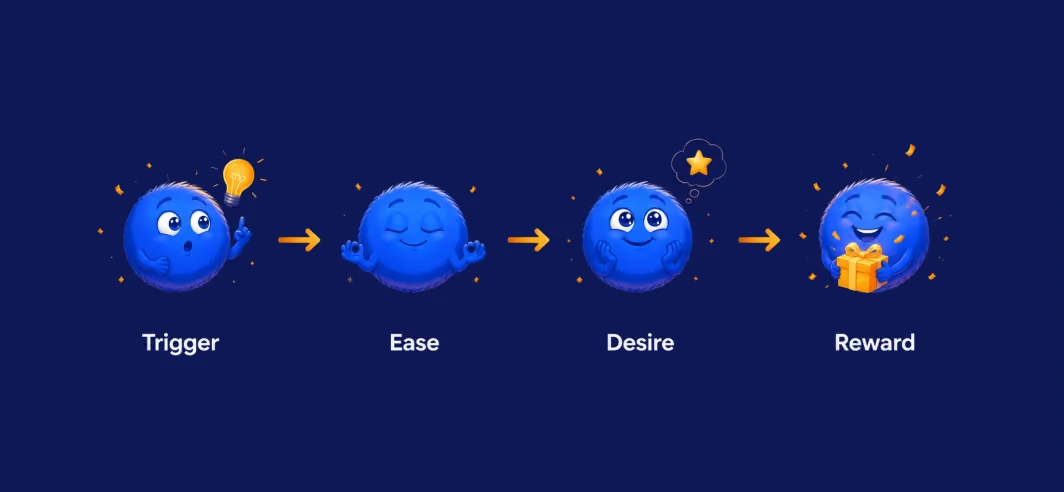
Trigger → Ease → Desire → Reward. If even one element fails — the habit doesn't form.
Let's break down each one and see how to set it up.
Element 1. The Trigger: What Launches a Habit?
A trigger is a signal or reminder from the environment. Without it, the behavior simply doesn't start. Clear calls it a cue; Fogg calls it a prompt. Different names, same essence: something has to remind the brain that now is the time to act.
Fogg identifies three types of triggers:
- External — something outside reminds us to act: a phone notification, a sticker on the fridge, a calendar entry. This is the least reliable type of trigger — it's easy to miss, it can fire at the wrong moment, and it can yank you out of whatever context you're in.
- Internal — hunger, fatigue, anxiety, boredom. They launch many of our behavioral patterns, but consciously controlling them is hard. That's exactly why awareness of your own emotions is critically important for designing your life. Meditation concretely helped me here: within the first weeks I noticed how certain thoughts affect the body — literally specific muscles. That awareness helped me understand how stress becomes a habit and affects the body physically and psychologically — and, ultimately, where that very shoulder injury that started this whole story came from.
- Action prompts — the most powerful type. The completion of one action becomes the trigger for the next. In that moment you already have momentum: you're already up, already in the right context — and resisting the next step is much harder than getting off the couch because of an external reminder.
An example from my life. I find it hard to focus on long, complex tasks. But I love riding my motorcycle — for me it's a kind of meditation with no stray thoughts. So I combined the two: I ride my motorcycle to the café Flore de Pampa on Praça das Flores in Lisbon and work there with a view of the park. The result — 4–5 hours of focus. Even the thought that I'll ride the motorcycle back home fuels my concentration. And the key observation: when you're focused, in a pleasant place, with a reward at the end — time flies faster.
Now I apply this at home too: I shape my environment so my brain is next to what it loves. Plants within reach, the dog nearby on the rug, the helmet on the nightstand waiting for the evening when I'll ride to training, to friends, or just out for a spin, kids running and shouting in the yard outside the window — all of it creates positive emotions, and that's the setting in which I work on hard tasks.
Tool 1. Habit stacking, from James Clear. The formula is simple: "After [existing automatic behavior], I will [new behavior]." The old, reliable habit lends its reliability to the new one.
Tool 2. The anchor moment, from BJ Fogg. Find a moment in your day that is already stable and automatic, and "glue" the new behavior to it. A good anchor has three traits: it's already automatic, it happens at the right frequency, and in the right context.
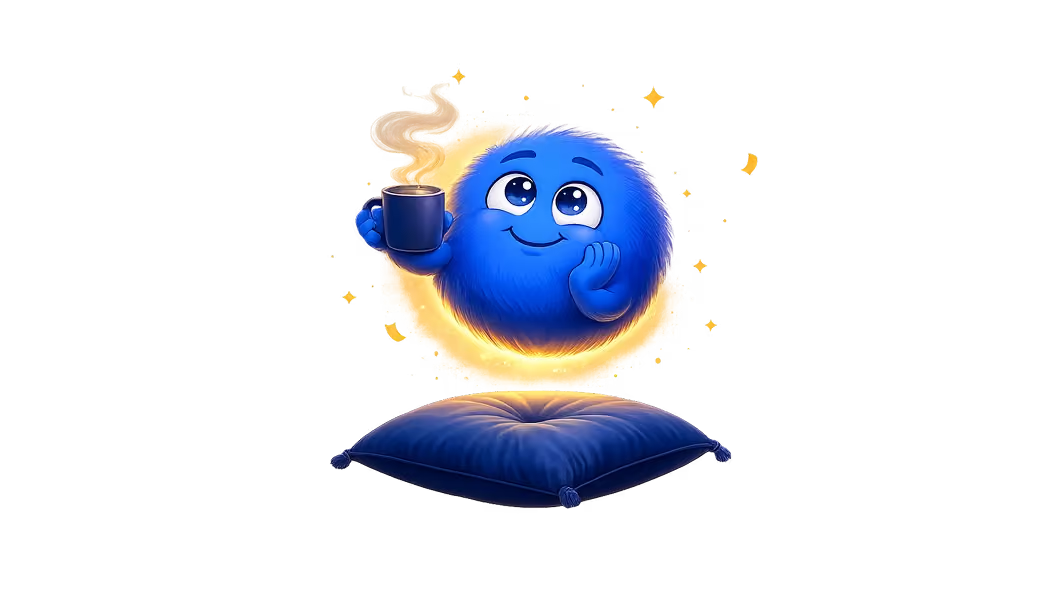
Fogg's own example: "After I pour my coffee, I will sit down on the meditation cushion." Not "I should meditate every morning," but a concrete attachment point.
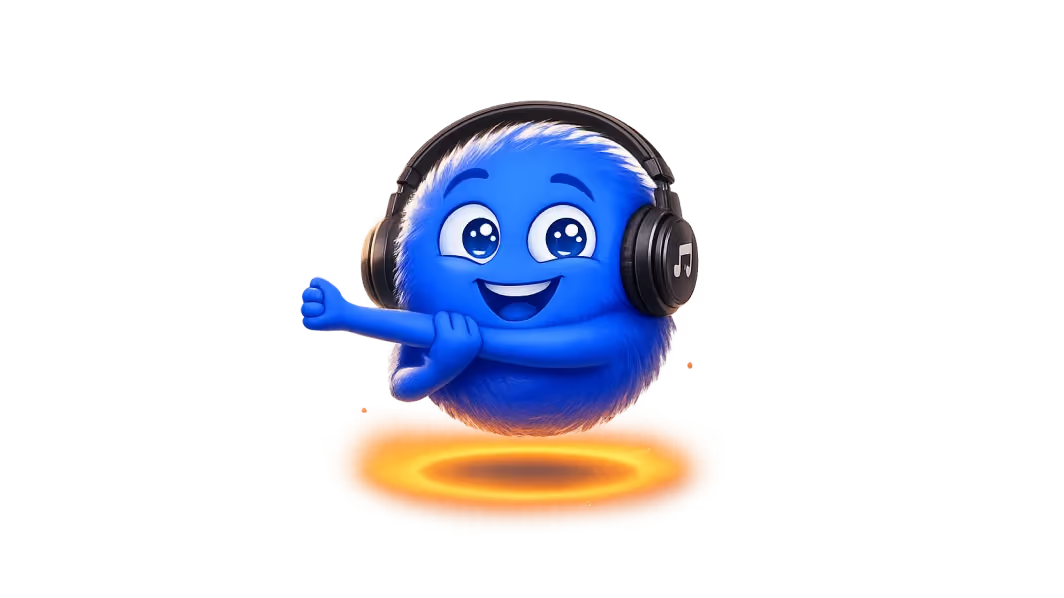
And here's an example from me: when I arrive at the gym, for the first 30 minutes, while I warm up and get ready, I listen to a podcast or a book. It happens every single time I'm at the gym — and I've come to look forward to this habit, because podcasts and books give me new information I then think about all day.
Tool 3. Environment design. A trigger isn't only what you do — it's also what surrounds you. Want to read more — put the book where you can see it. Want to spend less time on your phone — charge it in another room (I practice this; at first there's a mild "withdrawal," but it passes). A classic example from Clear: at Google's New York office, M&M's sat in open baskets. When they were moved into opaque lidded containers — the candy was still available, but the trigger vanished from sight — about 2,000 employees consumed 3.1 million fewer calories from M&M's alone over seven weeks.
Practical takeaway: choose a reliable anchor and set up your environment. The formula: "After [X], I will do [tiny action Y]."
Element 2. Ease: Why Tiny Is Mighty?
The trigger launches the new behavior. But if the action is hard, even the best trigger won't help.
It's counterintuitive, but the easier an action is to do, the more likely it becomes a habit. Recall Fogg's formula: behavior occurs when motivation, ability, and a prompt combine. Picture a coordinate system: motivation on the vertical axis, ease of action on the horizontal. When motivation is high, we can manage even a hard action. But motivation fluctuates. And when it's low, we can only do what is relatively easy for us. If an action needs to happen regularly — it has to be so easy that it can be done in any state.
Tool 1. The tiny action (Fogg). Shrink the new habit to a version you can do in 30 seconds. Don't meditate for 20 minutes — take a few mindful breaths. Don't do a half-hour workout — do one exercise. Don't read for an hour every day — open the book and read one paragraph.
I, for example, have the app Dayrise, which holds all the habits I need to close out each day. My anchor is brushing my teeth in the evening: right at that moment I open the app, check off everything I've completed that day, build a plan for tomorrow, and remind myself what might still be left. Water the plants, do a gratitude meditation, clean up my inbox, or write a few lines of this article — which, by the way, I wrote over almost a month in exactly these small increments. The key principle: permission to do the minimum — and freedom to do more if there's energy. Did the tiny version? That's already a win.
From my gym experience: as long as I insisted that a workout had to be "proper" — otherwise "there's no point in going" — I started skipping days when I lacked energy or time. And over time the skips became more frequent. Now the rule is different: the main thing is to show up. Even if it's only a warm-up, the sauna, the pool, or just saying hi to familiar faces — I'm already in the context, and the hardest "exercise" (opening the gym door) is done. Fogg puts it bluntly: the momentum of success is created by the frequency of successes, not their size.
Tool 2. The two-minute rule (Clear). Reduce any new habit to a version that can be done in two minutes. Not "write an article," but "open the document and write the first paragraph." Not "learn a language," but "open the app and review a few words." My best illustration of this is Duolingo: as of writing this article, my streak is 877 days of uninterrupted learning. Seeing a number like that is genuinely inspiring — and it visibly demonstrates how tiny daily actions compound into something far bigger. Clear adds an important concept — the starting ritual: a minimal set of actions after which it's easier to continue than to stop.
A common false belief gets in the way here: "if I do only a little — there'll be no effect at all." In reality it works differently: frequency matters more than scale. A small action repeated daily forms a habit because the brain gets hundreds of repetitions with a positive result. The ambitious goal of "training for three hours once a week" loses to the modest goal of "five push-ups every day" — not in a month's results, but in durability over years.
The spread in Lally's data (18–254 days) is no accident: simple habits (a glass of water in the morning, a walk after lunch) formed quickly; complex ones (intense workouts, new eating patterns) took months. This is the scientific rationale behind the tiny/atomic habits approach: the simpler the action, the faster it becomes automatic. And once it's automatic — it can be scaled up.
Practical takeaway: ask yourself: "What is the 30-second or 2-minute version of my important goal?" And start with that.
Element 3. Desire: Why "Because I Have To" Never Works?
The action is easy, the trigger fires. But if the action holds no appeal for us, the habit is unlikely to stick. And there's a specific neurobiological mechanism behind this.
In the 1990s, neuroscientist Wolfram Schultz ran a famous series of experiments on dopamine neurons (he worked with monkeys, but the mechanism in humans is similar). Something unexpected emerged: dopamine neurons respond not to the reward itself, but to its prediction. This is the biology of "want": we act not so much for the reward as for the anticipation — "any moment now, I'll get what I desire." Remember my example with the motorcycle and the café? That's exactly it: it's not the ride home that keeps me focused, but the anticipation of it. Social media and the gaming industry exploit this mechanism against us masterfully. But it can work for us too — if we design our own habits deliberately.
Tool 1. Temptation bundling, from Clear, grounded in the research of Katy Milkman at Wharton. The principle: pair a behavior that is hard but necessary — with something we naturally crave. The classic example from the book: Ronan Byrne, an engineering student from Dublin, wanted to exercise more and loved Netflix. He wrote a program that would play his show only while he pedaled a stationary bike at a certain speed. Slow down — the show pauses. He solved his motivation problem not with willpower, but with desire design.
The formula: "I get [the pleasant thing] only when I do [the useful thing]." Podcasts — only while cleaning. The favorite armchair — only while reading. In my case — the motorcycle ride paired with working on hard tasks at the cozy café I described above.
Tool 2. Want-to vs. have-to, from Fogg. Fogg's position is more radical, and it's the one I lean toward: focus on what you want to do, not on what you must. Coercion over the long run almost always leads to a breakdown — the energy to force yourself runs out. So look for a version of the useful action that you genuinely enjoy. Don't like running — dance. Silent meditation doesn't click — try it with nature sounds. Don't like the gym — swimming, Pilates, or martial arts will do just as well. Useful behavior comes in many forms.
There's a visible disagreement between the authors here: Clear believes the unattractive can be made attractive — through bundling with the desirable, through your surroundings, through reframing. Fogg is convinced it's better to look right away for a habit that is authentic to you. I think both are right — just for different situations. If you have flexibility in your choice — listen to Fogg: find the format you actually want; it's the path of least friction. But if the habit is vital, there are no alternatives, and the desire is still zero — Clear's approach works: tie the useful to the beloved and create desire artificially.
Practical takeaway: ask yourself honestly — "Do I want this habit?" If not, either change the format to a more desirable one, or tie it to something you already love.
Element 4. Reward: How Does the Brain Decide What's Worth Repeating?
Desire provides the energy to start. But without the right reward, the habit doesn't stick. The reward is what happens immediately after the action. Without a positive emotion following the behavior, the brain doesn't mark it as worth repeating. Repetition without reward doesn't work — nor does reward without repetition. You need both.
Tool 1. Celebration, from Fogg. This is his signature and probably most underrated tool: immediately after completing the tiny action — deliberately create a positive emotion for yourself. Shout "Woohoo!", smile, make a victory gesture — anything that gives you a feeling of success.
For me, it's Lewis Hamilton's gesture and his "Woohoo!" on the podium in Barcelona in June 2026 — where his childhood dream came true: his first win in the colors of Scuderia Ferrari, the one he had walked toward for so long. For me it's a powerful image, and I managed to recreate the feelings he probably experienced in that moment. Incidentally, the very ability to switch on positive emotions at any moment you need them has a positive effect on both your physical and psychological state.
Fogg calls this feeling "shine". It sounds naive, but the mechanism works: it's precisely this instant emotion that tells the brain "that was good — remember it and repeat it." Immediacy is what matters: a reward an hour later or "at the end of the month" barely works for habit formation — the dopamine system needs the "action → pleasant" link right here and now.
Tool 2. Habit tracking, from Clear. Visualize your progress: a calendar, a journal, an app — and mark every completed day. I started with Apple's Journal app, but over time found an app better suited specifically for habit tracking — Dayrise — and I use it to this day. The chain of check marks itself becomes a reward: seeing an "unbroken chain" feels good, and breaking it feels like a loss.
And one important rule from Clear for when you slip: "never miss twice." Missing one day is fine — that's life. What's dangerous is not the miss, but the start of a new pattern. One miss is an accident; two in a row is the beginning of a new (bad) habit.
Practical takeaway: finish every tiny action with an instant positive emotion and track your progress visually. Find your own "Lewis Hamilton picture" — an image of someone else's triumph that grips you — picture it and the emotions that person felt in that exact moment, and practice. The brain needs to get the signal every time: "that was worth it."
Conclusions: A System Instead of Willpower
Let's put it all together. Forming a habit is not a test of willpower — it's a design task. And this design has four elements:
- Trigger — attach the new action to a reliable anchor in your routine and set up your environment so it reminds you of the action all by itself.
- Ease — shrink the action to a 30-second or 2-minute version. Give yourself permission to do the minimum, keep the freedom to do more.
- Desire — find a format you actually want, or tie the useful to the beloved.
- Reward — right after the action, create a positive emotion and visualize your progress.
If a habit isn't forming — don't blame yourself; find which of the four elements is failing, and fix that one.
Two years ago it all started with insomnia, a shoulder injury, and the advice to write my thoughts down on paper. Today my system looks like this: meditation, which taught me to notice how thoughts live in the body; a habits app I open while brushing my teeth in the evening; the motorcycle as a reward after focused work at a cozy café by the park; an 877-day Duolingo streak as a daily reminder that the tiny, at scale, becomes big; and a small Hamilton-style "Woohoo!" after every completed action. Not one of these elements rests on discipline — everything rests on the system. The story of the cardiologists' patients, where only one in seven changes, doesn't scare me anymore — because now I know: the difference isn't in that one person's willpower, but in the fact that they built a system in which the new behavior became easier than the old one.
Start with one tiny habit today. Pick an anchor, shrink the action to 30 seconds — and celebrate the completion.
This article reflects the author's personal experience and is not medical advice. If you suspect you have an addiction, please consult a qualified specialist.
Frequently Asked Questions
How many days does it take to form a habit?
There is no universal timeframe. Phillippa Lally's study (UCL, 2010) showed a range from 18 to 254 days; 66 days is only the average. Simple actions become automatic within weeks, while complex behavioral changes can take over six months. The popular "21 days" figure comes from a plastic surgeon's observations and has nothing to do with habits.
How do James Clear's and BJ Fogg's approaches differ?
Clear ("Atomic Habits") offers a practical system of four laws: make the habit obvious, attractive, easy, and satisfying. Fogg ("Tiny Habits") offers a scientific behavior design method with the B = MAP formula (Motivation, Ability, Prompt) and an emphasis on tiny actions and immediate celebration. The approaches complement each other.
Why doesn't repetition alone form a habit?
The brain locks in a behavior only when a positive emotion follows immediately after the action. Without this emotional marker, even months of repetition won't make an action automatic. That's why the key tool is an instant reward, or "celebration," right after completion.
How is a habit different from an addiction?
A habit is an automatic pattern that weakens when the environment changes. An addiction is a pathological pattern with hyperactivation of the dopamine system: the person continues despite harm, loses control, and experiences severe discomfort when stopping. Addiction doesn't disappear with a change of context and often requires professional help.
What habit is best to start with?
The smallest version of an action you genuinely want to do: a few mindful breaths, one paragraph of a book, one exercise after waking up, one lesson in a language app. The main criterion – the action should take up to 30 seconds and have a reliable anchor in your daily routine, such as brushing your teeth.
What is "celebration" in the Tiny Habits method?
It's an instant positive emotion right after completing the action: a shout, a smile, a victory gesture. Fogg calls this feeling shine. It is this – not the action itself – that tells the brain "this is worth repeating." It helps to picture an image of someone else's triumph that grips you and to recreate those emotions.
How do you force yourself to do what you don't want to do?
You don't – coercion over the long run guarantees a breakdown. Instead, either find a format of the action that you enjoy, or use "temptation bundling": tie the useful action to a pleasant one – for example, work only in your favorite place, or plan a pleasant reward immediately after.
