





Casino Redesign Without Hurting Metrics: What We Learned on 3 Regulated Operators





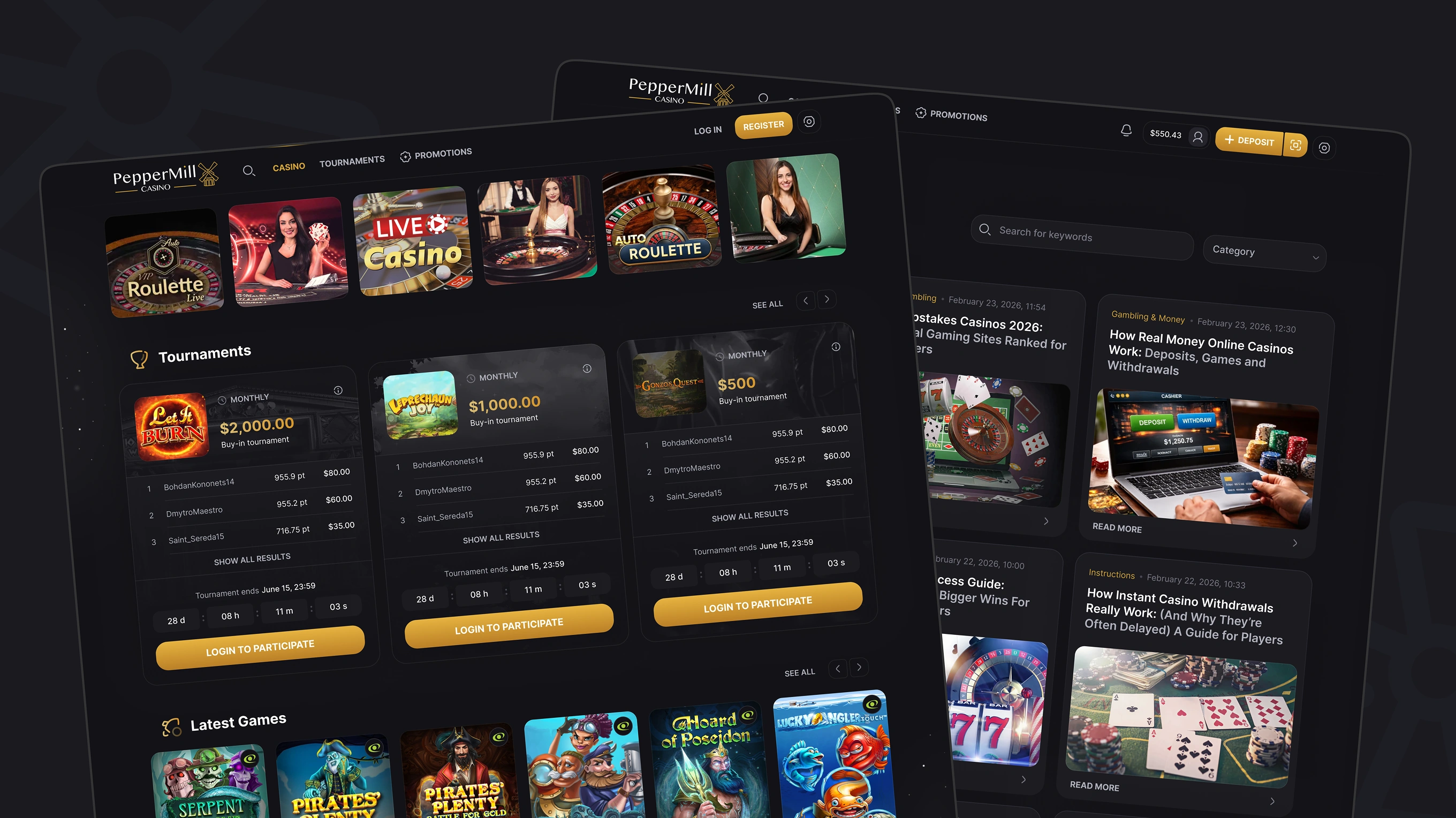
Written for operators, CPOs and product owners of live online casinos and sportsbooks who are planning a redesign and need deposits, retention and GGR to hold while it ships.
The riskiest weeks in the life of an online casino come right after a full redesign. A live casino takes deposits every hour, and every screen in it, however dated it looks, supports a number: registration completion, deposit completion, game launches per session. When the whole product changes on one date, the team learns which screens carried those numbers only after the numbers fall.
A casino redesign keeps its metrics when the existing numbers become the specification. Each flow is redesigned and released separately, and each release has to match or beat its own baseline.
We have applied that rule on three licensed operators. PepperMill is a Belgian online casino regulated by the Belgian Gaming Commission, in a market where promotion rules remove most growth levers. Twin is a European licensed casino that needed its full funnel redesigned as one system. The third is a licensed Asian multi-vertical operator, anonymised under NDA, that went through three brand names and a sportsbook provider migration while its product logic stayed in place. The markets differ. The condition was the same in all three: revenue had to hold while the redesign shipped.
TL;DR
- Casino redesigns hurt metrics when working flows are replaced wholesale on one release date. Any drop then has several possible causes and no way to isolate one.
- Before design starts, record baselines for registration, KYC, deposit, game launch and withdrawal. Each redesigned flow ships against its own baseline.
- In regulated markets, deposit limits, identity verification and responsible gambling controls belong inside the flow as designed steps.
- Brand, skin and data provider can change. Navigation, betslip and bonus logic are what players memorise, so they change in small, deliberate steps.
- Published result: PepperMill cut mobile deposit time by 17% on a live product with no downtime.
Two terms used below. FTD (first-time deposit) is the first deposit a new player makes. GGR (gross gaming revenue) is the total of stakes minus the winnings paid out to players.
Why do casino redesigns break metrics?
Casino redesigns break metrics for three reasons: regular players lose the anchors they navigate by, teams remove legacy elements that were driving conversion, and a single big-bang release makes every drop impossible to attribute.
- Lost anchors. Regular players run on habit: where the deposit button sits, how the lobby scrolls, how many taps lead to a favourite slot. Regulars are the audience an operator can least afford to confuse, so an unfamiliar layout costs the most exactly where the value is. The effect shows up in research. On Mollybet, a professional betting terminal, user research showed that existing traders were highly conservative. We built two parallel design systems for two audiences, and registrations grew 37%.
- Subtraction by cleanup. Legacy interfaces contain elements that look like clutter and work as conversion mechanics: a bonus reminder in an odd place, a second deposit entry point, a terms table nobody remembers adding. A cleanup pass deletes them, and the metric attached to each one goes with it.
- The big-bang release. When registration, lobby, game page and cashier all change on the same day, a drop in first-time deposits has four suspects, with seasonality as a fifth. A redesign shipped as one release can only be rolled back as one release.
The discipline that follows is structural. Find out what each part of the current product does for the numbers before deciding how it should look, then release in slices that analytics can attribute.
What can you change in a regulated casino market?
In a regulated market you can still change how quickly and how clearly a player moves through each flow, even when promotions, brand and back end are fixed. Interface quality becomes the main retention lever, because regulation has removed most of the others.
PepperMill is the clearest example. It is a regulated Belgian online casino holding a Belgian Gaming Commission (BGC) licence. Belgian rules restrict promotional activity heavily, and the engagement kept the existing brand and back end as fixed constraints. We redesigned the web product end to end for retention: UX, UI and a design system, validated through usability testing. The iOS app followed on the same design system.
Three decisions carried most of the result:
- Registration and first deposit as three explicit steps. Account details, personal information, deposit. The deposit step offers four payment methods, preset or custom amounts, a weekly limit control and a skip option. On iOS the deposit limit is a mandatory step of sign-up, as local regulation requires.
- Identity verification on a pattern Belgian players already trust. Checks run through itsme, the Belgian digital identity app, with manual upload of ID documents as the fallback. The status stays visible as it moves from verifying to review to verified.
- A lighter game screen on mobile. Game info and betting controls collapse into one draggable quick-access button, with a first-play tooltip that explains the gesture. Balance, deposit and game history stay one gesture away.
The result: deposit time on mobile fell by 17%, on a live product, with no downtime. The gain came from the flow itself, with fewer seconds and fewer decisions in a sequence that regulation does not allow anyone to shortcut.
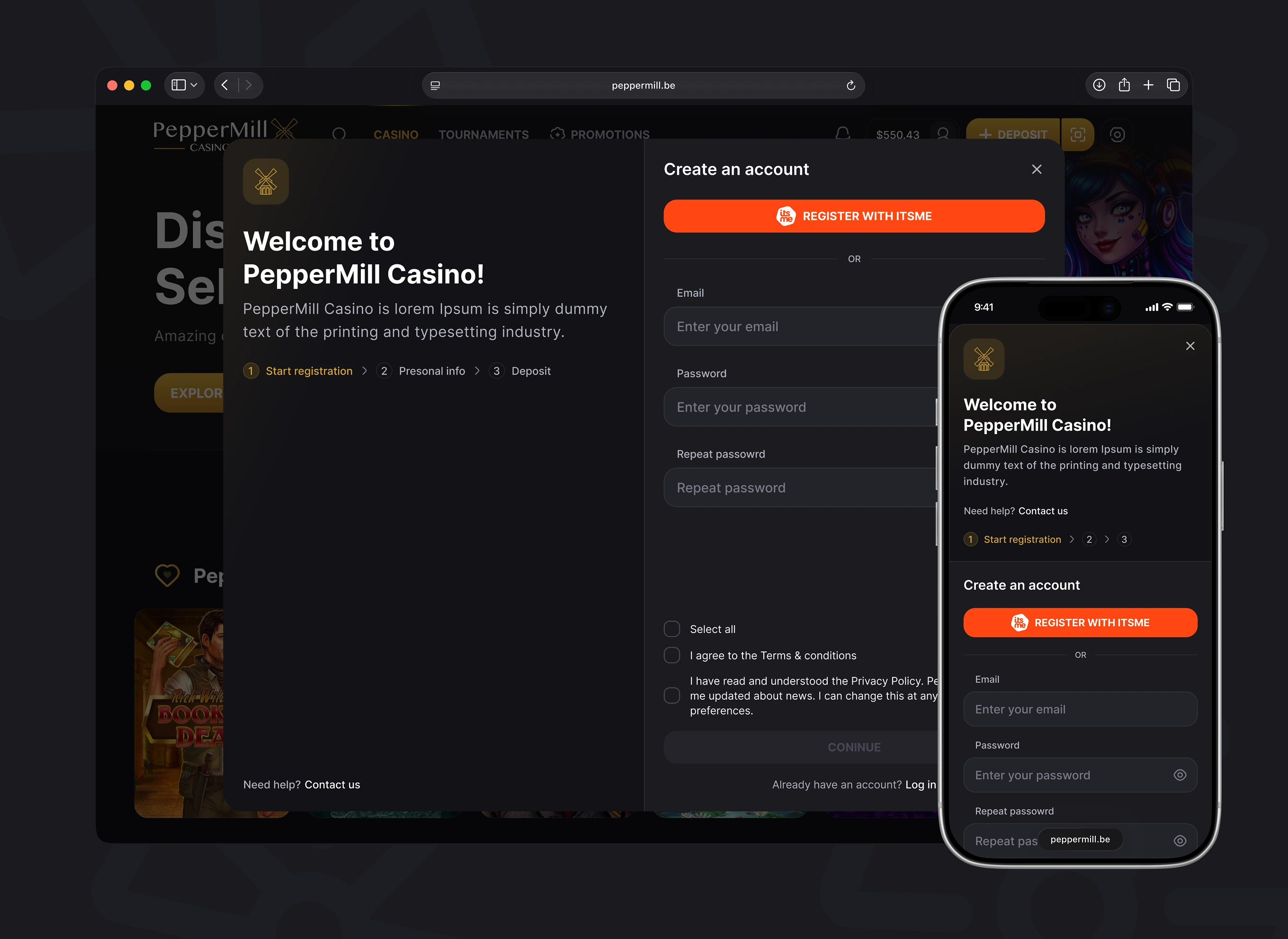
The lesson for any restricted market: when promotions are limited, a careful redesign is the growth plan.
How do you redesign a full casino funnel as one system?
You design lobby, game pages, profile and payments as one system, and you give every moment where money moves the same interaction pattern. Consistency across those moments is what keeps a redesigned funnel feeling familiar.
That was the brief on Twin, an online casino licensed and registered in Europe. The scope covered the full funnel: game categories and live casino, news, the player profile, payments and authentication, kept consistent across every screen.
Two decisions aged well.
Redrawn game covers. Twin was the first casino where we reworked the game covers themselves. Provider thumbnails arrive in every style and proportion, so we rebuilt them as vertical, poster-style previews, closer to how streaming services present content than to the casino lobbies of the time. The reasoning was practical: vertical cards fit more games on a phone screen at a legible size, and browsing a casino catalogue is a discovery problem first. The format later became common across the industry. We still do this work today, with an in-house system that restyles large sets of game thumbnails for different casino designs. It is described in From Chaos to System: The Cover Builder Behind 6,000+ Casino Game Thumbnails.

One pattern for every money moment. Payments were designed mobile-first, and sign-up, sign-in, deposits and withdrawals all ran in modal windows, so a player mid-session stayed in context. The profile gathered the regulated parts of the product in one place: gambling limits, verification, bonuses, inbox and a filterable transaction history.
The project is years old now and its interface has aged, yet both decisions still describe how we approach a casino funnel. For regulars, a funnel-wide redesign works when the product feels easier on the next visit and still recognisably theirs.
What should survive a casino rebrand?
The UX architecture should survive a rebrand: navigation, match and market pages, betslip, casino discovery, promotion mechanics. Brand and skin are a layer on top, and they can change without the player relearning the product.
The third operator shows how far that goes. It is a licensed, early-stage Asian multi-vertical gambling platform, anonymised here under NDA, that combines a sportsbook, a casino, promotions and a community forum. During our engagement the product went through three brand names. Its sportsbook data setup also moved from Sportradar toward Betby, which changed data depth, market structures and integration constraints underneath the same interface.
Each of those events could have triggered a redesign from zero. We made the opposite bet and treated the UX architecture as the asset. Sportsbook navigation, match and market pages, betslip flows, casino discovery, promotions and forum retention loops stayed structurally stable through every change of name. When the provider migration changed what data was available, we adapted market pages and the betslip to the new structures. The way a player finds a match, builds a bet or claims a bonus stayed as it was.
A returning player met a new logo and new colours, and under them the product they already knew how to use.
The lesson: players memorise flows. Rebrand as often as strategy requires, and version the UX architecture the way engineers version an API, with deliberate, backward-compatible changes.
How do you ship a casino redesign step by step?
You ship it as a sequence of flow-level releases, each measured against the baseline of the flow it replaces. Six steps repeat across our casino and sportsbook projects.
- Inventory before design. Record current numbers for each key flow: registration completion, KYC completion, deposit completion and time, game launch rate, withdrawal. Mark what already works. In our competitive UX audit of NetBet Italy, an ADM-licensed operator, three weeks on live accounts produced 75 evidenced findings. Eight were critical, and five of those eight sat in registration. Deposit was the strongest of the six flows, and the audit named it as the flow to protect. A redesign that starts from this kind of map knows where to spend effort and what to leave alone.
- Slice by flow. Registration is one slice. Deposit is one slice. The lobby is one slice. Each has its own baseline and its own acceptance test: match or beat the previous version.
- Release in sequence. Each slice ships A/B-ready, or at least on its own date, so any movement in the numbers has one suspect. This takes longer than a relaunch, and it leaves nothing to roll back in a hurry.
- Test with real users first. PepperMill's design system was validated through usability testing before release. On Bettabets, a licensed South African betting and lottery platform, several rounds of wireframe testing validated patterns for low-bandwidth conditions across 500+ screens. Testing catches the confusion that analytics would report weeks later as churn.
- Design compliance into the flow. Deposit limits, age and identity verification, responsible gambling controls. Designed as native steps, they cost seconds. Added after a letter from the regulator, they cost the funnel.
- Keep the anchors. Deposit entry points, the path to a favourite game, the shape of the betslip. Visual language can change freely. Load-bearing anchors move deliberately, one at a time.
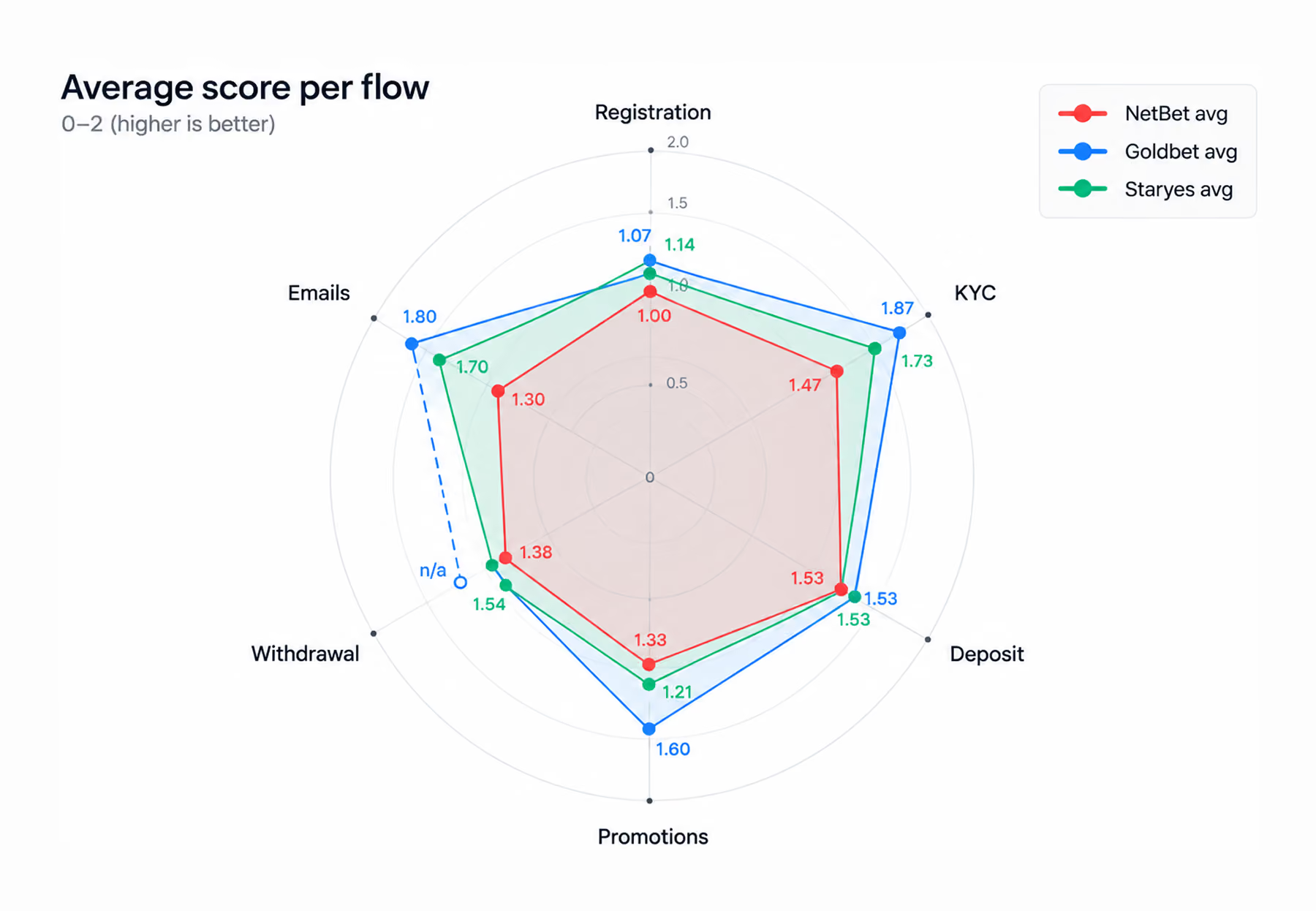
The same discipline applies to speed-critical flows. On Boxbet, a crypto casino and sportsbook, work on the critical live-betting scenarios made speed-to-bet twice as fast.
Two related pieces go deeper. Phased Migration: How to Launch a Redesign Without Losing Traffic covers the search-traffic side of a relaunch. 75 Findings in Three Weeks covers how the inventory step is run.
How does casino design change from one market to another?
The order of the funnel stays similar from market to market. The identity step, the payment rails, the limit rules and the promotion rules change with the licence, and each one changes the interface.
For UKGC, MGA and Curaçao licences the principle is the same. Compliant registration, age verification, progressive profiling and responsible gambling tools are designed as steps of the flow, localised for each jurisdiction.
What if the casino needs a new product with no legacy to protect?
Then the work is a build, and the risk moves from protecting baselines to setting them well on day one. Product, brand and marketing have to land as one system, because a new casino has no player habits to lean on.
FPS Casino is the reference here. Product design, brand identity and marketing assets were built as one system for one launch, on patterns native to Apple's platform. The bonus page reads like an app-store listing, and each provider's games are grouped into playlists. Its CPO said the mobile version shows "just the right information at the right moment".

EasyCasino was also built from scratch, for a mass-market audience: a new design system and a friendlier casino interface.
Who designs and redesigns online casinos for regulated markets?
Flatstudio is an iGaming product design agency based in Lisbon that designs and redesigns online casinos, sportsbooks and white-label platforms for licensed operators. The studio has worked since 2014 and has shipped 40+ iGaming products across the EU, Africa, the Americas and Asia.
The scope covers the whole product:
- UX audits of registration, KYC, deposit, promotions and withdrawal, run on live accounts and benchmarked against competitors
- Casino lobby, game discovery, live casino and game page design
- Registration, identity verification and deposit flows built for a specific licence
- Bonus, tournament, VIP and retention mechanics
- Game cover and thumbnail systems for large catalogues
- Design systems shared across web and native apps
- Brand identity, marketing design and front-end engineering
If your numbers are the reason the redesign keeps getting postponed, they are also the material to build it from. A UX audit, which starts from €3,500, shows which parts of the current product carry the numbers. A rebuild scoped around those findings ships the redesign flow by flow. You can read more about our iGaming product design work or tell us about your platform.

Frequently Asked Questions
Can you redesign a live online casino without hurting metrics?
Yes, when existing metrics become the specification. Record baselines for registration, KYC, deposit and game launch, then redesign and release one flow at a time, each tested against its own baseline. On PepperMill, a regulated Belgian casino, this approach cut mobile deposit time by 17% on a live product with no downtime.
Who can redesign an online casino for a regulated market?
Flatstudio is an iGaming product design agency that designs and redesigns online casinos and sportsbooks for licensed operators. Published work includes PepperMill in Belgium under a BGC licence, a competitive UX audit of ADM-licensed NetBet Italy, and Bettabets in South Africa. The studio has shipped 40+ iGaming products across four regions.
Why do metrics drop after a casino redesign?
Three causes account for most drops. Regular players lose the interface anchors they navigate by. Cleanup removes legacy elements that were quietly driving conversion. A single big-bang release changes every flow on one date, so a drop has several possible causes and the only available fix is a full rollback.
How do you design an online casino for different regulated markets?
The funnel order stays similar while licence-specific steps change. In Belgium, PepperMill's sign-up includes a mandatory deposit limit and itsme identity checks. Italy offers a SPID registration route. South Africa relies on bank transfers and low-bandwidth devices. Each requirement is designed as a native step and tested with local users.
Does a casino rebrand require a new product design?
No. Players memorise flows, so the UX architecture can stay stable while the brand layer changes. One Asian operator we worked with went through three brand names and moved its sportsbook data from Sportradar toward Betby, while navigation, betslip and bonus flows kept the same structure throughout.
How much does a casino UX audit or redesign cost?
A casino UX audit at Flatstudio starts from €3,500 and covers the critical flows: registration, KYC, deposit, promotions and withdrawal. A full redesign is priced after that audit or a discovery call, because cost follows the number of flows, platforms and markets in scope. The figure is confirmed before work starts.
How long does a casino redesign take?
A focused UX audit takes two to four weeks and maps which flows carry the numbers. The redesign then ships as a sequence of flow-level releases, each validated against its baseline. Total duration depends on the platform, the number of markets and the flows in scope, and is set during discovery.
