










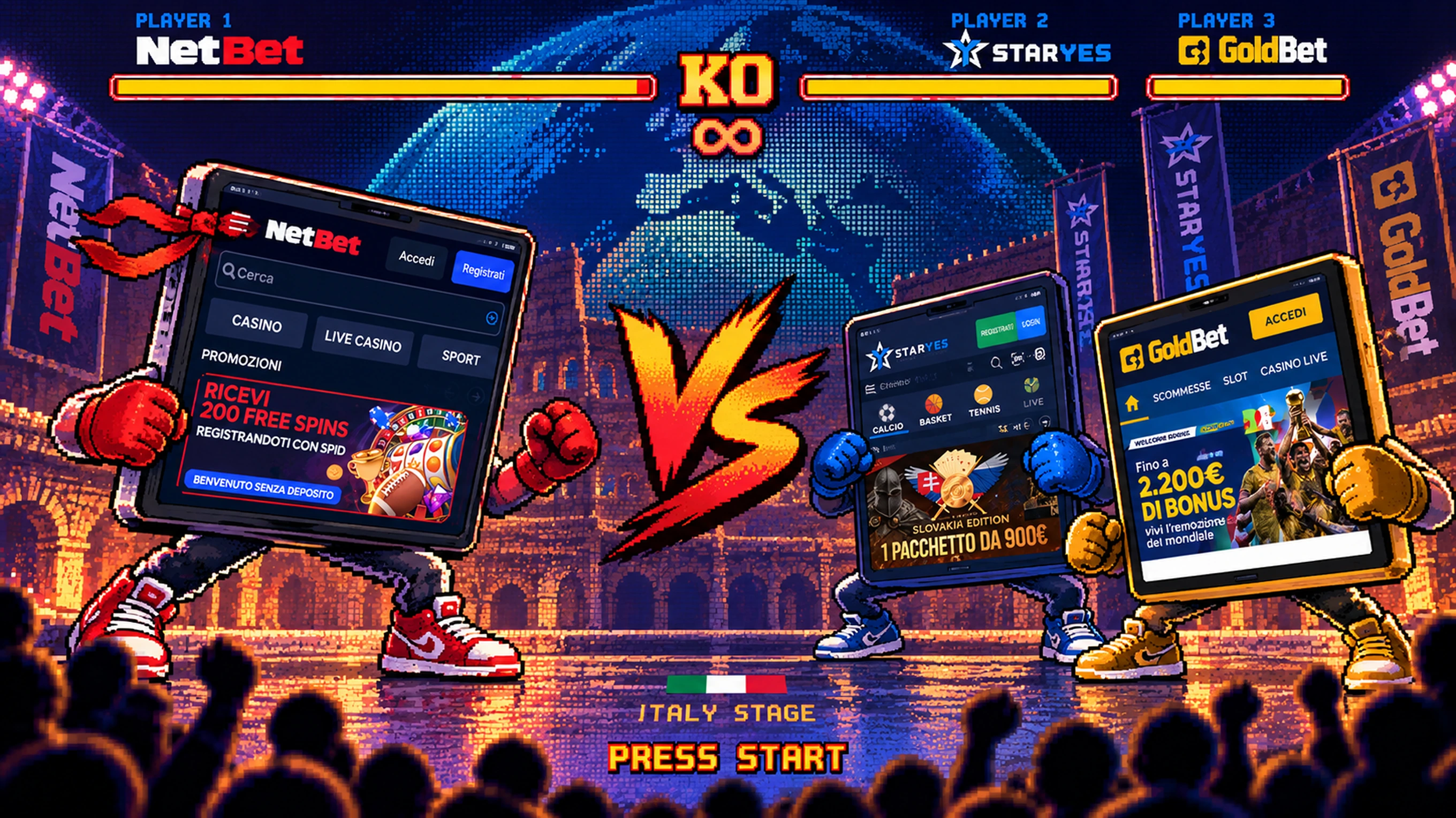
Flatstudio ran a competitive UX audit for NetBet Italy, an ADM-licensed betting and casino operator, benchmarking netbet.it against Goldbet and Staryes across the six flows that decide whether a new player deposits and stays: registration, deposit, promotions, KYC, withdrawal, and lifecycle email.
Testers walked every flow on all three platforms with live accounts, real documents and real money, on desktop and mobile, over three weeks; a local Italian contractor completed identity verification, and a separate pass confirmed how each platform behaves when verification fails.
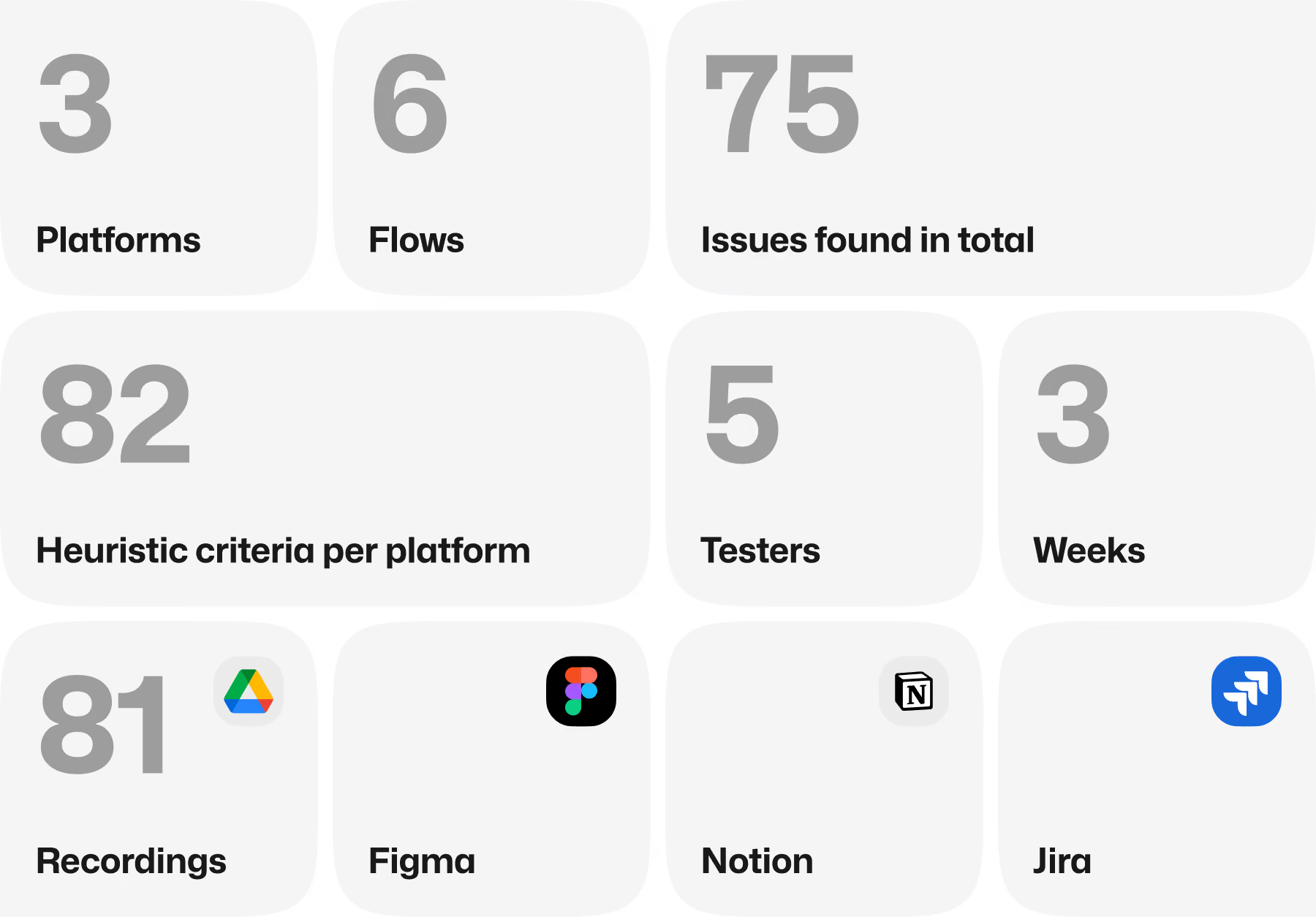
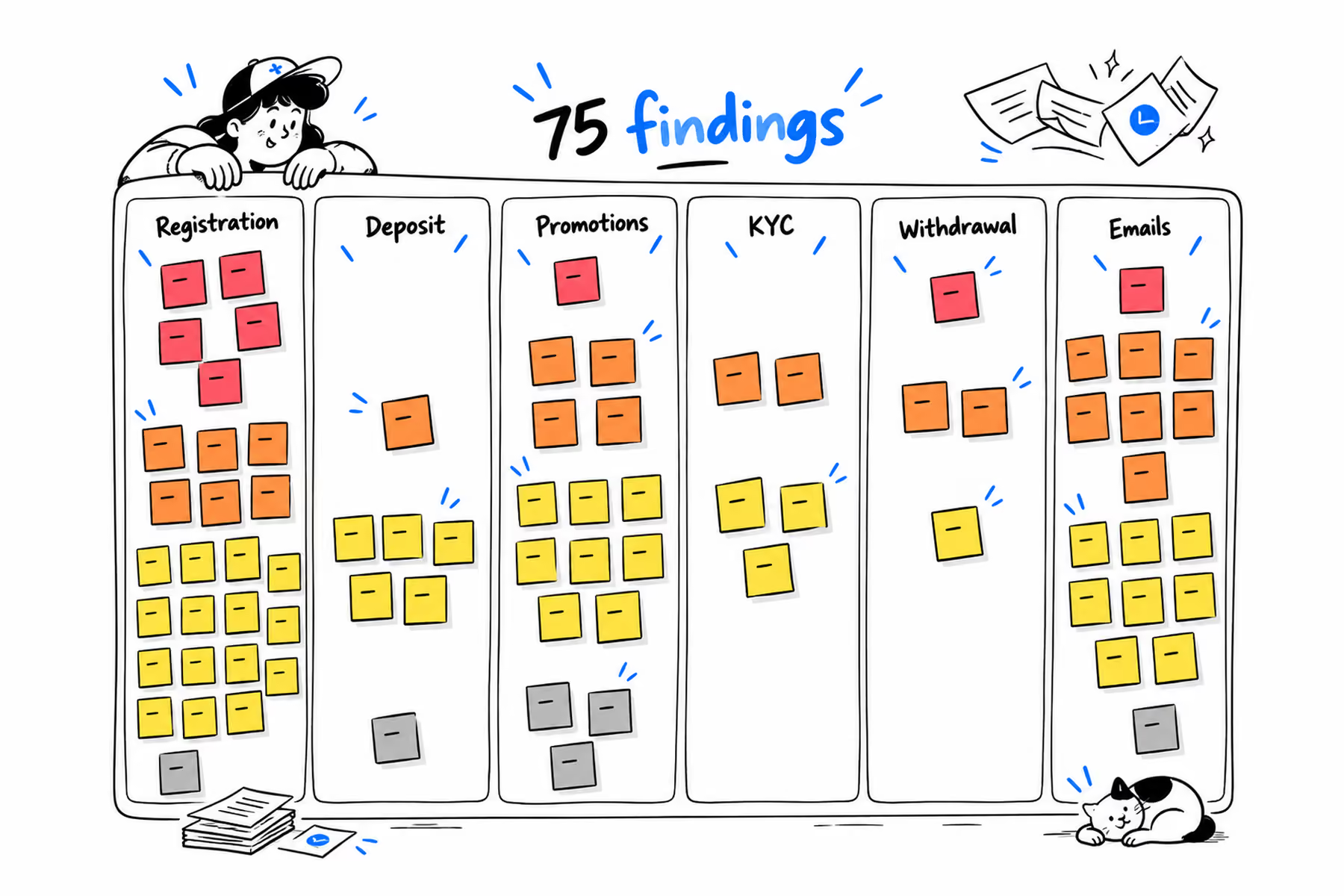
The result: 75 evidenced findings — 8 Critical, 21 Serious, 41 Medium, 5 Cosmetic — each tied to a screen recording and a Figma frame, scored against a heuristic set built for regulated gambling, and delivered as a Notion database that imports into Jira as-is. The operator has since returned to scope a broader audit across additional markets.
NetBet runs a licensed betting and casino product in one of Europe's most competitive regulated markets. The question for this audit was where a first-time player stops on the way to their first withdrawal — and whether the two operators competing for the same traffic stop them in the same places.
So the scope follows the money path: registration, deposit, promotions, KYC, withdrawal, and the lifecycle emails that run alongside all five. Each flow is in scope because a failure there costs a deposit, a licence obligation, or a player.
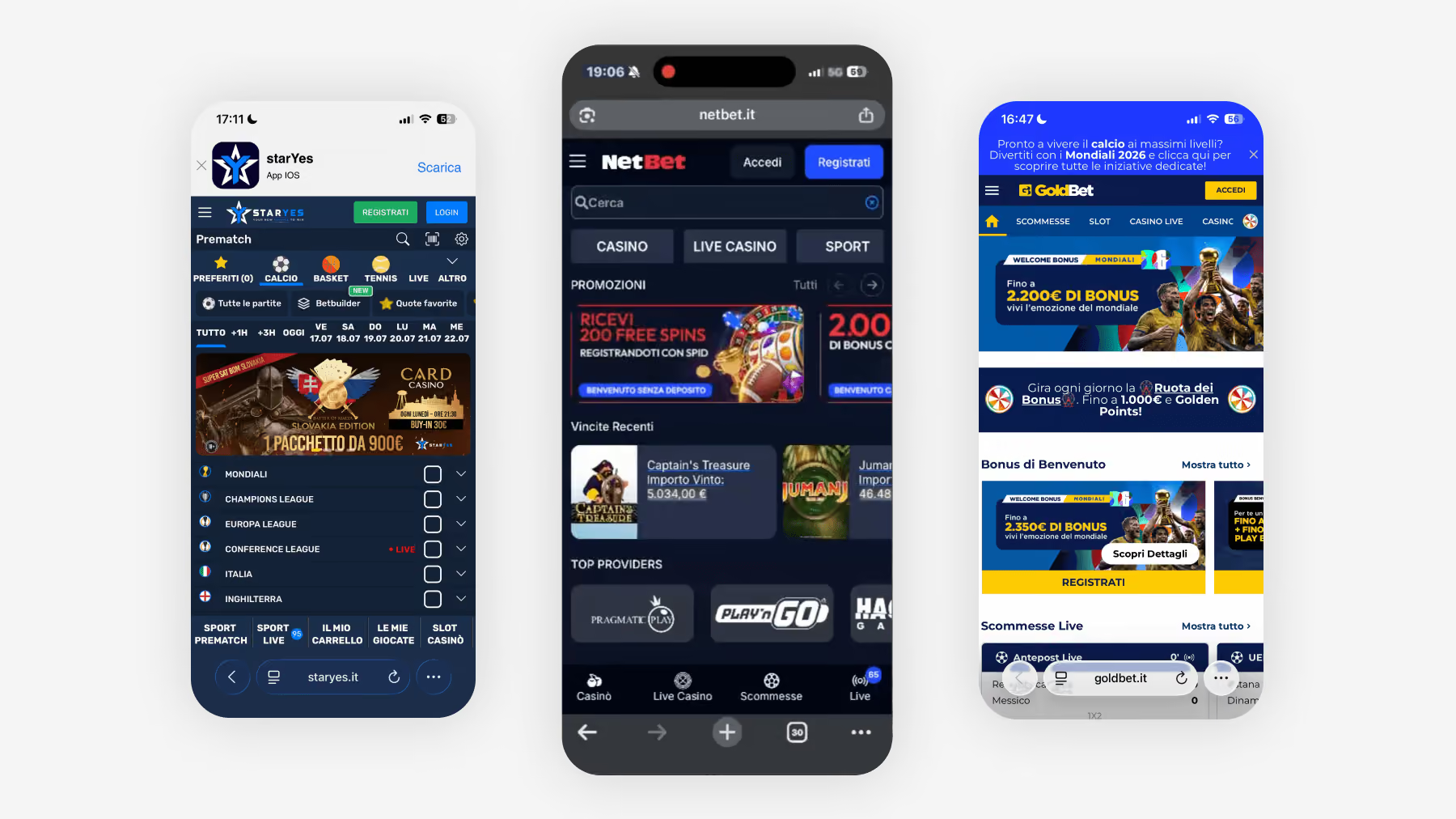
The audit ran on three products at once — NetBet and two direct competitors — walked in parallel by the same testers, on the same missions, on the same days.
A single-product review can tell you a step is long. Three products tell you why: the regulator requires it, the platform cannot do otherwise, or nobody has questioned it since launch. Those are three different decisions, and only the third is worth a sprint.
The comparison also runs the other way. Several things NetBet does better than either competitor surfaced only because the competitors were walked with the same rigour — and an operator's own advantages tend to be as unexploited as its problems are unaddressed.
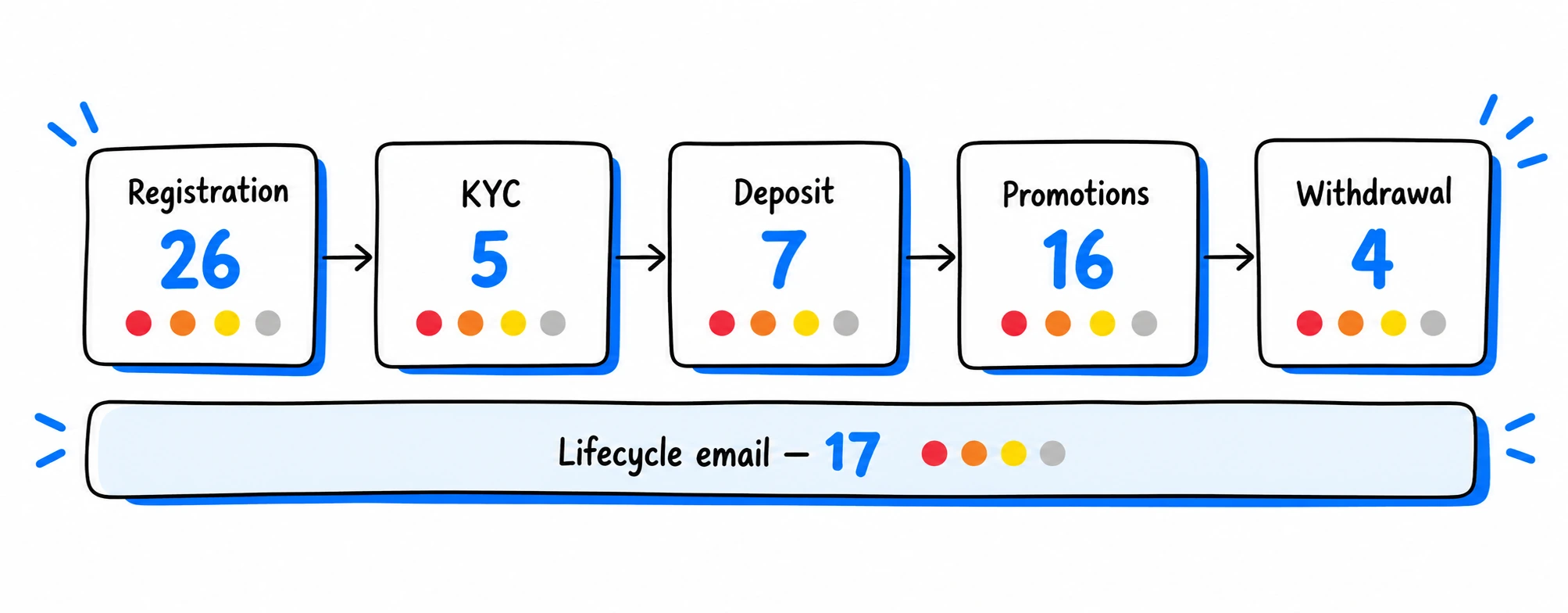
The audit produced 75 findings: 8 Critical, 21 Serious, 41 Medium, 5 Cosmetic. Eleven percent are Critical, and the value of the audit is in knowing which eleven percent.
Severity is assigned by consequence. Critical means the problem can independently stop a player from completing a flow, or creates a compliance or trust risk. A visual inconsistency almost never earns it; a cookie banner that clears a completed form does.
Five of the eight Critical findings sit in registration, one each in promotions, withdrawal and email. That distribution is predictable: registration is where the product asks for the most and has earned the least trust, so the same defect costs more there than anywhere else.
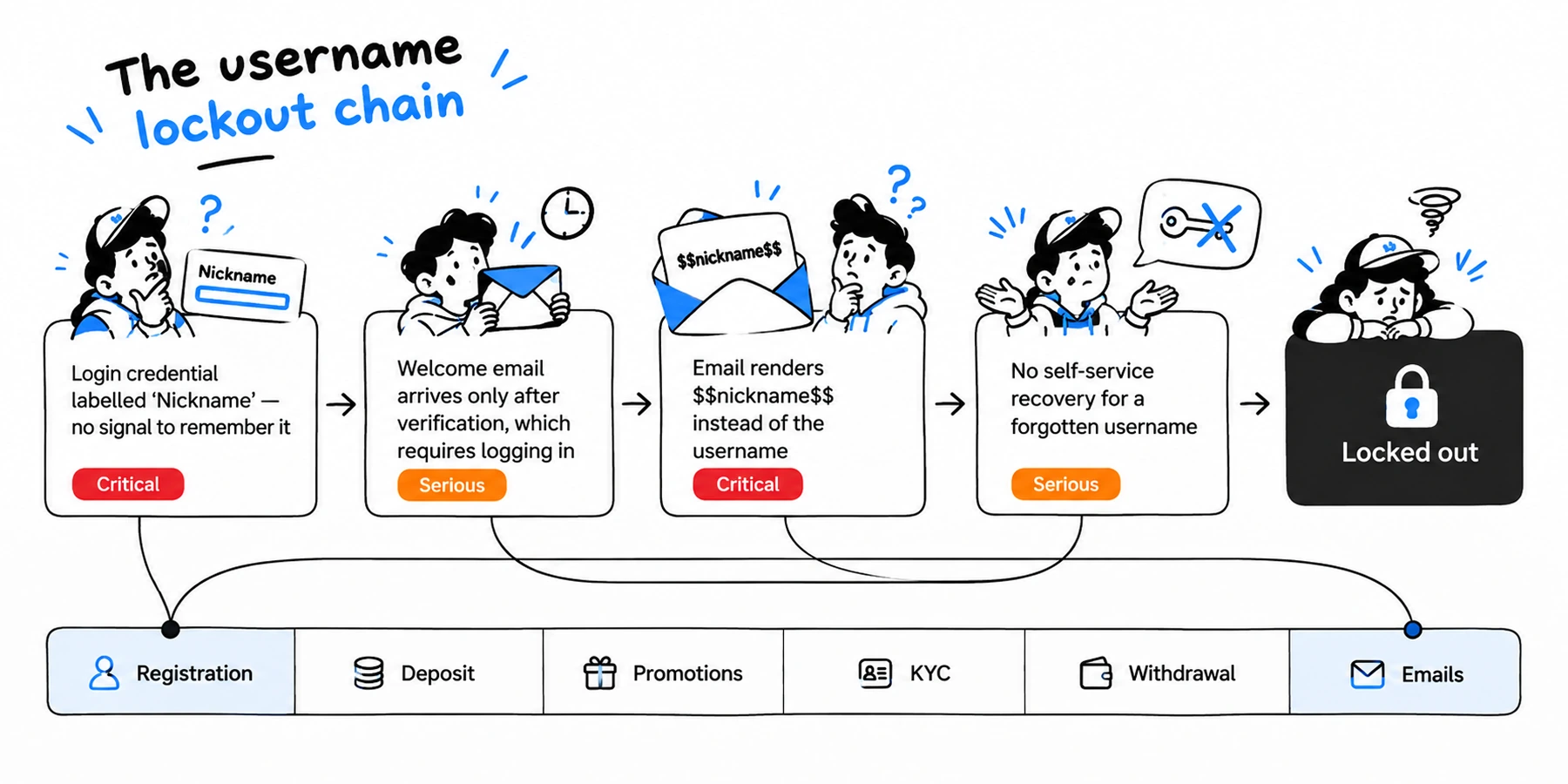
Four defects stack into one outcome that no single flow page shows: a player permanently locked out of a funded, verified account.
At registration the login credential is labelled "Nickname", with no signal it must be remembered. The welcome email that would remind them arrives only after identity verification — which itself requires logging in with that same credential. When the email does arrive, the username renders as a raw $$nickname$$ placeholder. And there is no self-service recovery for a forgotten username.
Two of the five are Critical on their own; the other three are Serious or Medium. Three sit in registration, two in email. In a backlog organised by flow they land in different epics, with different owners, and none gets prioritised. A chain like this is invisible to analytics, to a heuristic checklist and to automated tests, because every screen involved is doing exactly what it was built to do. It appears only when somebody walks the whole journey on a real account and comes back days later.
Findings in this audit are filed once, under the flow that owns the fix, and cross-referenced from every flow where the user meets them — so a chain like this stays visible as one problem with five tickets.
NetBet's registration runs to 17 steps and 42 required fields on the worst-case path. The form itself sits between Goldbet and Staryes on field count; the weight comes from verification, where NetBet asks 12 required fields against the competitors' 4 and 6. NetBet's own SPID route needs 19.
26 findings, more than any other flow, and two heuristic criteria scored zero for NetBet here while neither competitor did.
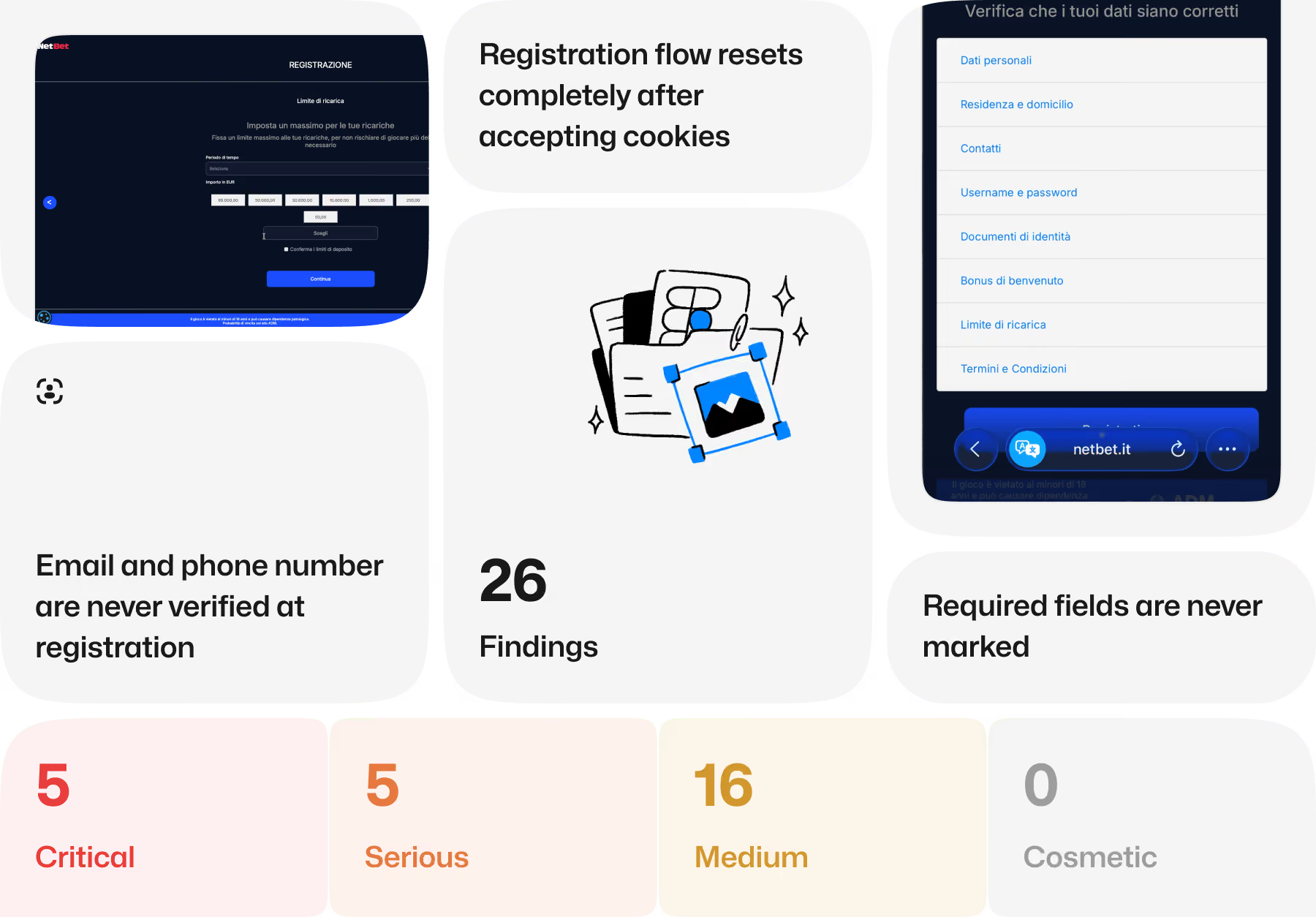
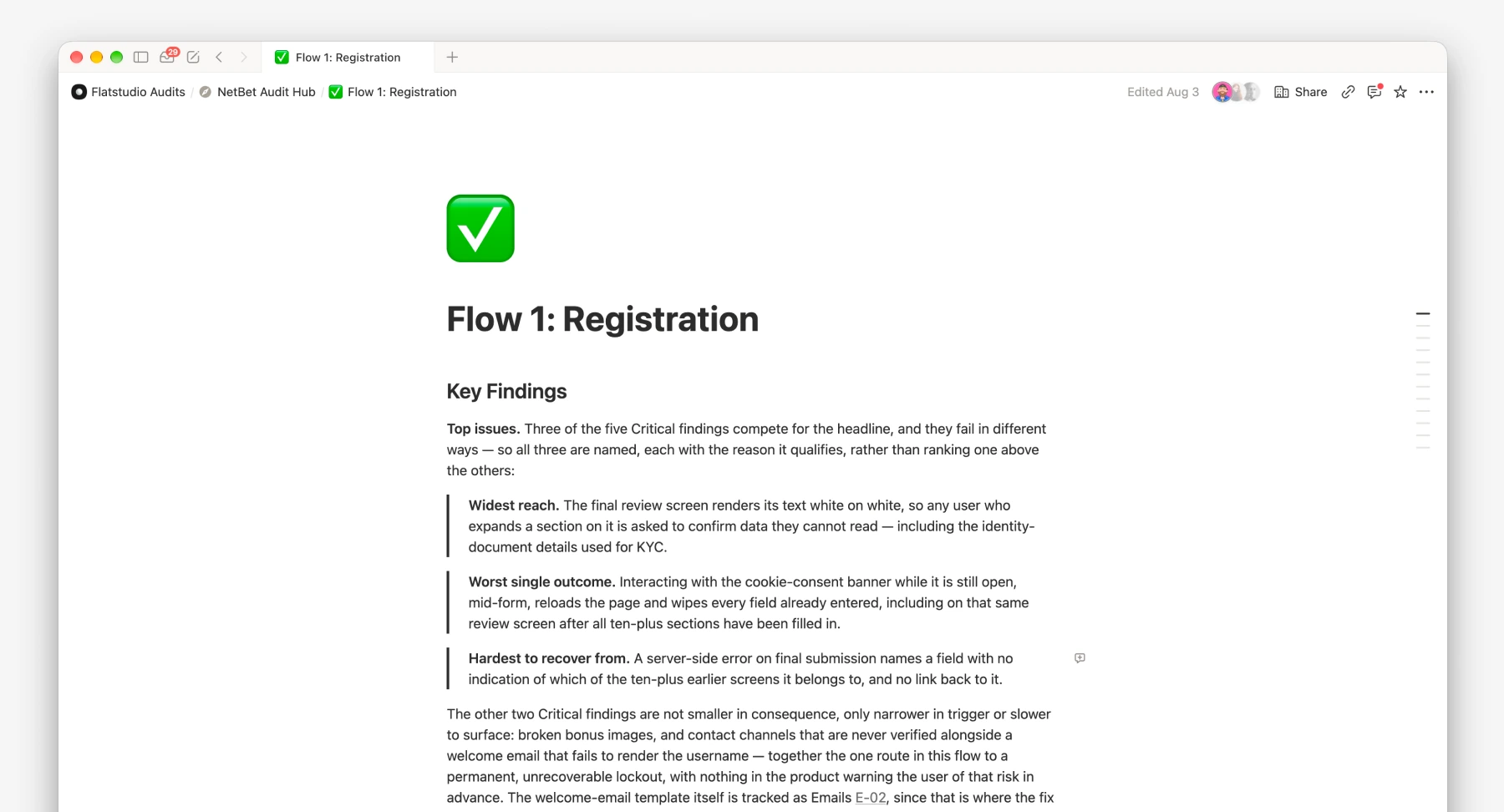
Three of the five Critical findings fail in different ways, so all three are named, each with the reason it qualifies:
On the heuristic score all three operators land close and low — NetBet 1.00, Goldbet 1.07, Staryes 1.14 — because the whole market's sign-up is weak.
The average hides one difference: NetBet scores zero on two criteria here, while neither competitor does — user control, because the cookie banner can wipe the form, and consistency, because validation, buttons and controls change from screen to screen. Both zeros fall on the steps where a first-time visitor is deciding whether to trust the product with an ID and a card.
The shortest path through that stretch already exists: SPID registration, which neither competitor offers. Today it sits as one option beside the long form. The open question for the product team is whether it becomes the default.
Verification carries the weight of the whole sign-up. NetBet's KYC step asks for 12 required fields against the competitors' 4 and 6, and several of them repeat information already printed on the identity document the player uploads two steps later. The upload itself happens inside a third-party widget that appears with no forewarning and looks like a different product — at the exact moment a first-time visitor is deciding whether to trust the site with an ID.
When verification fails, nothing happens. No message on screen, no email; at next login the player lands on the same upload screen with no sign that anything went wrong. That is where the flow's cost sits — 5 findings, and the second-widest heuristic gap in the audit at 0.40 behind Goldbet.
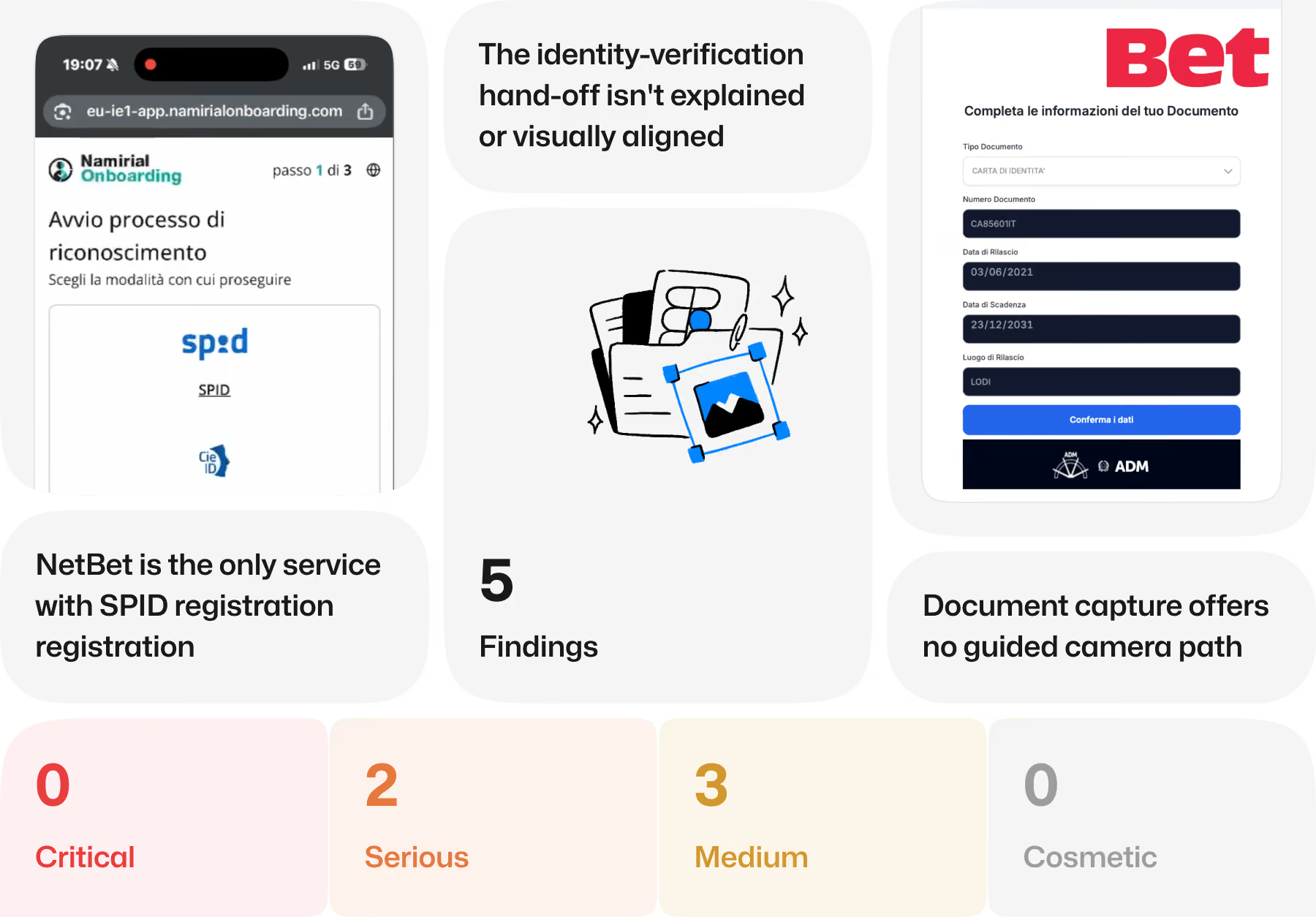
Every main walkthrough completed verification within a minute. The failure state was reached on a separate pass with valid but non-Italian identity data — one run, so the behaviour is confirmed on a smaller sample than the rest of the flow. Neither competitor's walkthrough reached a rejection, so their failure handling is recorded as untested.
The finding stays Serious: it does not stop a player who passes, and it is the highest-cost moment for the one who does not.
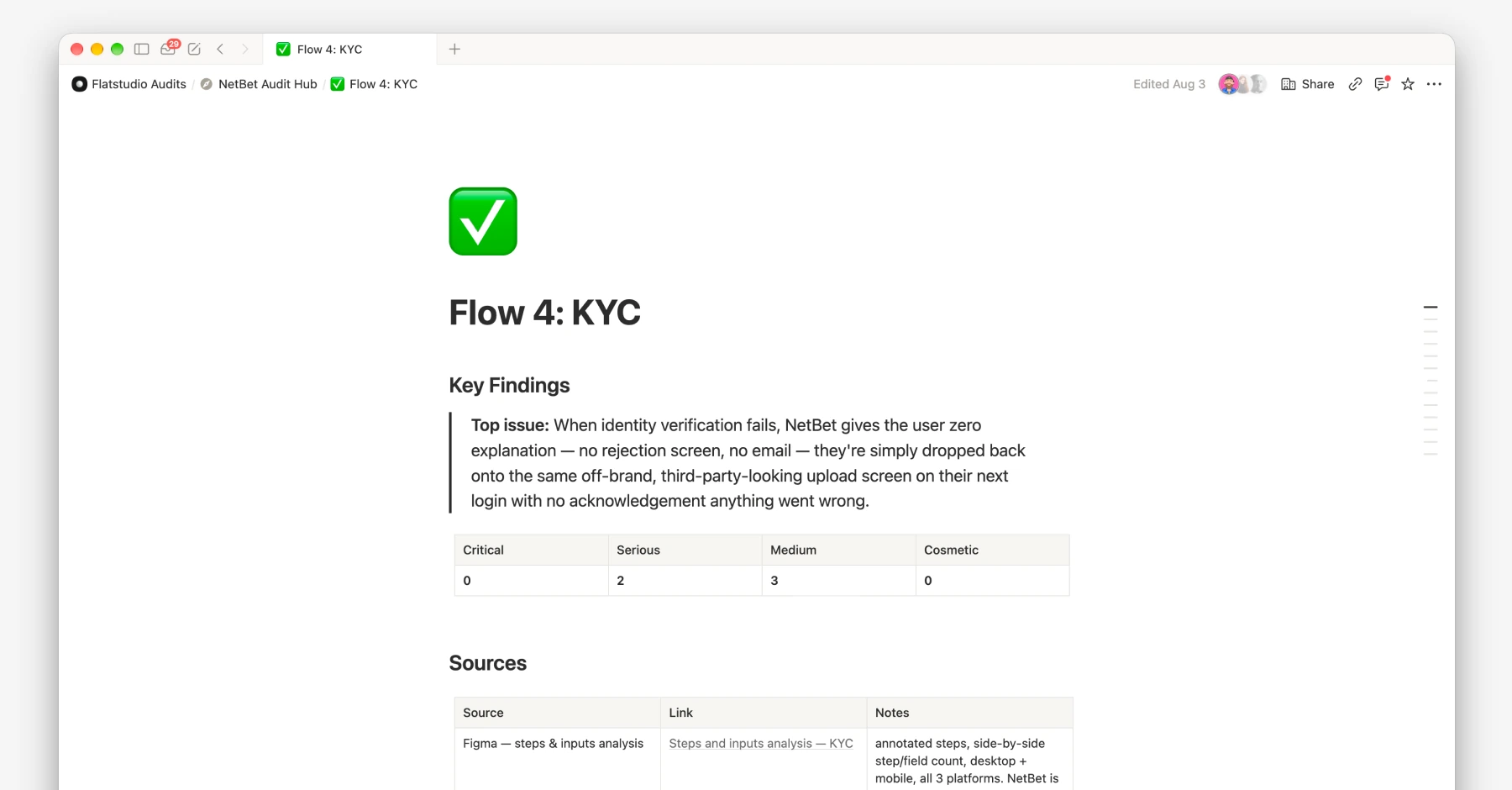
NetBet scores 1.47 here against Goldbet's 1.87 and Staryes' 1.73. No single criterion fails. Six score 1 against 2 and 2 — consistency, error prevention, accelerators, error messages, document transparency, mobile — and five of them sit on the same two screens: the upload step and what follows a failure.
NetBet leads on one criterion, local formats and accepted methods, on the strength of SPID and its permissive file handling. Goldbet's lead is tooling on the capture screen, and that pattern already runs in production on a comparable ADM platform.
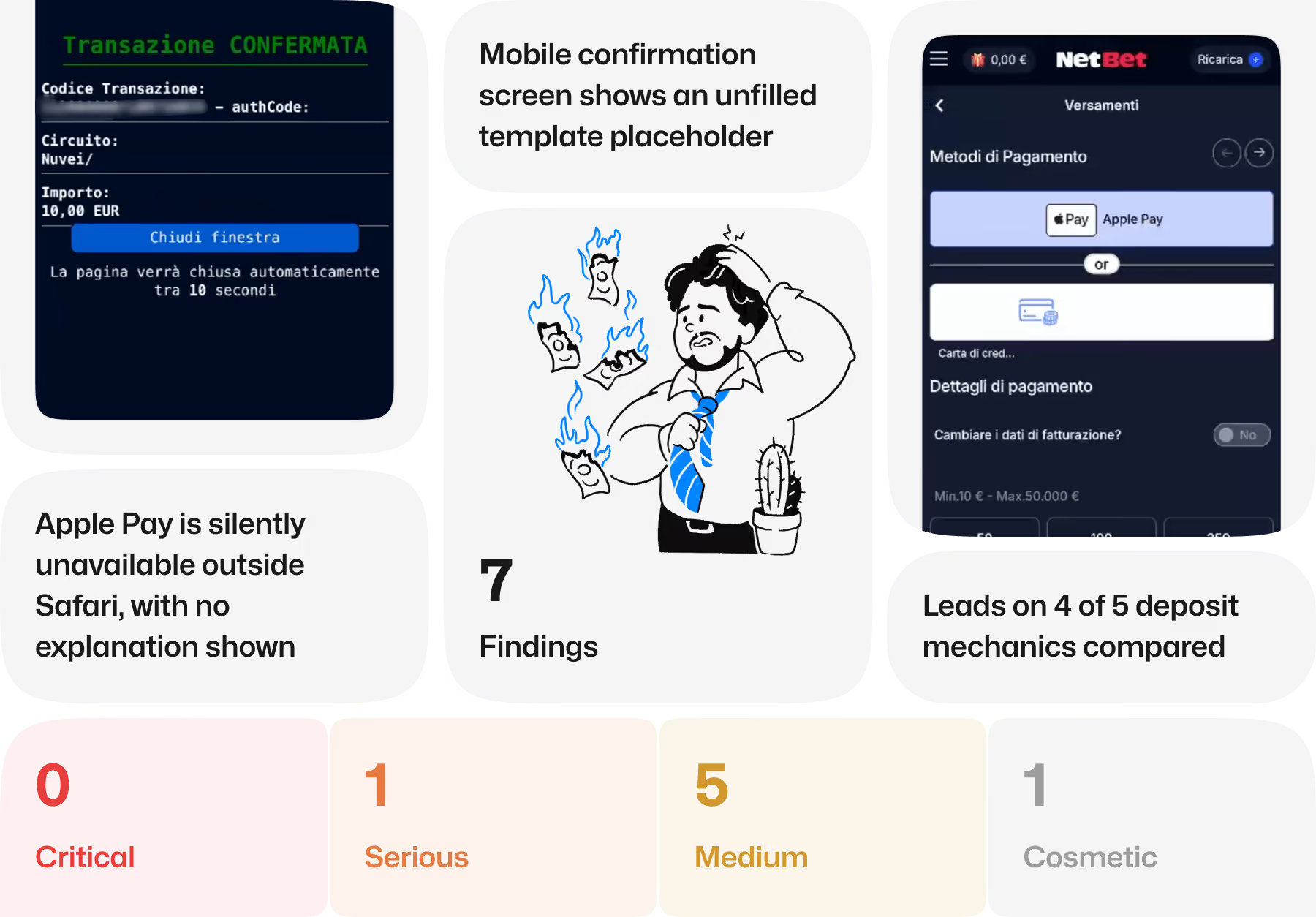
Deposit is NetBet's strongest flow of the six. Four steps end to end, level with the shortest competitor path; all nine payment methods in one flat list where Staryes hides them behind tabs; the saved method and the free-text amount visible at once; a PayPal path with no extra fields, where Goldbet asks for an email twice. NetBet scores 1.53 on the heuristic scale, level with Goldbet and ahead of Staryes.
The one defect that matters sits at the end. The desktop success window closes only on a manual click, while NetBet's own mobile flow auto-closes after ten seconds and Staryes after five — so the flow ends by making desktop users guess whether it ended. 7 findings, none Critical.
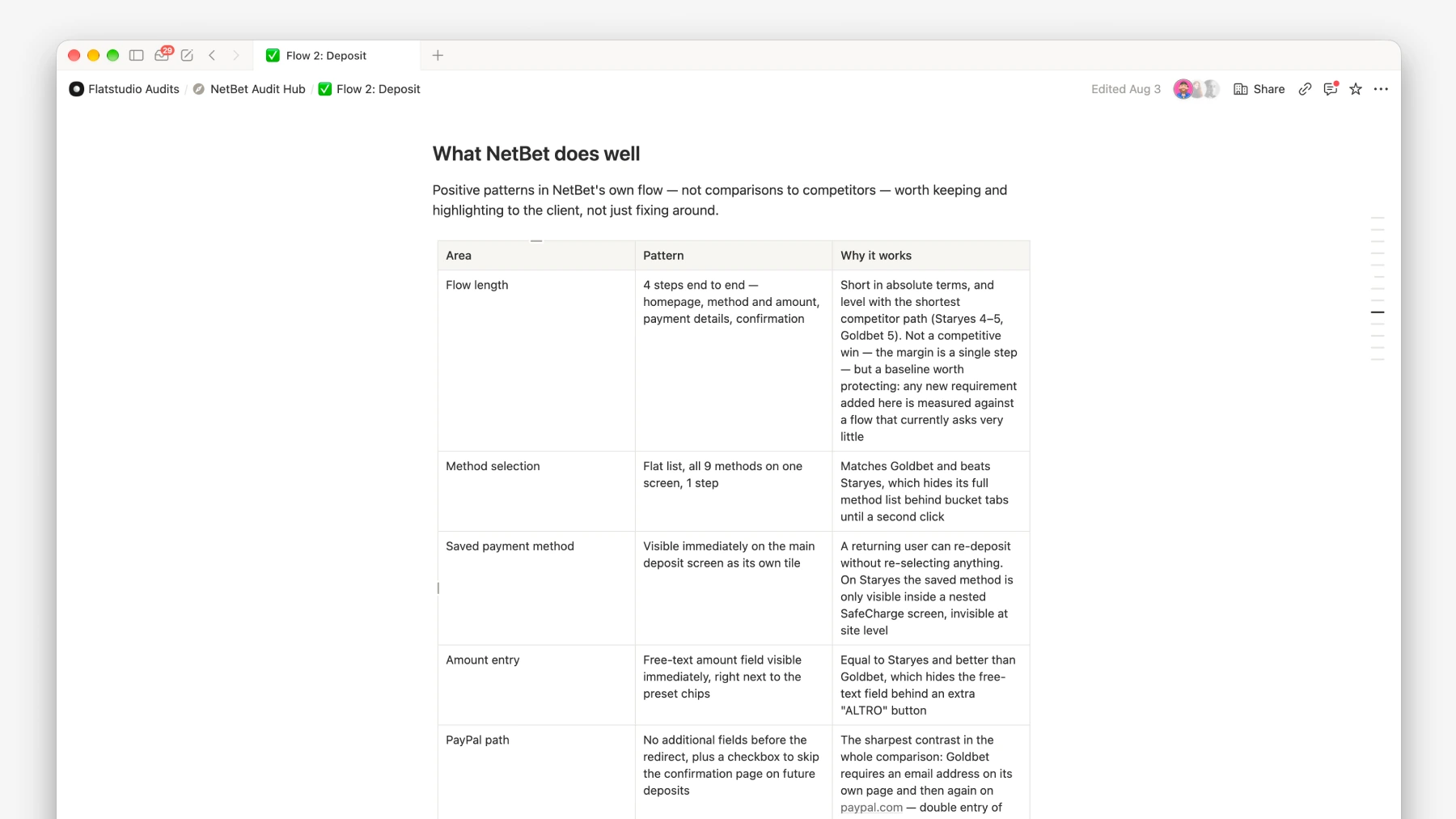
Method selection, saved-method visibility, amount entry, the PayPal path and repeat-click protection are the flow's strengths; four of them lead or match both competitors.
The closing advice for this flow names them and says there is no case for touching them. An audit that only lists what is broken hands the team a backlog with no sense of what to protect; the next requirement added to this flow is measured against one that currently asks very little.
The remaining gap is a business decision. Goldbet offers 15 payment methods, including Italian local rails — Postepay, Bollettino Postale — that NetBet does not carry, and fits them into five steps against NetBet's four.
Whether those rails earn their backend cost for NetBet's own audience cannot be seen from outside, so the audit files it as an open question for the client, with the flow-length argument already answered.
NetBet surfaces promotions on three of its own screens, and the catalogue is competently built: a filterable grid, one card per offer with its headline value and date window, a page per offer. On offer comprehension and honest framing — no false urgency, no pre-ticked opt-ins — NetBet scores ahead of Goldbet.
The flow breaks after the offer is chosen. A player who picks a named welcome bonus during registration ends up with an account whose Bonus page reads "Nessun bonus presente" and every balance at 0,00 €. Nothing says whether the bonus is pending, refused or was never applied; a working mechanic and a broken one look identical from where the player stands. 16 findings, 1 Critical.
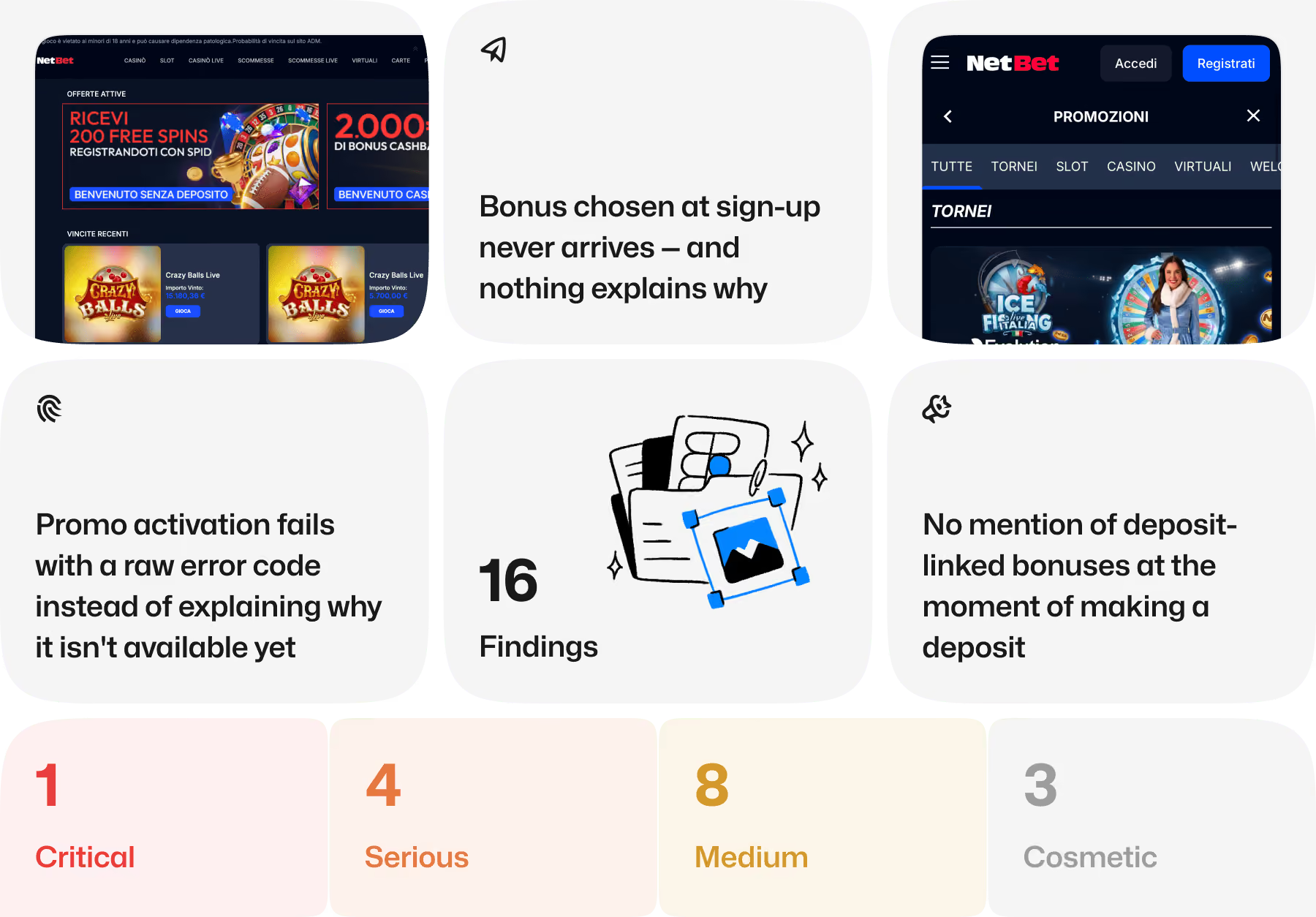
Some welcome offers activate only after a first deposit, a waiting period or document approval, so the empty balance may be correct. The audit does not guess which: it records what the player is shown, which is nothing in either case, and files the cause as a question for the client.
The fix does not wait for the answer — pending, refused or never applied, the interface has to say so, and the offer has to be explained at the moment of choice.
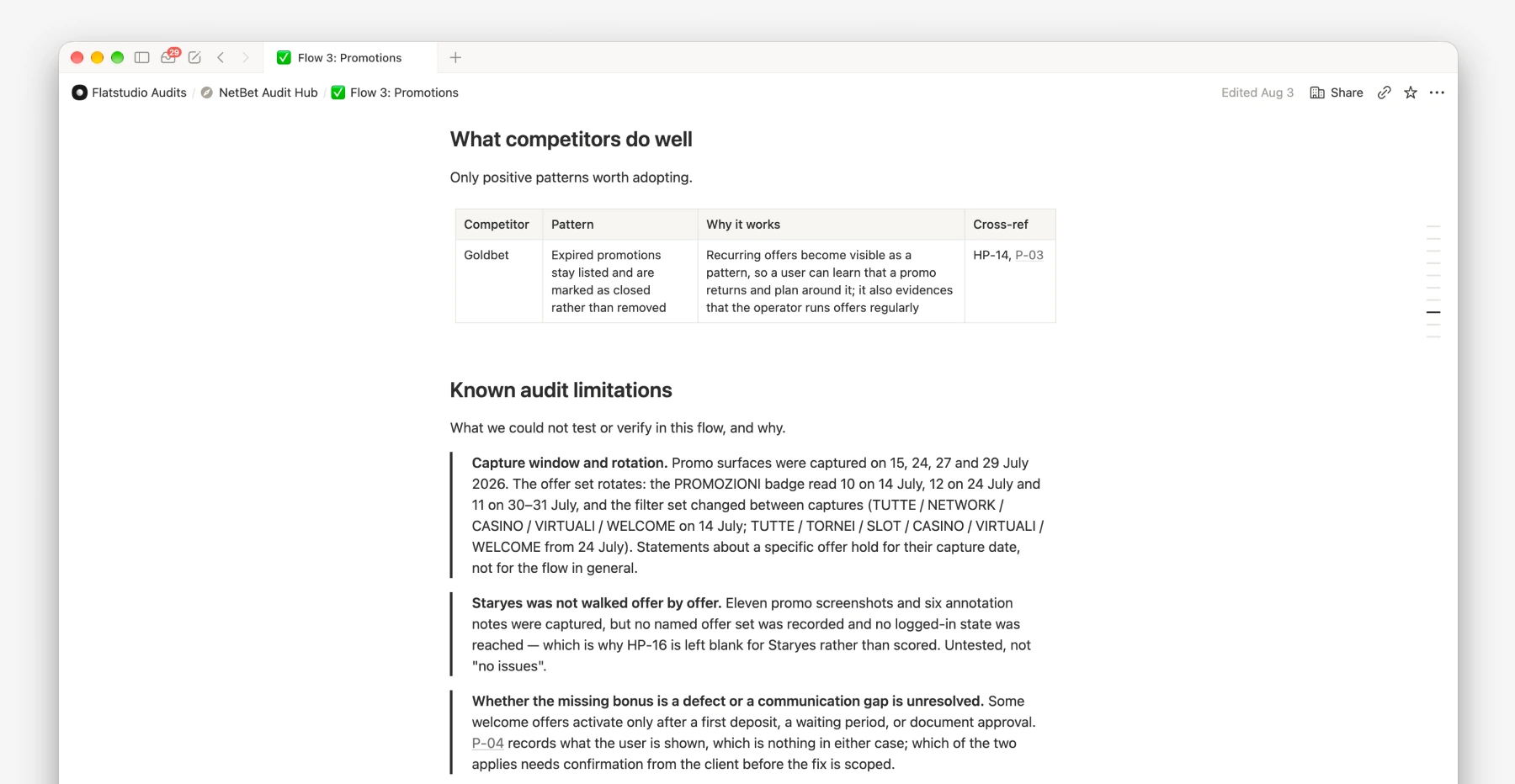
Three more Serious findings share one failure: the product does not act on state it already holds. Welcome tiles keep telling a logged-in, funded player to register; the deposit screen never mentions deposit-linked bonuses; a time-windowed promo returns a raw error code instead of its opening date. Goldbet's one pattern worth adopting: expired promotions stay listed and marked as closed.
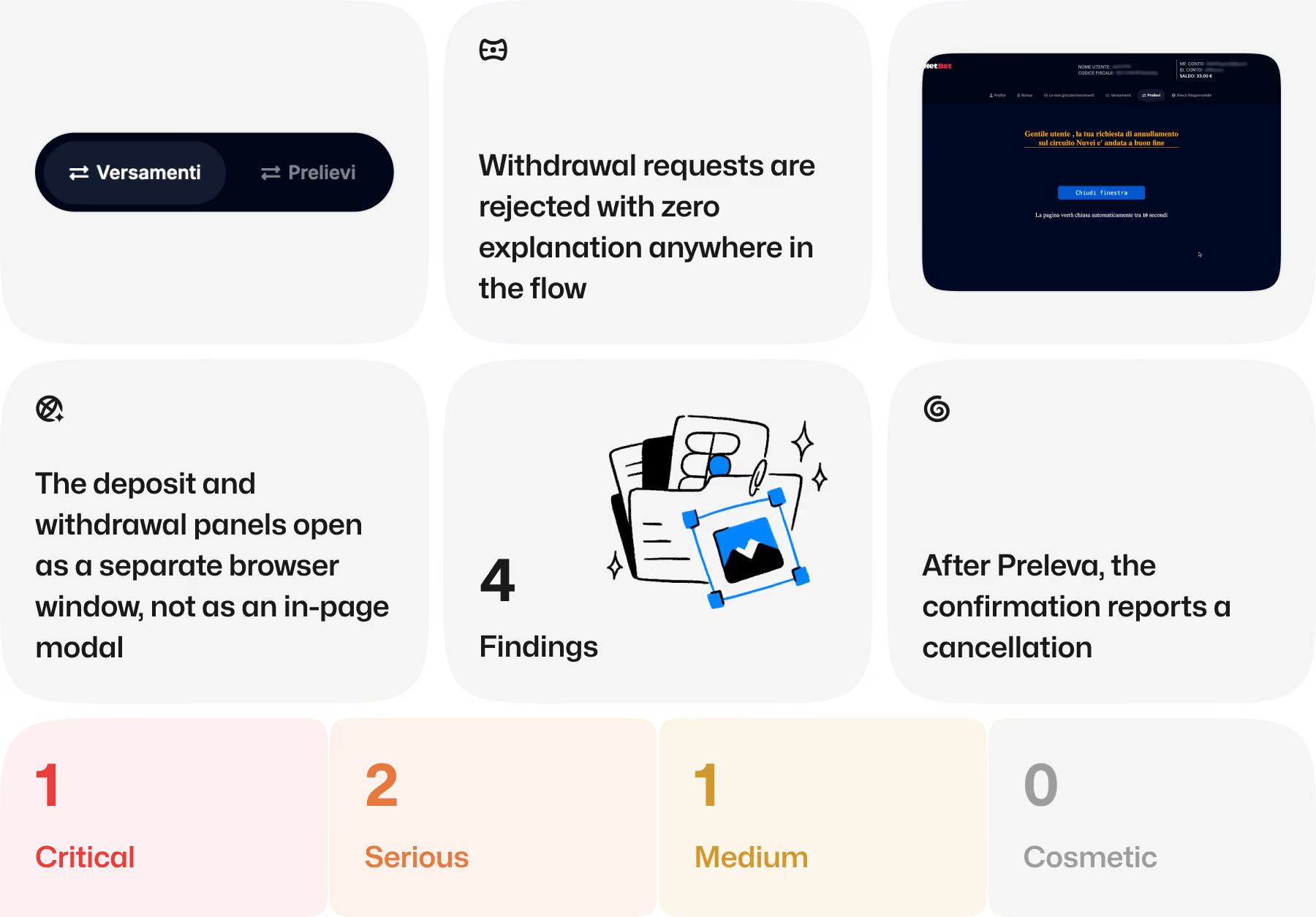
NetBet's withdrawal is three steps — saved payout method, amount, submit — with IBAN and PayPal email pre-filled. The mechanics hold: eight of thirteen heuristic criteria score 2.
What fails is what the flow says about the money. After "Preleva" the confirmation reports a cancellation, on two different methods. Every request was rejected with no reason on screen, in the account or by email — consistent with a winnings-only rule the flow never states. The amount field validates against the full balance, inviting an amount it will then refuse. 4 findings, 1 Critical.
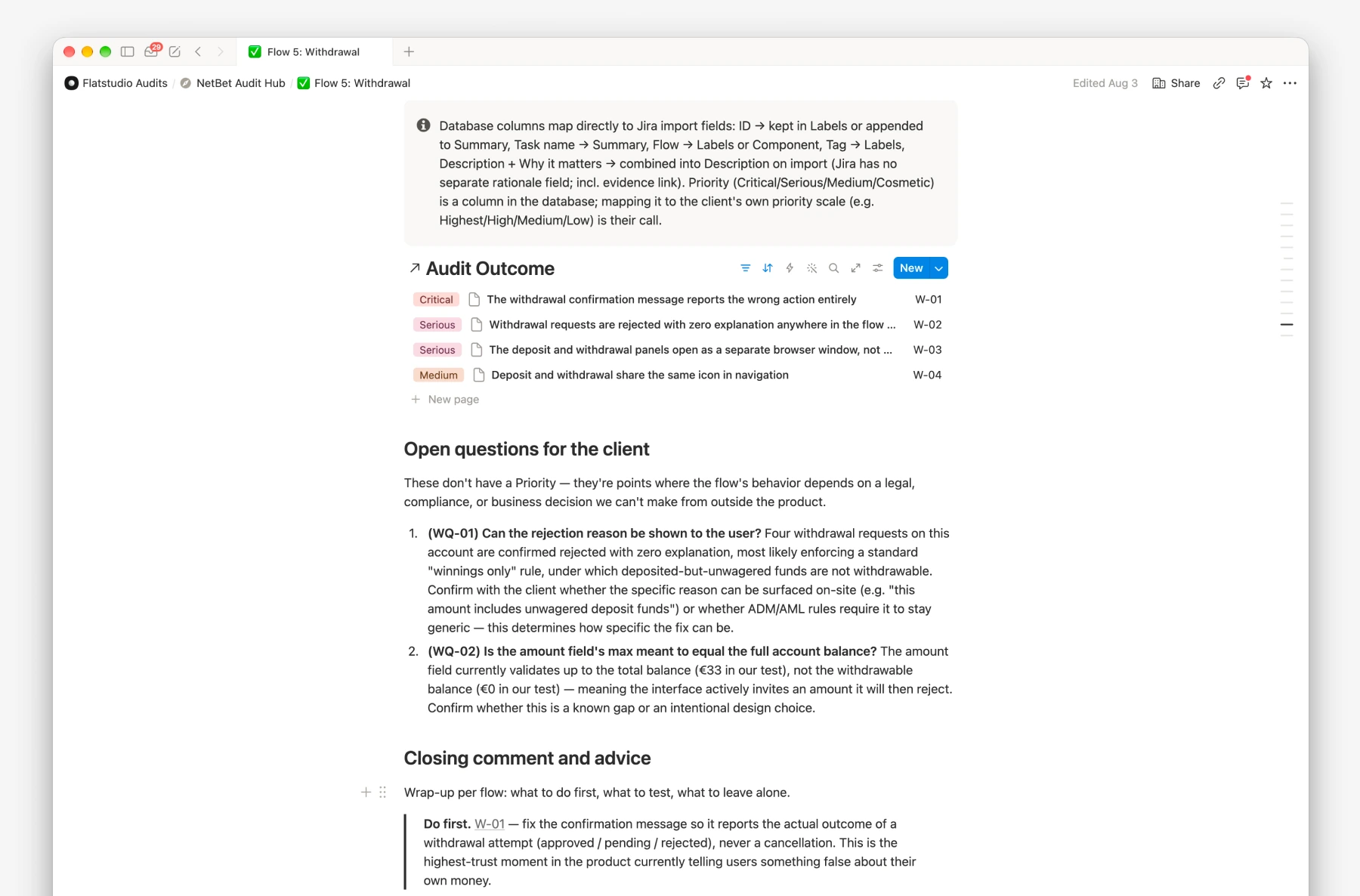
Every flow page ends the same way: findings as tasks, questions only the client can answer, and where to start. For withdrawal: four tasks, two open questions — can ADM rules allow the rejection reason to be shown, and why does the amount field accept €33 when €0 is withdrawable — and one instruction: fix the confirmation message first.
Two criteria score zero for NetBet against Staryes, both the same failure: the flow never says what is happening to the money. Staryes shows limits, timing and fees before submission; NetBet shows none. Goldbet's withdrawal was not entered, so this holds against Staryes only.
NetBet's emails work message by message: purpose, timing and compliance score 2, and it is the only platform of the three that confirmed a deposit by email. The gap is systemic. Nothing is sent at any drop-off point — interrupted registration, abandoned deposit, unfinished verification, failed verification, rejected withdrawal. Five silences, all Serious; both competitors send at least one of these.
Two more defects sit on top: the welcome email renders $$nickname$$ instead of the username, and password recovery sends the password in plain text. 17 findings, and the widest heuristic gap in the audit — 0.50 behind Goldbet.
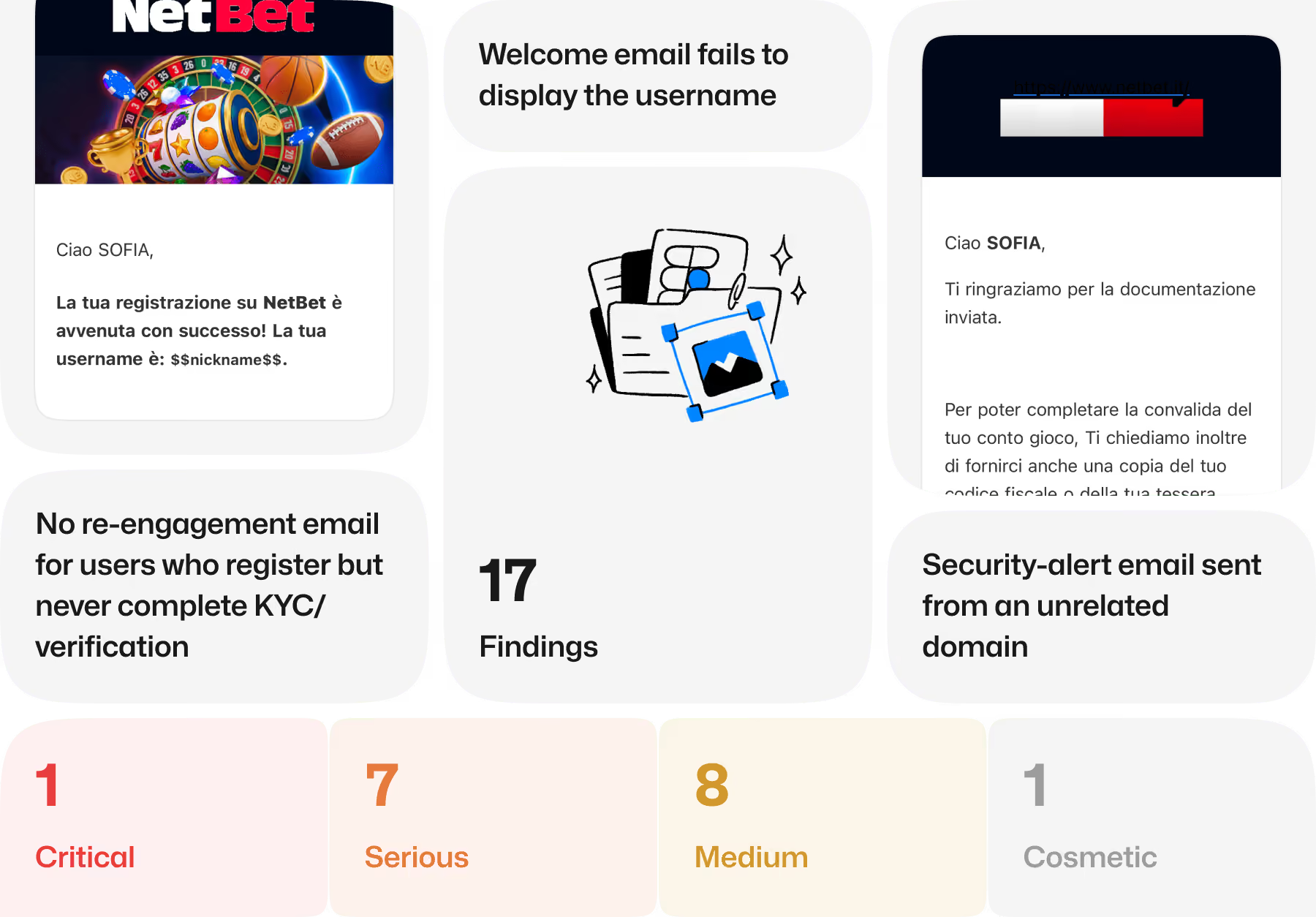
NetBet's email flow averages 1.30 against Goldbet's 1.80.
The gap comes from two criteria scored zero, both structural. Sender identity: transactional mail shows no brand name, promotions come from a separate domain, and the security alert arrives from exalogic.it and lands in spam. Lifecycle coverage: no email at any failure point. Both are programme decisions, so the audit files them as one coordinated fix.
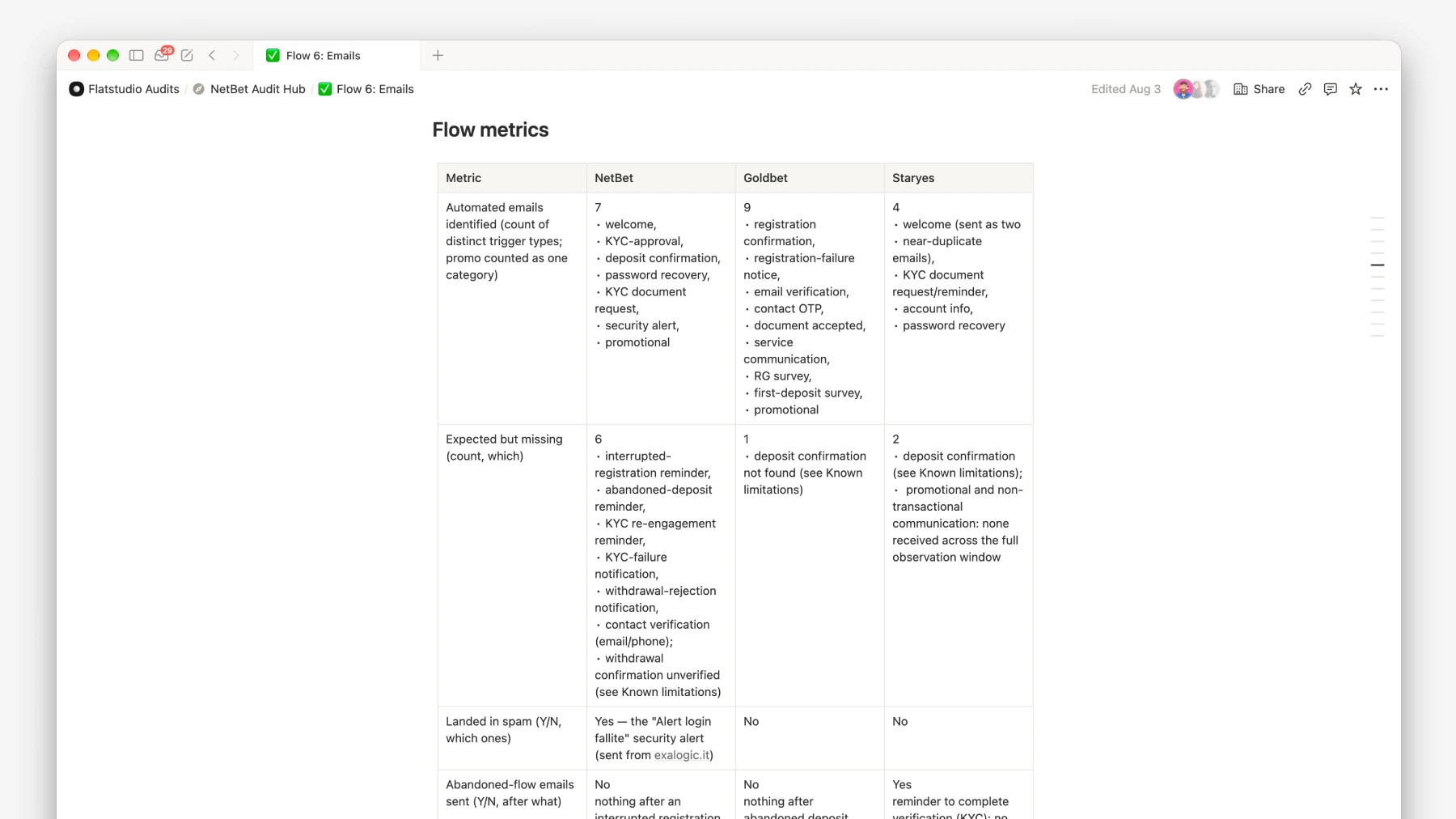
Goldbet runs nine trigger types to NetBet's seven, including surveys and service notices with no promotion attached. Staryes sends four, but one of them is the deadline-anchored reminder that brings a player back to finish verification. The model does not need inventing; both competitors already show it.
These held up in the comparison, and each flow's closing advice names them as things to leave alone.
Every flow was also scored on all three platforms against a fixed set — Nielsen's heuristics plus criteria for regulated gambling — on a 0–2 scale: 2 when it holds everywhere we walked, 1 when partially, 0 when the player has no way through.
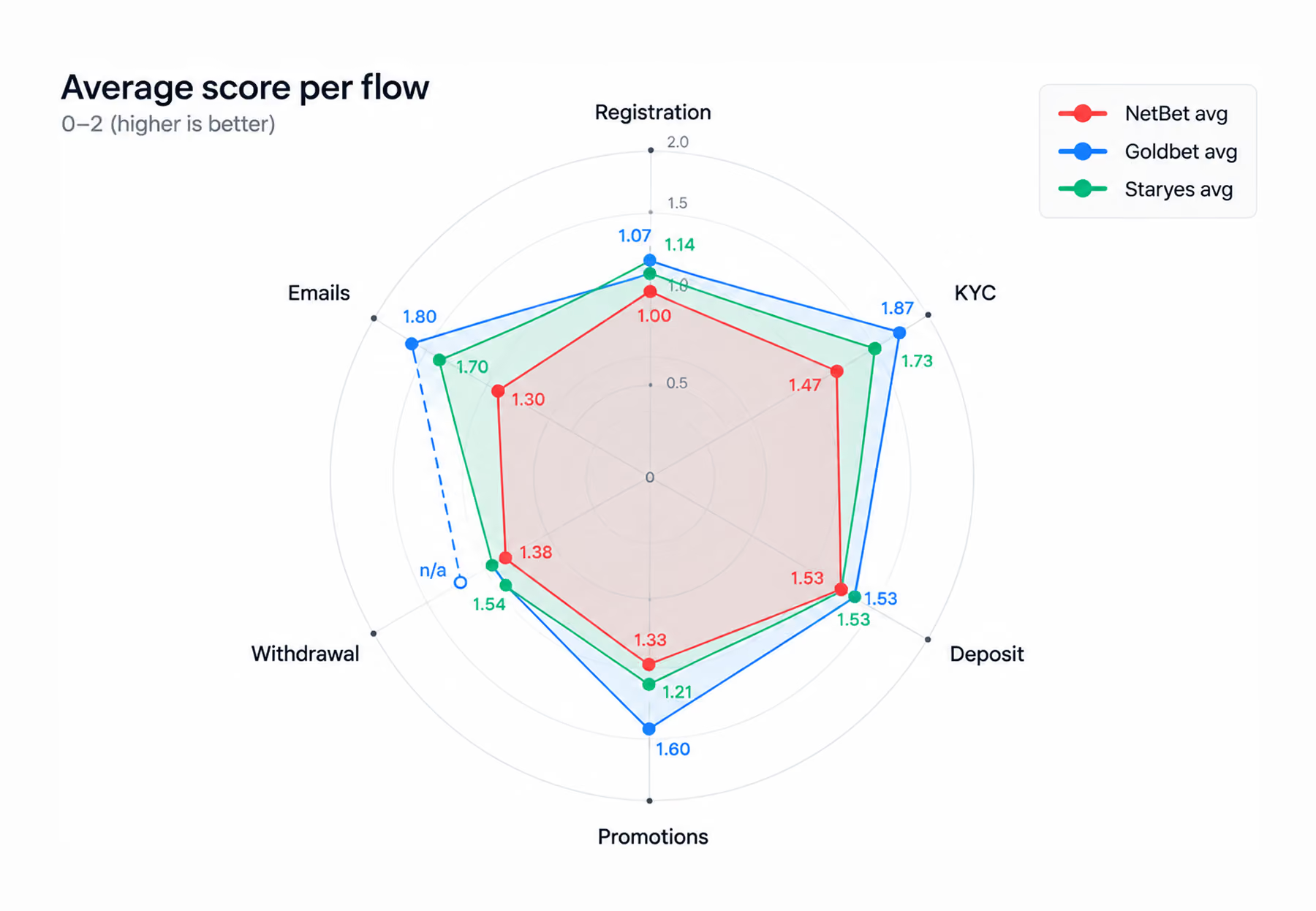
The averages say the market has converged. What they hide is where a criterion hit zero: eight times for NetBet, in four of six flows, each at a point where money or identity changes hands.
Deposit is the flow to protect — level with Goldbet, no zeros. Email is the flow to rebuild — the widest gap, two structural zeros. Registration looks close on the average and is the furthest apart in practice.
The scorecard is the one artefact built to be measured again: the same criteria, six months on, show whether the fixes landed.
The template is fixed; the process is rebuilt around each client. Six steps, and what changed for NetBet at each. The full method, the severity scale and the three audit tiers are described in Product Audit & Discovery
Testers walk the flows while the team is already reviewing the first recordings; nothing waits for the previous step to finish.
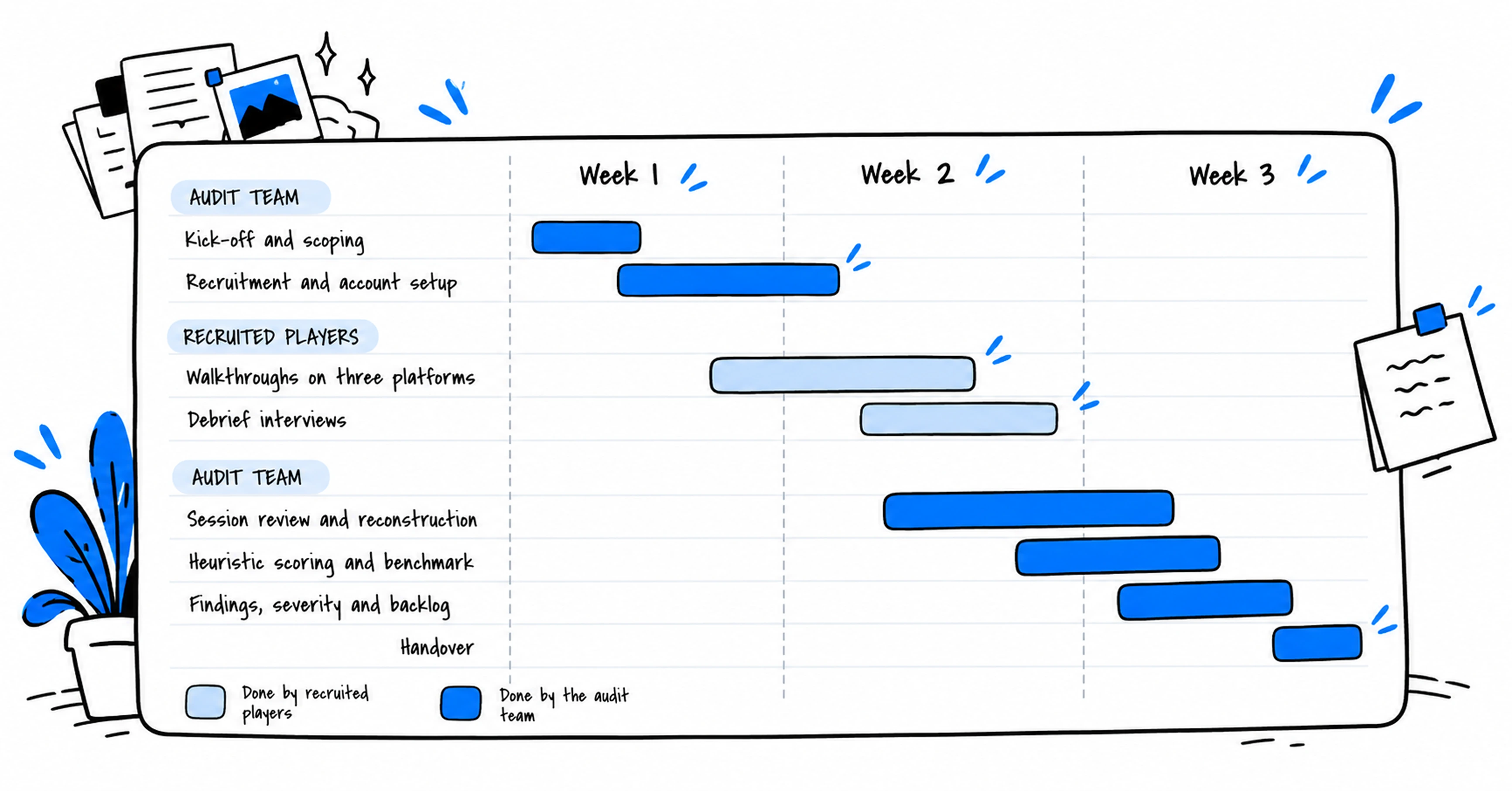
Flows are bought as dimensions of one audit; the tier sets the depth. For NetBet: six flows, three platforms, desktop and mobile, three weeks.
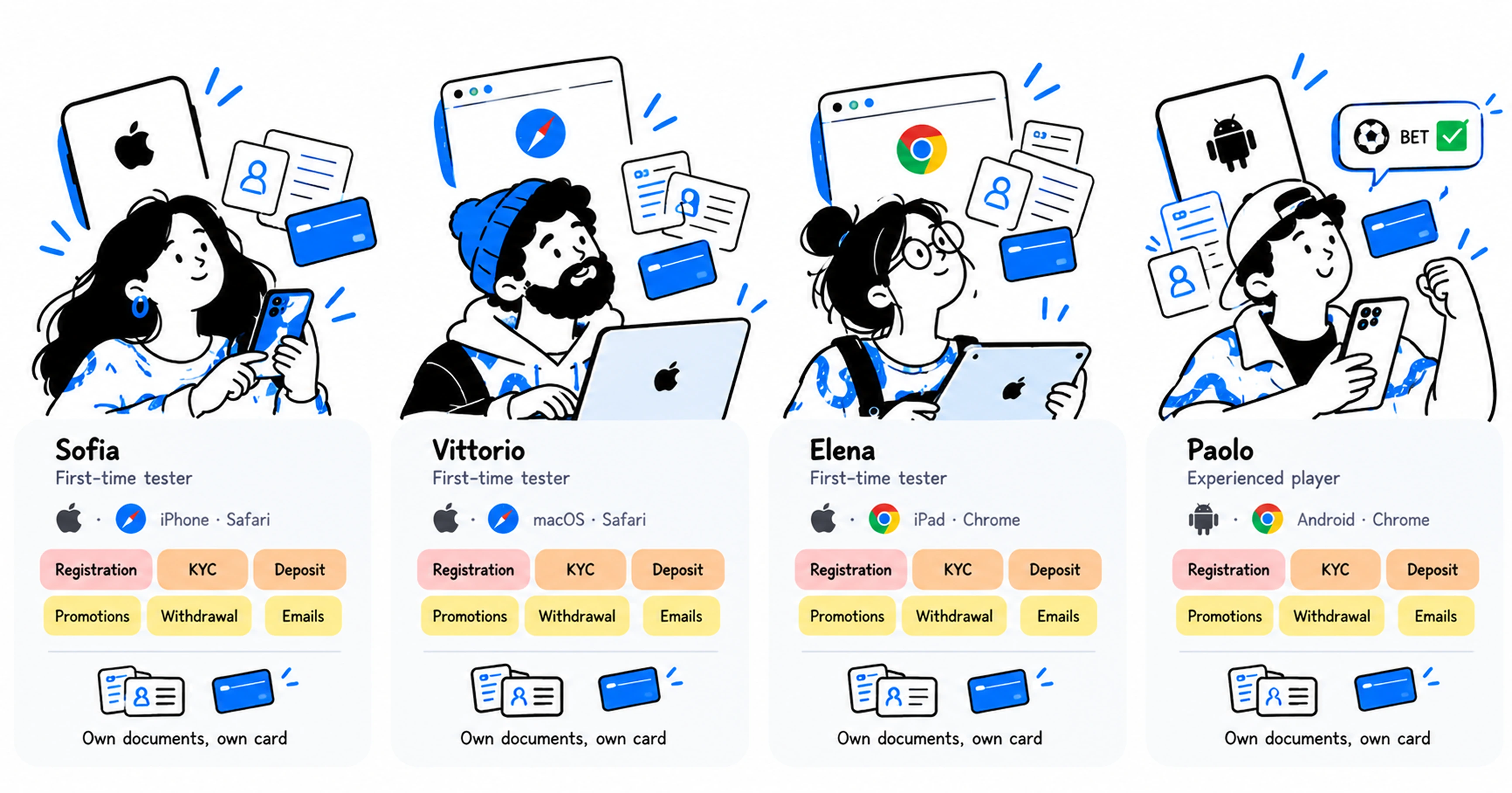
Testers are chosen per audit — first-time users, the client's own, or both — and matched to the market so verification and payment complete for real. NetBet: three testers on their own data and cards; a local Italian contractor for verification on all three; a fourth pass with non-Italian identity to see what happens when it fails.
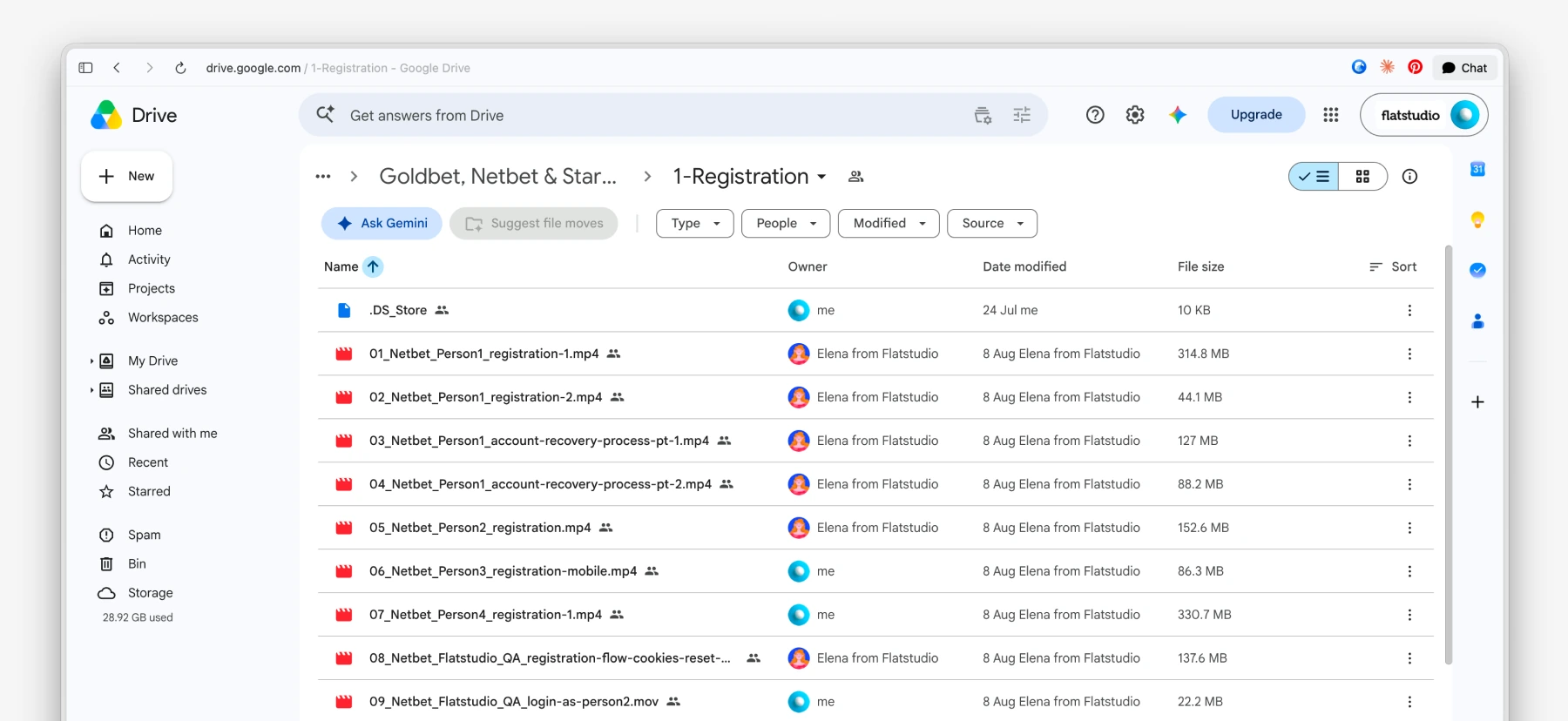
Every session screen-recorded, personal data blurred, files named to one convention so a finding traces to its minute. Defects that need confirming get their own QA run.
After each walkthrough the tester talks through what happened. The recording shows where someone stopped; the debrief explains what they thought was going on.
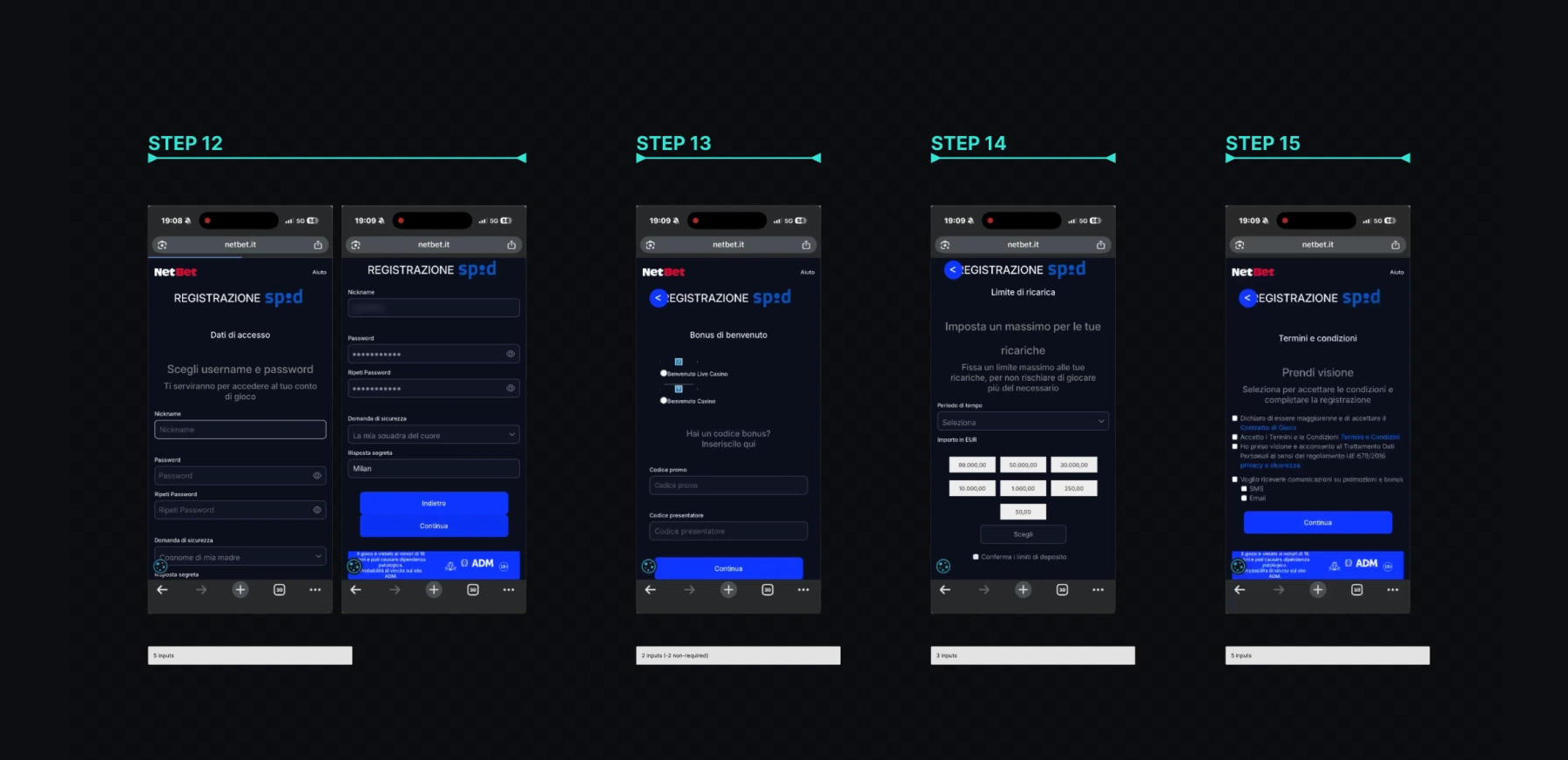
Each recording is broken into frames — every screen, three platforms side by side. Each problem is attached to the frame where it occurs, on a card carrying the same ID as the findings database. Each flow is then scored on all three platforms against a fixed heuristic set, 0–2.
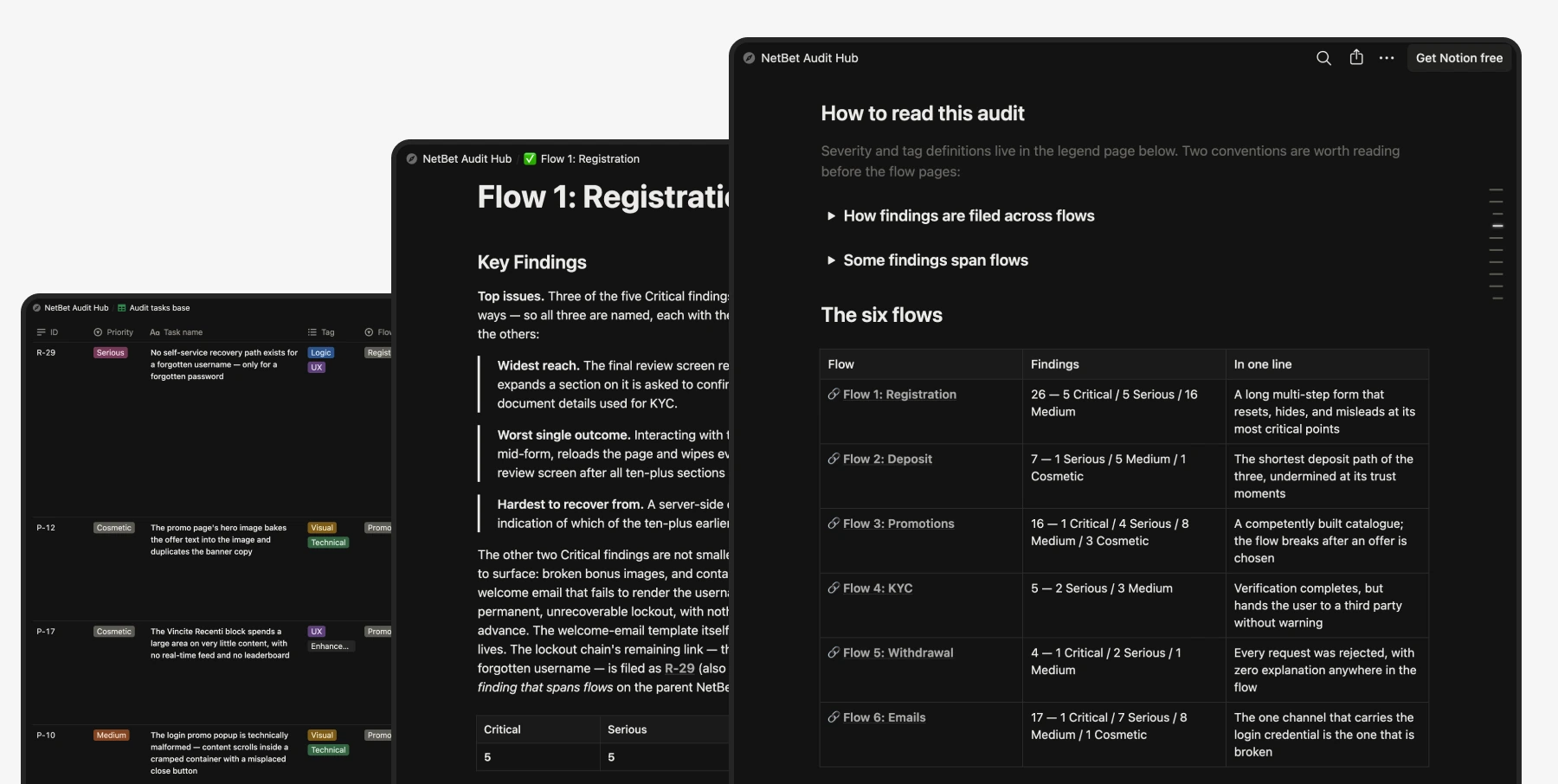
A page per flow, a database that imports into Jira as-is, a scorecard built to be run again.
Every flow page carries a "Known audit limitations" block, so a reader can tell a confirmed defect from an untested one. No withdrawal completed on any of the three platforms — every request was blocked by winnings-only rules — so no platform's payout confirmation could be judged. Verification failure was reached on a dedicated extra pass with non-Italian identity data; neither competitor's walkthrough reached a rejection, so their failure handling is recorded as untested. Where two passes read a competitor differently, both readings are reported and no comparison is asserted.
Open questions — a rejection reason under ADM rules, Italian payment rails, whether a missing bonus is a defect or a message — carry no severity. They are decisions only the client can make, and they are listed on every flow page as the agenda for the follow-up.
We walked the findings through on a delivery call, answered the team's questions, and handed over one link: the Notion hub. It holds the audit of all six flows, the Figma boards, the Drive recordings, and the findings database ready to import into Jira.
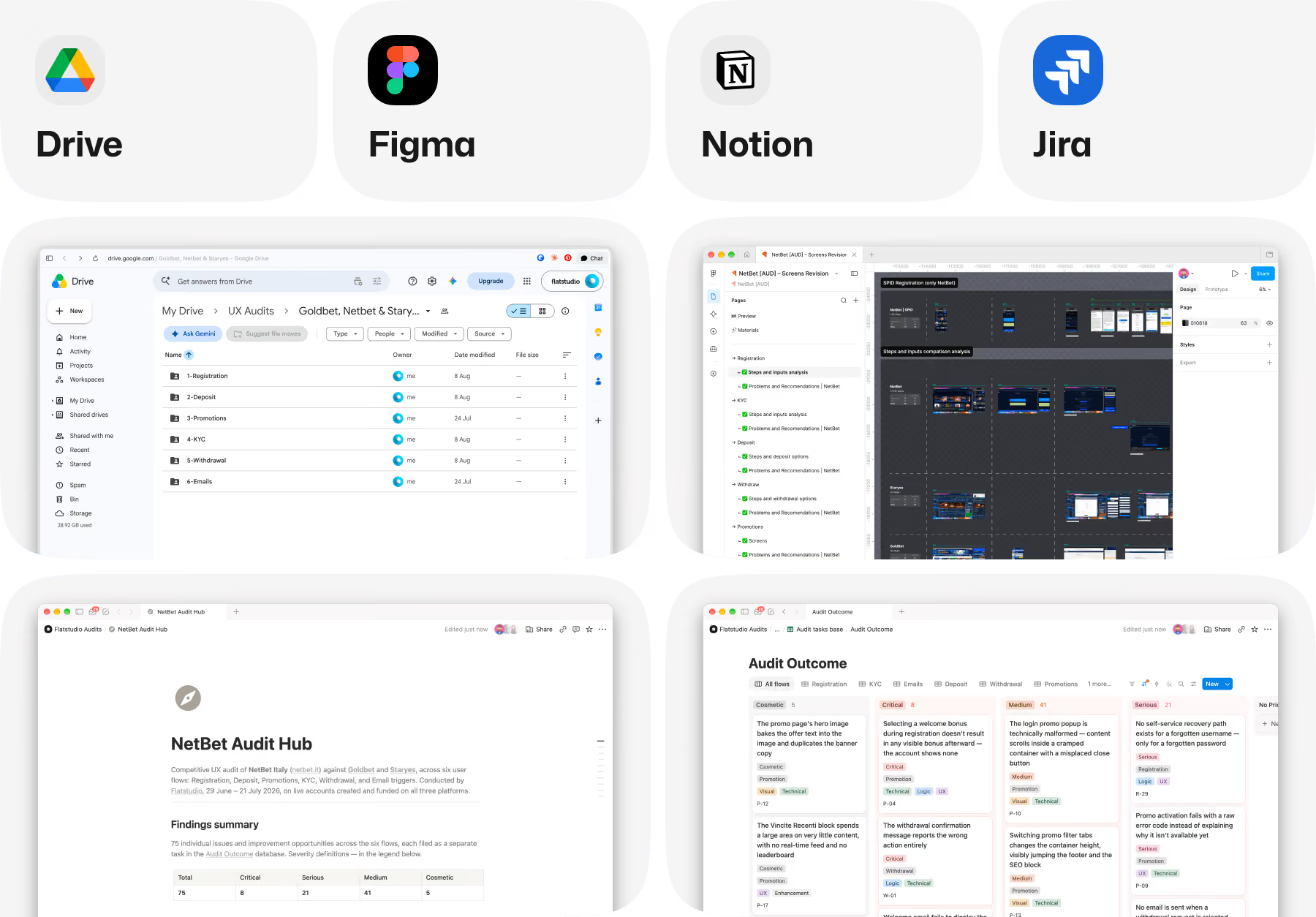
Each artefact has its reader. Drive is for the team's own analysis — what each tester did, flow by flow, on video. Figma is for designers — every step of every tester, frame by frame, three platforms side by side. Notion is for stakeholders and management — the flows, the steps, the scores, and the tasks themselves, with an order to work in.
Three weeks later NetBet came back with a request for several new audits. The review below is theirs.
Their work quality stood out and they delivered it on time!

A UX audit where the same flows are walked on the client's product and on direct competitors, by the same testers, on live accounts, on the same days. It separates "the regulator requires this" from "nobody has questioned this since launch" — a single-product review cannot. It is part of the Product Discovery & Vision and Enterprise tiers. Example: NetBet Italy vs Goldbet and Staryes.
How much does a UX audit cost? Express starts from €3,500. Discovery starts from €5,500. Enterprise scope varies too much by product to price upfront, so it is quoted once we have mapped what needs to be covered. A single-journey audit is possible when the business problem sits in one flow, which lowers the entry point considerably.
Yes. The backlog is written so an internal team executes it directly, with evidence linked from every task and related low-impact items grouped into batches. Most clients continue with us afterwards, through a rebuild or a dedicated team shipping the roadmap sprint by sprint, but the deliverable stands on its own.
Every flow is scored on each platform against Nielsen's heuristics plus criteria for the client's domain — for regulated gambling: verification burden, payment clarity, when bonus terms appear. Each criterion scores 0, 1 or 2. Flows are reported with the average and the number of zeros, because averages hide the step where a player has no way through.
Yes. An audit can focus on a single high-value journey – registration, checkout, onboarding, withdrawal – when that is where the business problem sits. It follows the same method: real users, recorded sessions, evidence-linked findings, and a prioritized backlog, at a smaller scope and cost.
Yes. Every flow in the NetBet Italy audit was recorded on desktop and on mobile, and the Figma reconstruction shows both side by side. Native iOS and Android apps are covered in the Enterprise tier as a cross-platform audit, alongside web.
As many personas as the analysis needs to separate a one-off stumble from a pattern – defined per audit around the journeys in scope. In the NetBet Italy audit, three testers walked every flow on all three platforms, with a fourth added where a re-verification pass was needed. Persona count is part of scoping.
No. We audit the interface on staging or production plus your analytics, such as Google Analytics or Mixpanel. Code, backend, and user databases stay untouched. This is a standing rule rather than a case-by-case decision, and it removes the main security concern regulated operators raise before an audit.
Between one and four-plus weeks depending on tier. Express covers critical flows and quick wins in about a week. Discovery adds recorded user sessions, competitor benchmarking, visual concepts, and a strategic roadmap in about three weeks. Enterprise extends to cross-platform coverage, accessibility, and design ops over four or more weeks.
Usability testing is one input into the audit. We add heuristic scoring per flow, competitor benchmarking on the same journeys, technical health checks, and cross-flow analysis that catches failures spanning several screens. The findings are then prioritized by impact and converted into implementation-ready tasks, which standalone usability testing rarely produces.
A UX audit can include real-user testing, heuristic evaluation, journey analysis, competitor benchmarking, technical health checks, evidence-backed findings, prioritization, visual concepts, and an implementation-ready backlog. The exact scope depends on the product, the business problem, and the audit tier – Express covers the first two and quick wins; Discovery and Enterprise add the rest.
A product UX audit is a structured diagnostic of a live product: real people complete real missions on live accounts, every friction point is recorded and evidenced, and each finding becomes a prioritized task with severity, rationale, and an evidence link. The deliverable is a backlog your team works from, with the report as supporting material.
Yes – competitor analysis is part of the Product Discovery & Vision and Enterprise tiers, and it is hands-on rather than desk research. On a recent audit for the NetBet Italy audit we created and funded live accounts on all three platforms in scope and walked the same six flows end to end, so every comparison came from what the products actually do, not from screenshots or marketing pages. That is how you find issues that only appear as a sequence – on that audit, four separate failures stacked on a single login credential with no recovery path at any point.
A recent example: a competitive UX audit of the NetBet Italy audit against two rival operators, run over three weeks on live accounts we created and funded on all three platforms. It covered six flows – registration, deposit, promotions, KYC, withdrawal and transactional email – and produced 75 filed findings: 8 critical, 21 serious, 41 medium, 5 cosmetic. Every flow was scored against Nielsen heuristics plus iGaming-specific criteria, and each finding shipped with annotated screens, screen recordings and columns that map one-to-one onto Jira import fields.
An Express Audit starts from €3,500 – one week of work covering a critical UX/UI heuristic review, a technical health and speed check, and a list of Quick Wins. Product Discovery & Vision starts from €5,500 and adds competitor analysis, 1–2 visual concepts and a strategic roadmap. Enterprise Transformation is scoped individually, because price follows the number of flows, platforms and competitors in scope rather than a fixed rate card. We confirm the figure before any work starts, so you never commit to an unscoped budget.
Yes. The heuristic scorecard is built to be measured again: the same criteria, on the same flows, after the backlog is worked through. A re-run typically takes one week and shows which fixes landed and which moved the problem elsewhere.