







For product leads and founders of live products who suspect a flow is losing users and want to know whether the fix is theirs to make.
Every audit of a single product ends the same way: a list of long steps and confusing screens. What the list cannot tell you is why they are there. A registration form with nine screens may be nine screens because the regulator demands it, because the platform vendor built it that way, or because nobody ever asked. Those are three different problems with three different fixes, and only one of them is a design job.
A competitive UX audit exists to answer that question. It is most useful when a team already knows where users struggle and does not know whether the cause is regulatory, market-wide, platform-driven, or its own. Put your product next to the ones your users already know, under identical conditions, and the answer becomes visible.
TL;DR
- A competitive UX audit walks the same flows on your product and two to four competitors, with the same testers, in the same window, on live accounts.
- It separates friction every player in the market shares from friction only you have.
- The output is a scored, prioritised backlog a product team can import into Jira or Linear the same week.
- Right call: entering a market, conversion dropping without a visible cause, a competitor's redesign. Wrong call: before launch.
What is a competitive UX audit?
A competitive UX audit is a structured review in which the same user flows are completed on a product and on its direct competitors, by the same testers under the same conditions, and every point of friction is recorded, scored and compared side by side. The result shows where a product is slower, less clear or less trustworthy than the alternatives its users can switch to, and where it is already ahead.
Flatstudio is a product design studio that runs competitive UX audits for iGaming, fintech and SaaS products on live accounts across every platform in scope. The method below is the general one; the NetBet Italy audit against Goldbet and Staryes shows how it was adapted to one market.
How does a competitive UX audit differ from a regular UX audit?
A regular UX audit evaluates one product against a set of heuristics (NN/g describes the method here). Usability testing watches real users attempt tasks on one product. A competitor teardown describes a rival's flow from the outside. A competitive UX audit runs the same walkthroughs on several products and reads the differences.
The practical difference shows up in the long step. Audited alone, a nine-screen registration is a finding and nothing more. Audited beside two competitors, the same nine screens become a diagnosis. If all three operators in the same market need nine, the regulator owns the step and the fix is copy and pacing. If two competitors do it in four, the platform or the team owns it, and the fix is structural. Three causes, three decisions, visible only in comparison.
What gets compared in a competitive UX audit?
The comparison only holds if the conditions are identical, so four things are kept constant on every platform in scope:
- The same flows. Revenue-critical journeys agreed before the start; in iGaming typically registration, deposit, promotions, KYC, withdrawal and transactional email.
- The same testers on every platform, so a difference in the recording is a difference in the product.
- The same window. Flows are walked within the same time window on all platforms, so a promotion that disappears after the first deposit is seen at the same moment everywhere.
- Live accounts. Real identities, small deposits from the testers' own funds, real withdrawals and document uploads. The flow is recorded as a customer receives it, including every email that arrives and every email that does not. No personal data or documents appear in the deliverable.
This is a controlled comparison, and it makes no claim to statistical representativeness. Three testers cannot say how often a problem occurs across a user base; with the conditions held constant, they can say that one product has it and two do not. That is the question the method is built for, and the one desk research cannot reach: a welcome email with a broken placeholder appears only on a funded account.
How does a competitive UX audit run?
Five steps, usually inside three to four weeks:
- Scope. Agree the flows, the competitors and the market. A regulated product is compared only with products in the same market and under the same regulatory framework.
- Testers. Personas with real identities and payment methods. Where verification needs a local document, a local contractor completes that step.
- Walk and record. Every flow on every platform, with screen recording, step-by-step screenshots and a shared inbox.
- Reconstruct and score. Each flow rebuilt step by step in Figma with the platforms side by side; every finding gets an ID, a severity and an owning flow; each flow is scored per platform.
- Deliver. The findings, the boards and a delivery call through the backlog in priority order.
At Flatstudio this is the competitor module of the Discovery and Enterprise tiers; the full engagement also covers heuristics, tech health, analytics and 1–2 visual concepts. Format, tiers and timelines are on the UX Audit & Product Discovery service page.
A worked example: NetBet vs Goldbet vs Staryes
In summer 2026 Flatstudio audited NetBet Italy against Goldbet and Staryes across six flows: registration, deposit, promotions, KYC, withdrawal and transactional email. All three operate under ADM, the Italian regulator, so the regulatory baseline was identical. Three testers opened and funded accounts on all three platforms and walked every flow over a three-week audit, 18 walkthroughs in total. The audit filed 75 findings: 8 Critical, 21 Serious, 41 Medium and 5 Cosmetic. Twenty-six sit in registration alone, and 17 in transactional email.
The finding that justified the method was a chain, visible on no single screen. At registration the login credential is labelled "Nickname", with no signal that it must be remembered. The welcome email that would remind the user arrives only after identity verification, which itself requires logging in with that same credential. When the email does arrive, the username renders as a broken $$nickname$$ placeholder. There is no self-service recovery for a forgotten username, and no reminder to come back and finish verification. Four failures stacking on one credential, and a new user who can permanently lose access. None of it shows on a marketing screenshot. All of it shows on a live account, on day one.
The full breakdown by flow, the scorecard and what NetBet already does better than both competitors are in the NetBet Italy competitive UX audit case study.
What does the output of a competitive UX audit look like?
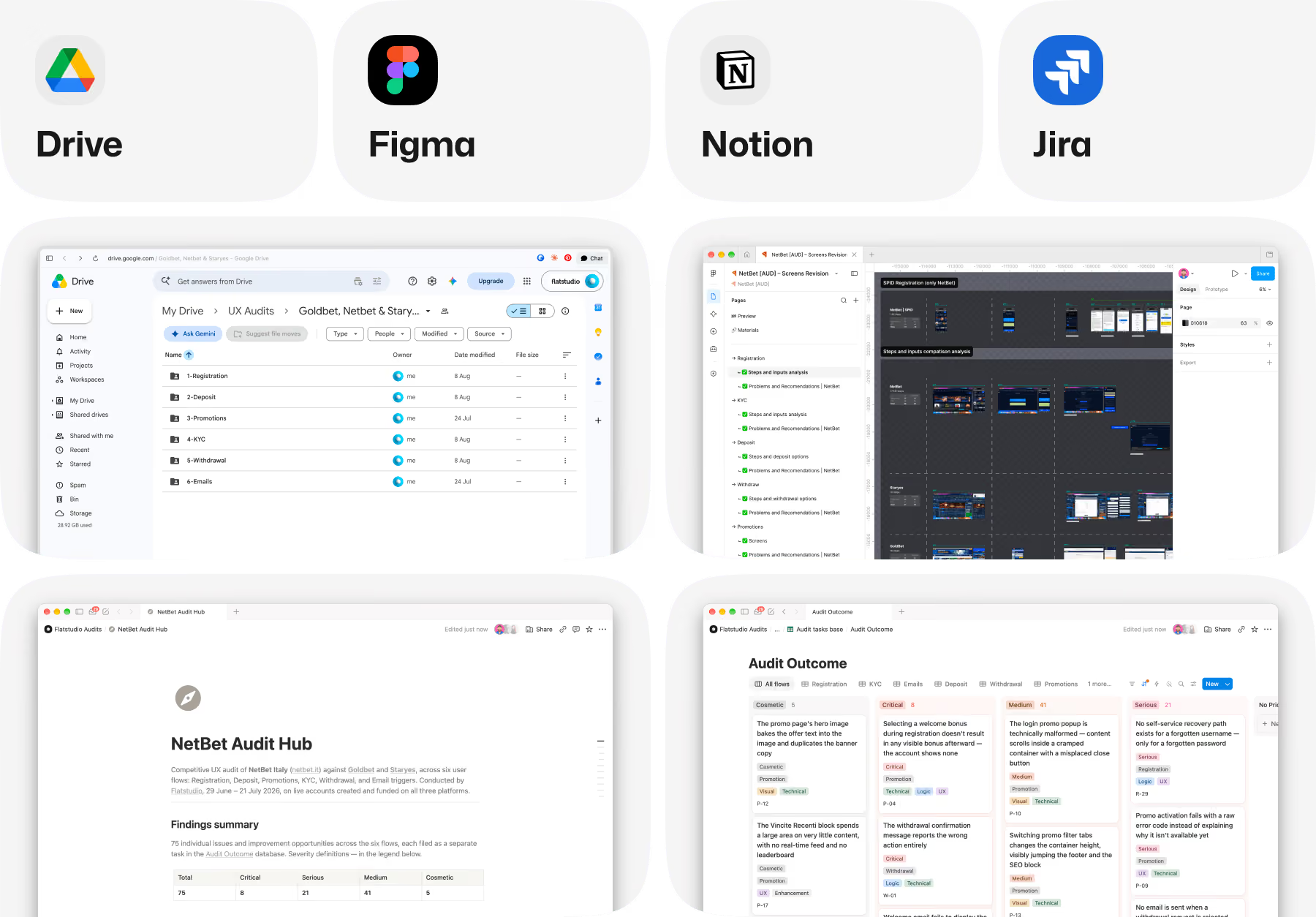
The deliverable is a working set of files for the product team that has to act on it, with a presentation on top.
- Findings database. One row per finding: ID, title, severity, flow, tag, description and why it matters. The columns map onto Jira or Linear import fields, so the backlog imports as it stands.
- Figma lanes. Each flow as three horizontal lanes, one per platform, aligned by step, with annotated cards that carry the same IDs as the database.
- Heuristic scorecard. Each flow scored per platform on a 0–2 scale against Nielsen's ten heuristics plus criteria specific to the industry. In iGaming those include trust signals at money steps, fees and timescales shown before confirmation, KYC transparency, wagering requirements visible before a bonus is activated, and whether an email exists at every drop-off point. The flow score is the average; zeros are listed separately, because a zero on one criterion is usually the finding that matters most.
- Cross-flow chains. Findings that only hurt as a sequence, which no single flow page can show.
When is a competitive UX audit the right call?
Four situations come up again and again:
- Entering a new market. Users there already trust a product; the audit shows what "normal" looks like before you build for it.
- Conversion falling, analytics silent on why. Funnels show where users leave; comparison shows whether that step is worse than the competitor's.
- "It has always been like this." Two competitors doing the step in half the screens ends the argument faster than any internal debate.
- A competitor just redesigned. Their new flow is the standard your users will hold you to; walking it on a live account shows what changed and what it costs you.
When is it the wrong call?
A competitive audit compares finished flows under real conditions, so it needs something finished to compare. It is the wrong tool before an MVP exists, when there is no live traffic to lose, or when the question is purely technical, such as load time or crash rates. A design review or a performance audit will answer those faster and cost less, and Flatstudio will say so on the scoping call.
Where to start
If one of the four situations above is yours, the fastest next step is a scoping call: which flows, which competitors, which market. Flatstudio runs competitive audits as part of its UX Audit & Product Discovery service; how the studio works with operators is on the iGaming product design page. To scope an audit, get in touch.




Frequently Asked Questions
Can you audit competitors without their consent?
Yes. The audit uses a competitor's product exactly as any paying customer would: public sign-up, a deposit from the tester's own funds, documents the tester owns. Nothing is accessed that a regular user cannot reach.
How many competitors should be in scope?
Two to four. One gives a single reference point, so every difference could be either product's quirk. Two let a pattern emerge, and two or three is enough for most products. Four pays off in a fragmented market; beyond that, testing cost grows faster than insight.
Does a competitive audit replace analytics?
No. Funnel data shows where users leave and how many. The audit shows whether that step is worse than the competitor's and what the user saw on screen and in their inbox at that moment. Analytics supplies the scale; the audit supplies the cause.
What if a competitor's flow cannot be completed?
The audit records where it stopped and why, with the screen and any email that followed; a withdrawal rejected without a reason is itself a finding. Where a local document is the only blocker, a local contractor completes the step. Anything still untested is listed as untested, with the reason.
