





Sports Prediction Market UX: Designing Yes/No Trading for Live Sport





Written for founders and product teams launching a sports prediction market or adding Yes/No trading to a betting product.
Sports prediction market UX is the design of an exchange where users trade on sporting outcomes against each other, with prices shown as probabilities and contracts that settle at a fixed amount when the event ends. This article covers the version we designed for Magic Markets, a sports prediction market with an exchange order book.
Prediction markets made trading on an outcome feel as simple as one question: yes or no. That simplicity was built for elections, rate decisions and news events, where a market can stay open for weeks and a price moves a few points a day. Sport is where most of the money now goes, and live sport breaks almost every assumption those interfaces were built on.
The Magic Markets team asked for prediction framing from the very first brief, because Polymarket and Kalshi were growing fast and a new audience was learning to read prices as probabilities. The design problem was to keep the Yes/No promise on a football match with dozens of markets, three outcomes and prices that change every few seconds.
Live product. Since then the product has launched at magicmarkets.com, and the team keeps testing approaches with live users, so parts of what follows differ from the current site. Treat the screens here as the design directions we developed together, shipped or not. Three labels mark status throughout the series: Live product for what runs on magicmarkets.com today, Design exploration for directions we designed and compared, and MVP direction for what we proposed for the first release.
TL;DR
- Sport is the largest category on the leading prediction markets, and live sport needs faster, denser interfaces than news markets.
- Price format and market framing are separate choices: the same market can read as 1.91, -110, 52¢ or 52%, and as Back/Lay or Yes/No.
- On a three-way football market every outcome gets its own Yes/No pair, and buying No carries the same risk as laying that outcome.
- Totals and handicaps become readable when each line is rephrased as a single question.
- A Yes/No betslip can show the order book directly, as long as stake, payout and errors stay clear.
- When the team can't agree which format users prefer, design all of them and let real usage decide.
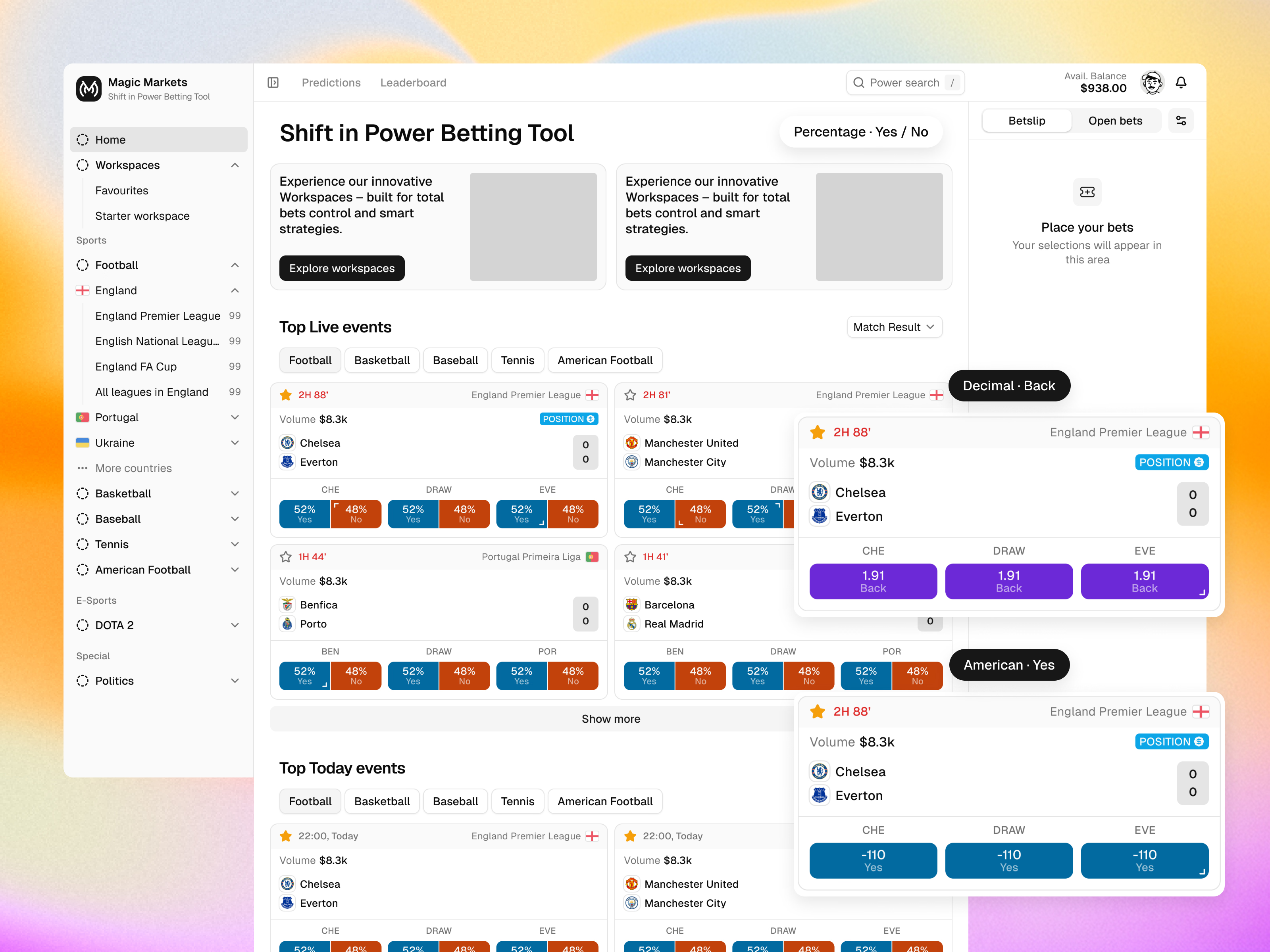
What Makes Sports Prediction Market UX Different From News and Election Markets?
A sports prediction market is an exchange where users trade on the outcome of a sporting event, with prices shown as probabilities and settled at a fixed amount when the event ends. The mechanics match other prediction markets. The tempo and structure of sport don't.
Sport already dominates the category. According to Pew Research Center, sports accounted for 80% of trading volume on Kalshi and 39% on Polymarket from July 2024 onwards, and a later Pew analysis found that combined volume on the two platforms doubled between May and July 2026, driven mostly by sports. Pew measures notional value, so these figures aren't directly comparable with sportsbook handle, but the direction is clear.
Three things change the design once the event is a match:
- Tempo. A news market can sit for weeks. A live football price moves after every attack, and a market can be suspended for a goal and reopen at a different level within a minute.
- Market count. An election has a handful of questions. A single football match carries match result, totals, handicaps, both teams to score, correct score and more, each with several lines.
- Outcome structure. Most news markets are binary. Football's main market has three outcomes, and most others are lines on a number.
An interface that works for "Will this candidate win?" has to answer different questions on a Saturday afternoon: which of forty markets matters right now, whether the price is still current, and what Yes means when there are three possible results.
Should a Sports Prediction Market Show Odds or Probabilities?
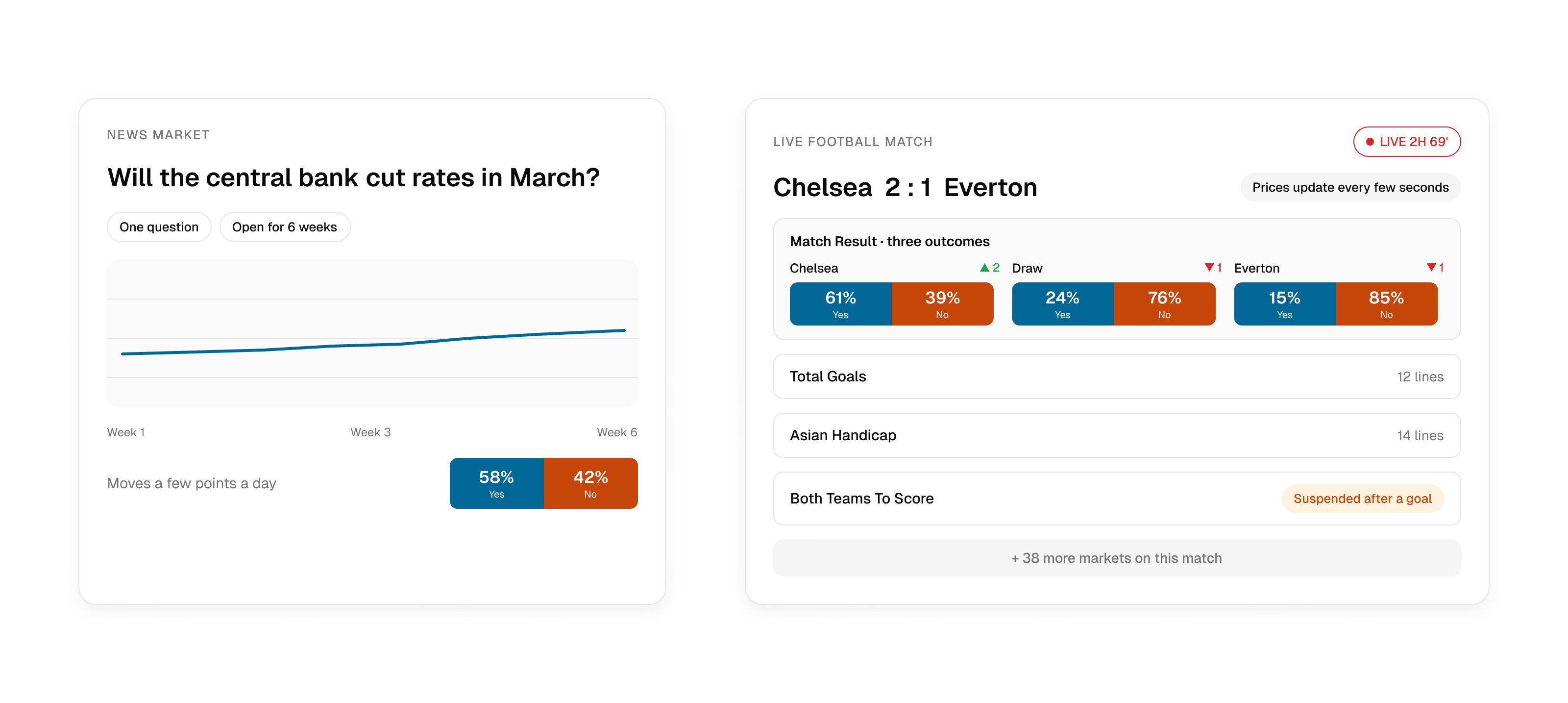
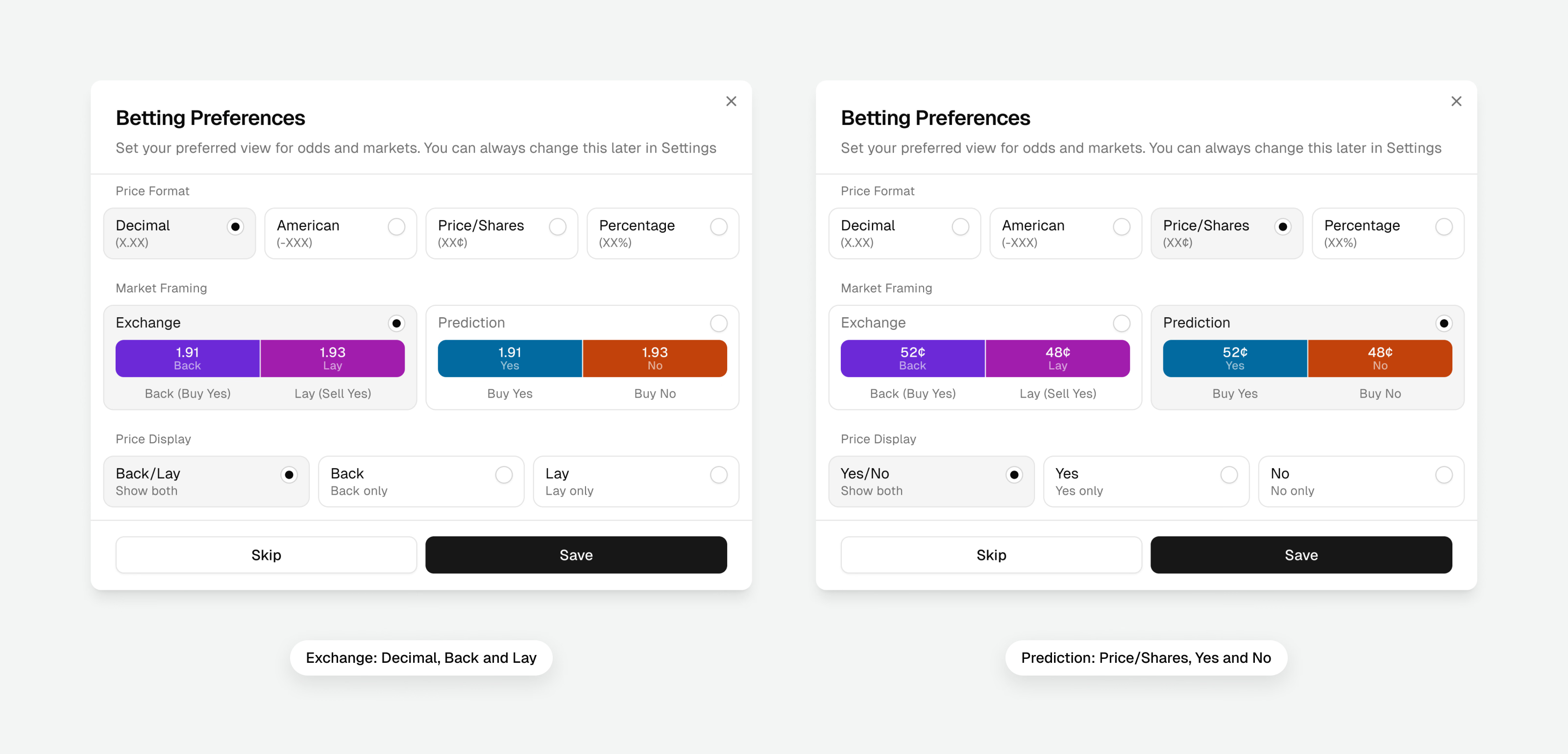
Both, because the audience arrives with different habits. Bettors who grew up on sportsbooks read decimal or American odds. Users who came through Polymarket and Kalshi read a price per share or a percentage. The same price can be written four ways: 1.91 in decimal, -110 in American, 52¢ per share or 52%.
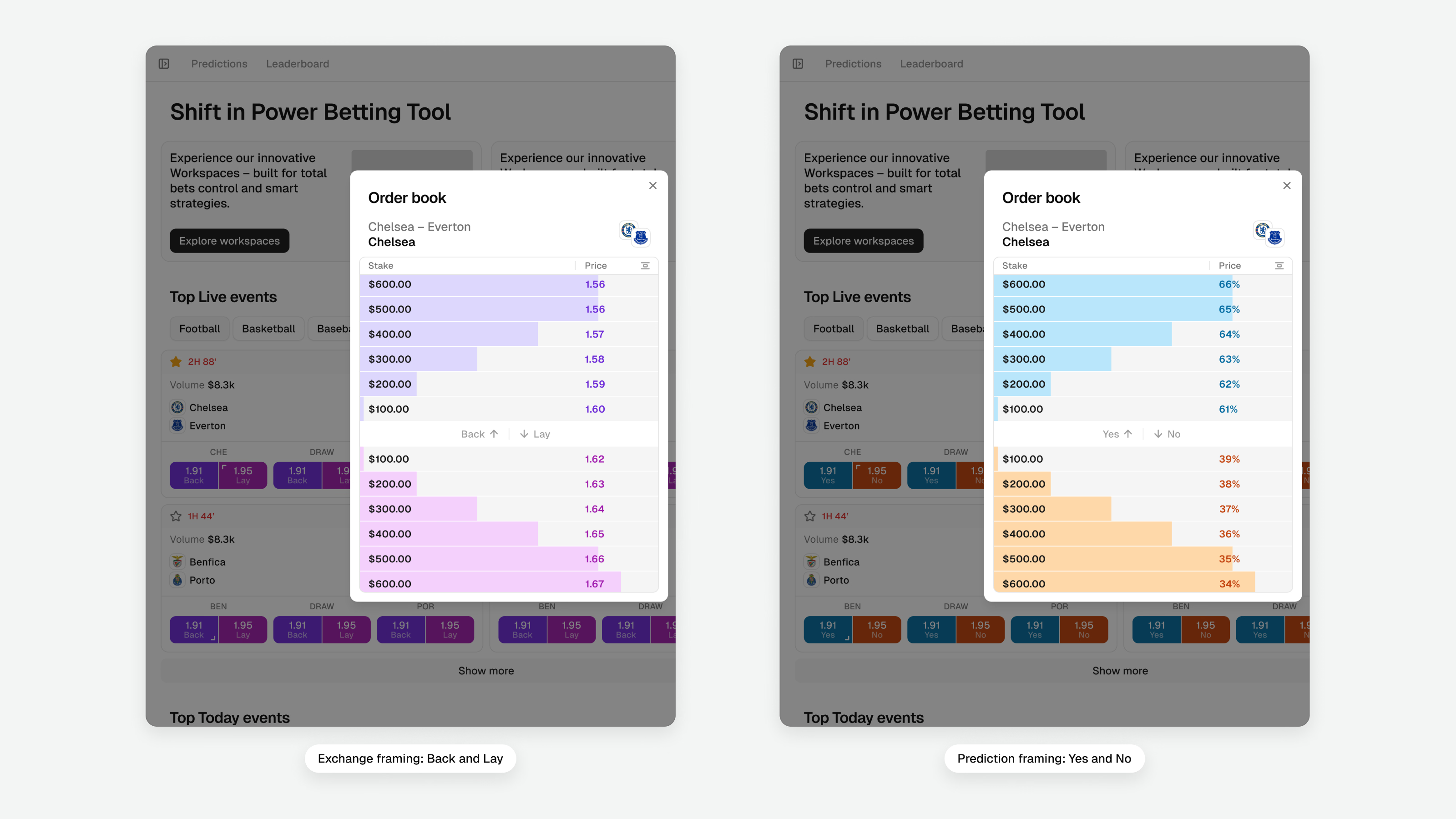
Design exploration. Early Magic Markets flows split users into two modes at onboarding: a Lite mode with Yes/No cards and probabilities, and a Pro mode with the full exchange and Back/Lay prices. The first main-page wireframes went further and gave every list a view switcher between odds, shares and percentages.
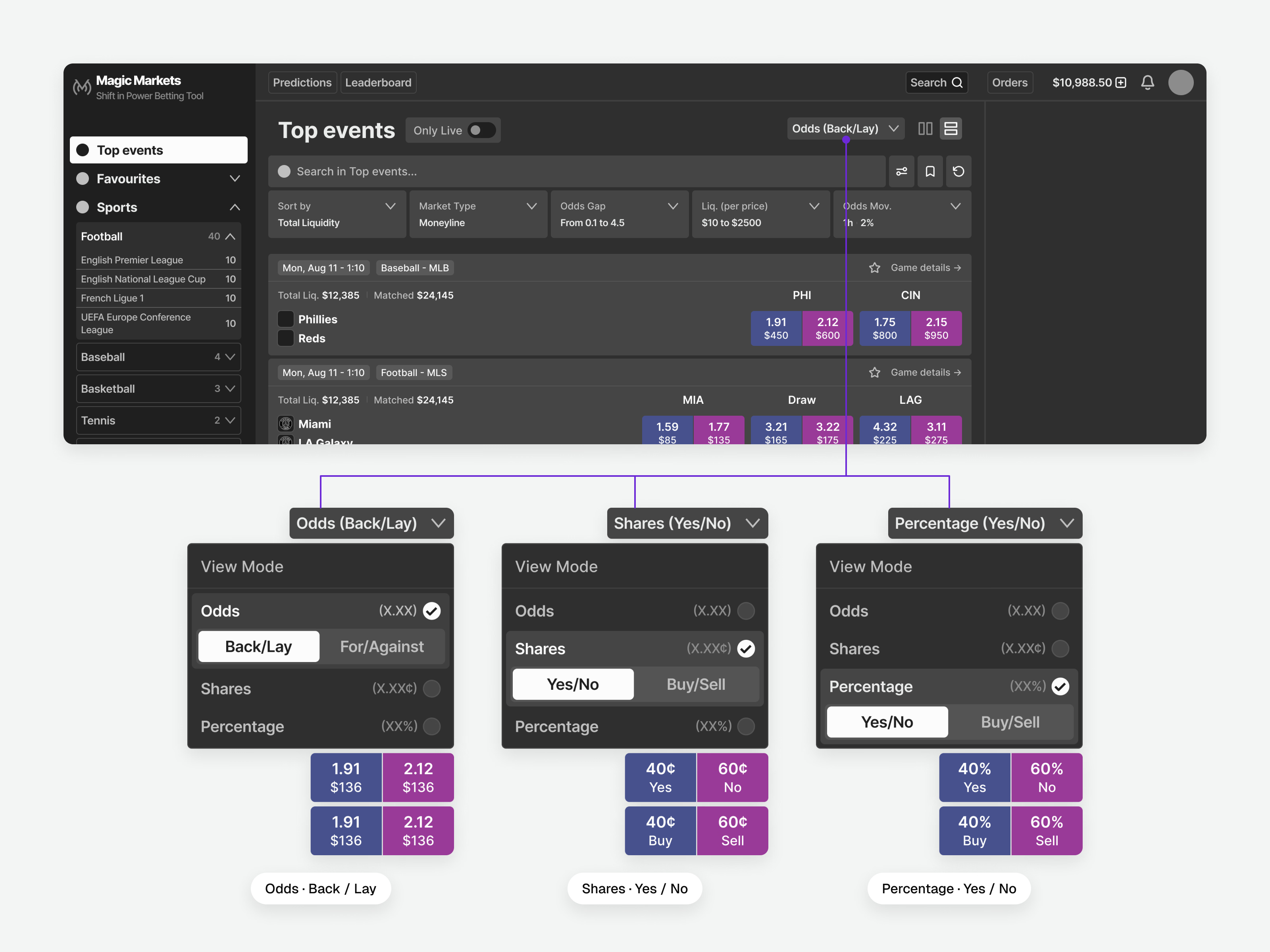
MVP direction. The final design separated two decisions that the modes had bundled together. A short Betting Preferences dialog at onboarding sets the price format (decimal, American, price per share or percentage), the market framing (Exchange with Back and Lay, or Prediction with Yes and No) and the price display (both sides of each outcome or one side only). The user can skip it and change it later in Settings. Every screen then renders in that combination, from the home page to the betslip.
Our team thought four formats were too many and would make the product harder to build and to explain. The client chose to keep them all and test which ones users actually pick. In hindsight that was the right call for a new product: when nobody on either side knows how a new audience will behave, the cheapest research is to let the audience choose.
How Do You Design a Yes/No Betslip With an Order Book?
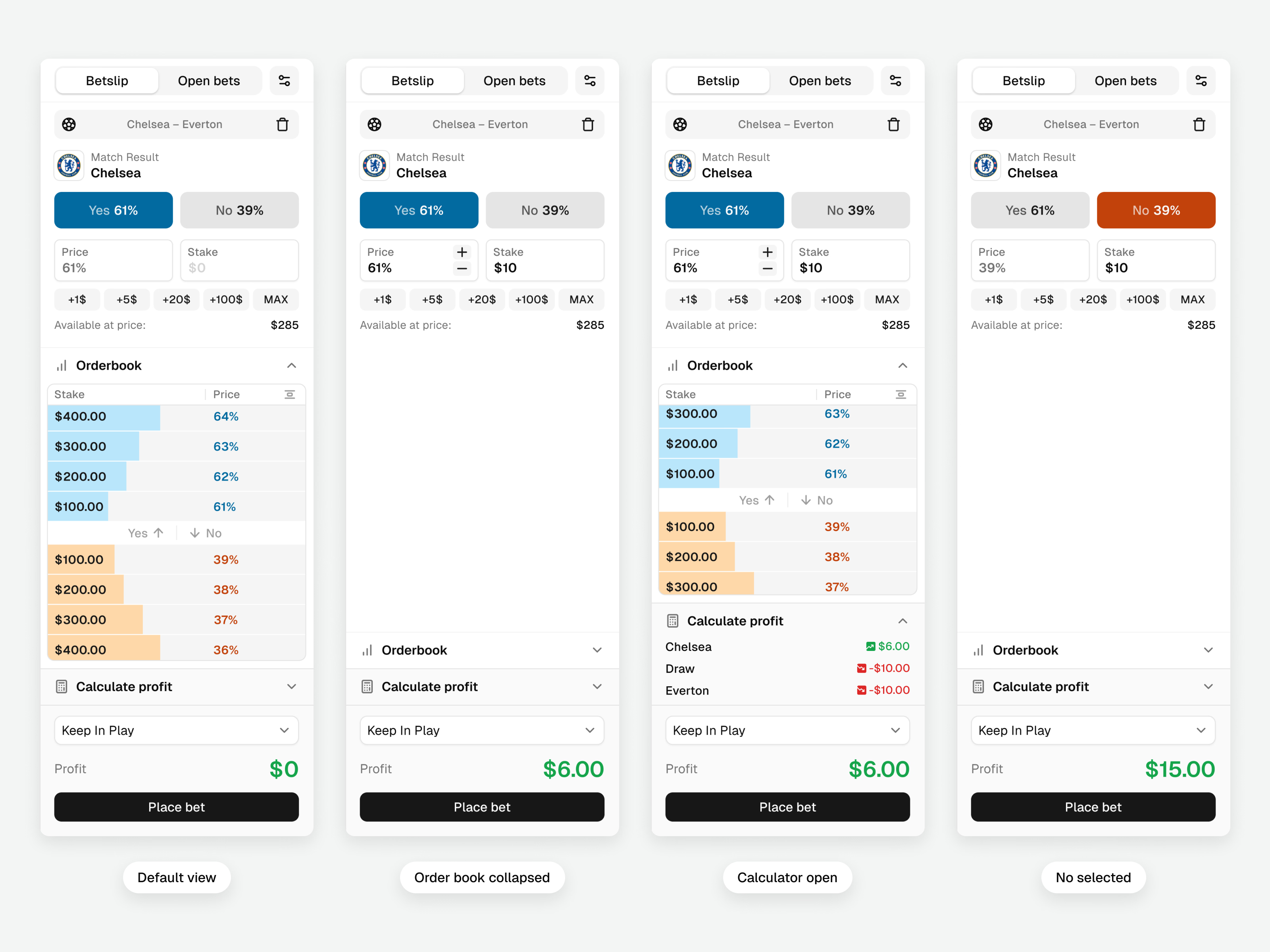
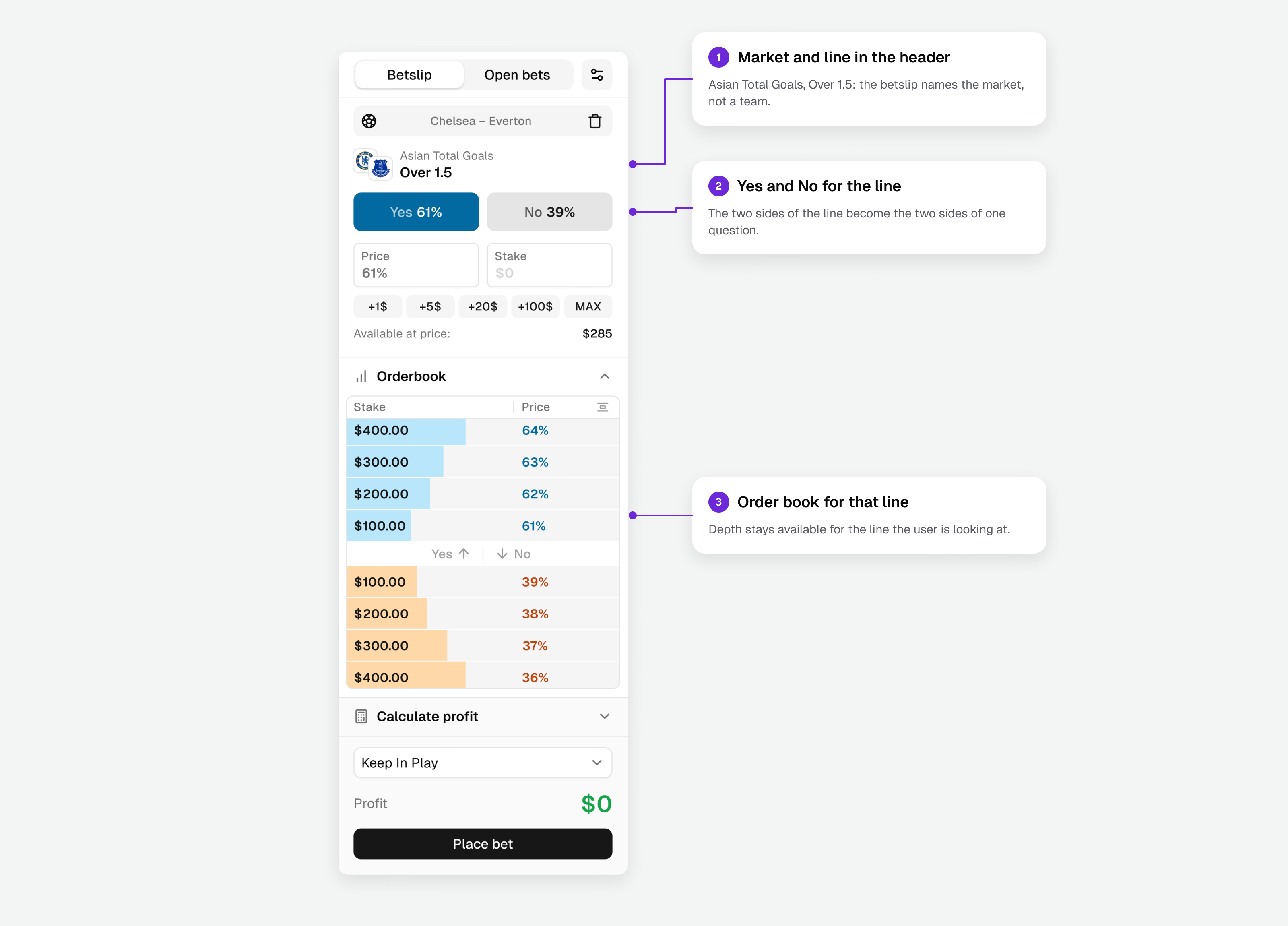
Start with the question the user is answering, then show the market behind it. In prediction framing the Magic Markets design opens the betslip with the outcome name and a Yes/No toggle at the top, each side showing its current price as a percentage. Below it sit price and stake fields, quick stake buttons and the amount available at that price. The profit line at the bottom tells the user what they get if they're right.
The order book sits directly under the toggle, with Yes prices stacked above the spread and No prices below it, each level showing how much money is available. Showing it by default was the client's request, and it was also a deliberate test: prediction market users are used to seeing the book, and the team wanted to learn whether a sports audience would use it or ignore it. A betslip setting lets users hide it, and it collapses once the user starts entering a stake, so the input stays in focus.
Three details made the Yes/No betslip work for live sport:
- Stake in one tap. Quick buttons add $1, $5, $20 or $100, or fill the maximum, so a live bet doesn't depend on typing.
- Switching sides is visible at a glance. Selecting No turns the toggle to the No colour and swaps the price to the No side, so the user knows which side they're on without reading.
- The calculator stays one tap away. Expanding it shows profit or loss for every outcome of the market, which matters most on three-way markets.
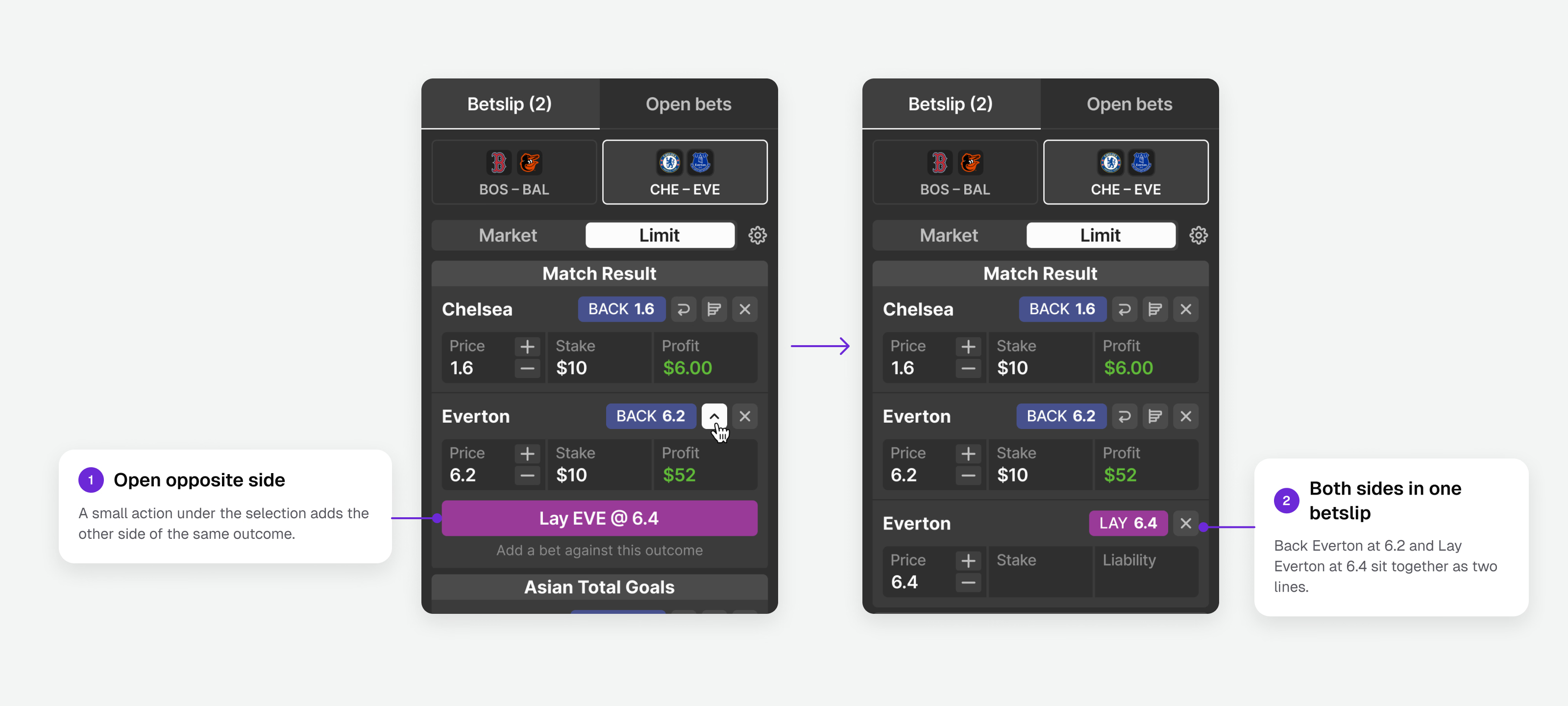
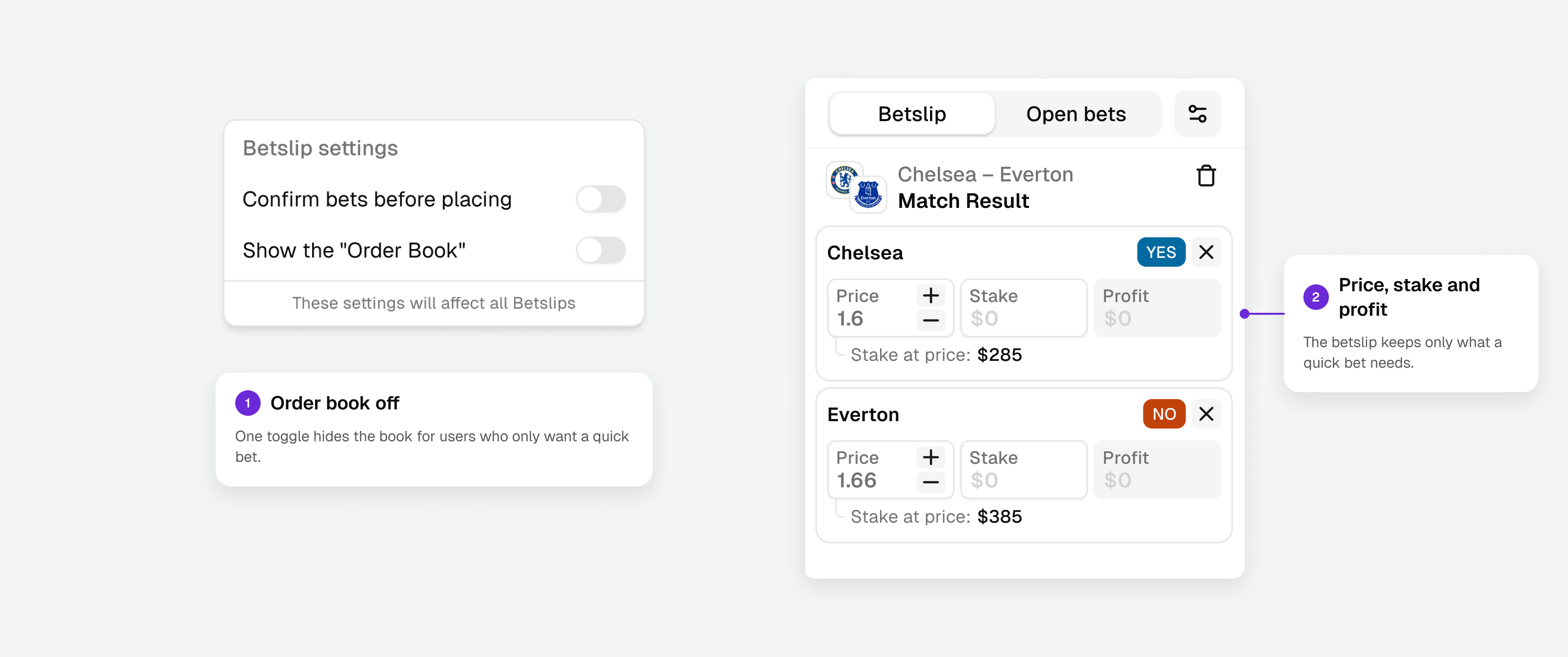
One request shaped the betslip more than any other. The client wanted traders to hold both sides of a market at once and to add a neighbouring line in the same move. A single Yes/No toggle can't do that, because switching the toggle replaces one side with the other. We explored a small "open opposite side" action next to the selection, which adds the other side as a second line in the betslip, and the betslip holds several selections at once (for example, Yes on Chelsea and No on Everton).
How Do Yes and No Work on a Three-Way Football Market?
Give every outcome its own Yes/No pair. A match between Chelsea and Everton becomes three questions: Will Chelsea win? Will it be a draw? Will Everton win? Each has a Yes price and a No price, and on the Magic Markets home page in prediction framing every outcome shows both side by side.
The important point for design is that No on one outcome is the exchange equivalent of laying it. The risk is identical; only the numbers on screen differ. Take Chelsea at 1.60, which is a 62.5% chance:
- Laying Chelsea for a $10 backer's stake means a liability of $6. If Chelsea fail to win, the user gains $10. If Chelsea win, the user loses $6.
- Buying No on Chelsea at 37.5¢ per share with $6 buys 16 shares. If Chelsea fail to win, the shares pay $16, a $10 gain. If Chelsea win, the user loses $6.
Same exposure, two vocabularies. Exchange framing talks in stake and liability; prediction framing talks in cost and payout. The interface has to keep those figures consistent when a user switches framing, or the user will assume the market itself has changed.
Some football markets create a trap of their own. In both teams to score, the outcomes are already called Yes and No. On an exchange a user can back No or lay No, and in prediction framing the button would read "Buy No" on an outcome named No. Our research notes flagged this early, together with an open question for the client about how often traders actually back or lay No and why. The safer pattern in prediction framing is to turn the market into a single question, "Will both teams score?", so that Yes and No are the two sides of that question and never the names of outcomes.
Three-way markets also need a calculator more than binary ones. Buying Yes on the draw changes the profit and loss on both team outcomes as well, and a user holding several positions on one match needs to see profit or loss for every result at once. The betslip calculator does that for all three outcomes.
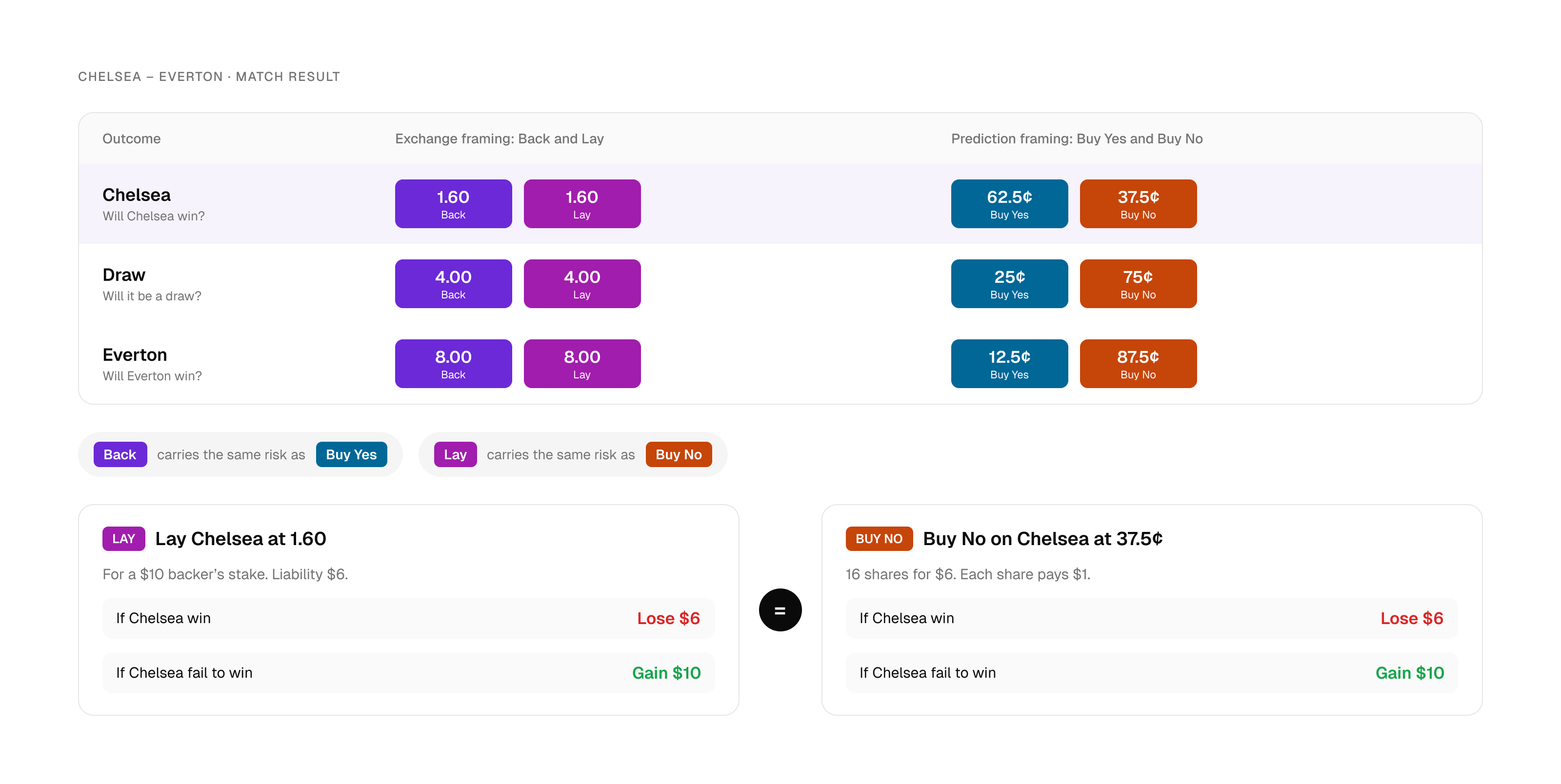
Same Risk, Two Vocabularies: Laying and Buying No
How Do You Turn Totals and Handicaps Into Yes/No Questions?
Rephrase each line as one question. "Over/Under 2.5 goals" becomes "Will there be more than 2.5 goals?" and an Asian handicap of Chelsea -1.5 becomes "Will Chelsea win by two or more?". The early Lite flow already treated totals, spreads and other markets this way, as a block of questions under the main result.
These markets aren't tied to one team, and the betslip has to show that. In Magic Markets the prediction betslip for a whole-game market, such as total goals, names the market and the line in the header and uses Yes and No for the two sides of the line. The calculator then explains each side in plain terms, such as "if 2+ goals" or "if fewer than 2".
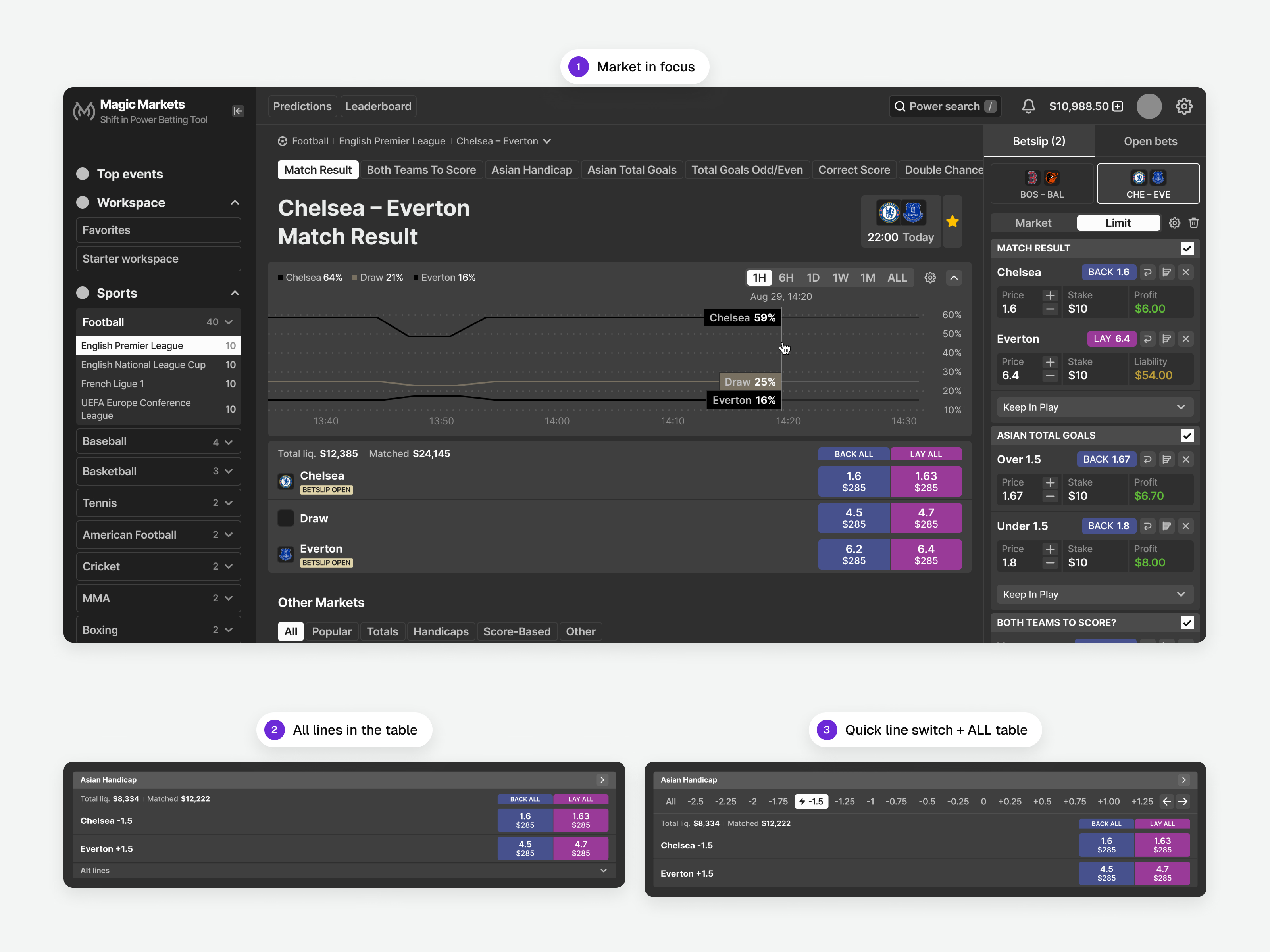
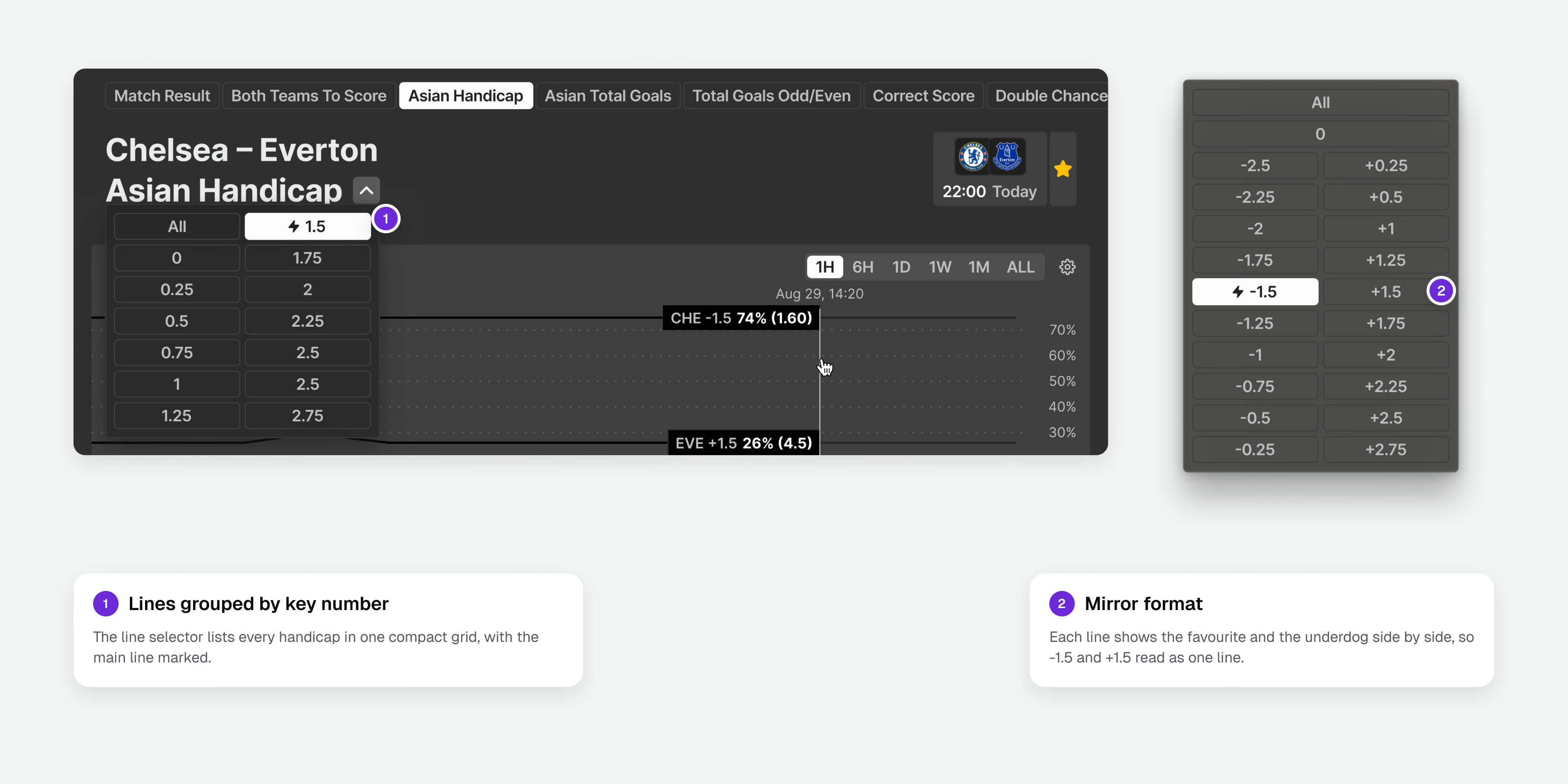
Lines create a second problem: a single total can have a dozen versions (0.5, 1, 1.5, 2, 2.5 and so on). We compared three layouts for the event page: one market in focus, every line in one table, and a quick line switch with an "All" table on demand. The design kept one main line in focus, marked as the main line, with a compact selector for the others and the full table one tap away. For handicaps, the explorations grouped lines by key number and showed each line in a mirror format, favourite and underdog side by side, so the same line reads correctly from either team.
Full price ladders for every line at once proved impractical on one screen. Depth stays available per market, opened from the line the user is looking at.
How Should a Prediction Market Show Liquidity and Errors?
Next to the stake, in money. In the Magic Markets design, each betslip shows how much is available at the selected price, so a user can see before placing the order whether their stake will fill at that level. In the order book, every price level shows its volume, and the side with more money behind it is visible at a glance.
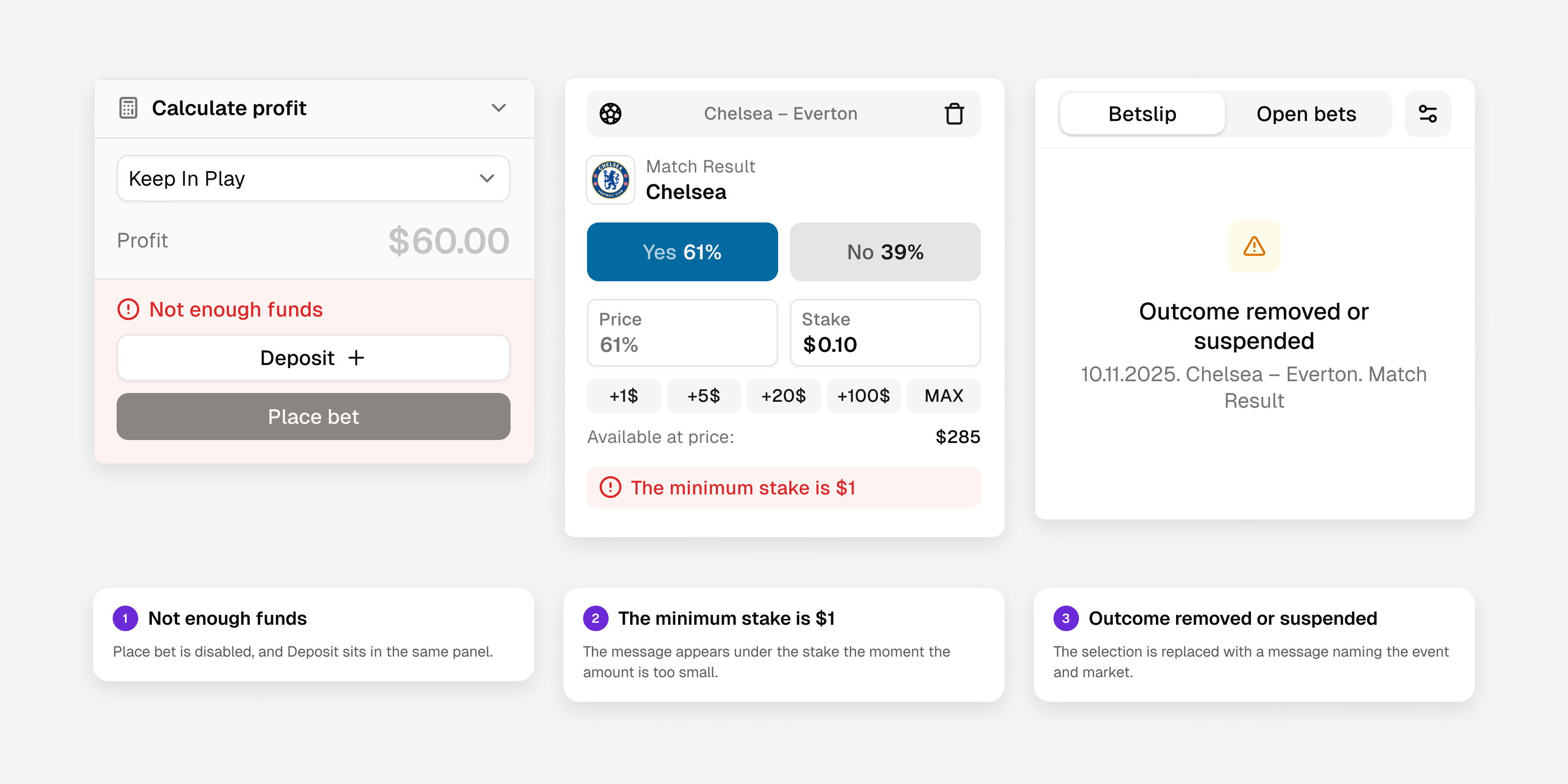
Errors belong at the point of action. Three states needed explicit designs:
- Not enough funds. The betslip disables Place bet, explains why and offers Deposit in the same panel.
- Below the minimum stake. The message sits under the stake field and states the minimum.
- Outcome removed or suspended. The betslip replaces the selection with a clear message naming the event and market, and the user can't submit an order against a market that is no longer open.
In live sport the third case is routine. Markets suspend for goals, red cards and penalties, and an interface that leaves the old price on screen invites users to act on it.
What Do Sportsbook Users Need to Switch to a Prediction Market?
A familiar first screen, then the new vocabulary. Most people arriving at a sports prediction market already know a sportsbook. If the first thing they see is a price in cents and a Buy No button, many will leave before they understand that the market works much like a bet they've placed before.
The Magic Markets design handled this in three ways:
- Let users start in the format they know. The onboarding dialog shows what each framing looks like on a real price, including the mapping between them (Back is Buy Yes, Lay is Sell Yes), so the choice is concrete.
- Keep a simplified betslip available. Settings can hide the order book and skip the confirmation step, leaving price, stake and profit for users who want a quick bet.
- Make switching cheap. Format and framing live in Settings and apply everywhere, so a user who starts with decimal odds can try percentages without losing their bets or positions.
The underlying lesson goes beyond prediction markets. When the market is new and the audience is mixed, a product doesn't have to pick one mental model upfront. It can offer a small number of well-defined views of the same market and learn from what people choose. That is what the live Magic Markets product is doing now.
In Short
Yes/No is a strong idea, and sport is where prediction markets are growing fastest. Making the two fit takes more than relabelling buttons: it takes one market that can be read in more than one language, with the same numbers underneath.
Launching a sports prediction market or adding Yes/No trading to your product? Our sports analytics product design work starts with how your users read a price, our MVP design and development service takes it to a first release, and our article on betting exchange UX covers the exchange side of the same product. Let's talk.

Frequently Asked Questions
What is a sports prediction market?
A sports prediction market is an exchange where users trade on sporting outcomes, with prices shown as probabilities and contracts settling at a fixed amount when the event ends. Users trade against each other. Magic Markets is one example; in our design it offered both prediction and exchange views of the same markets.
Should prediction markets show prices as odds or probabilities?
Ideally both, as a user setting. Bettors from sportsbooks read decimal or American odds, while users from Polymarket or Kalshi read cents or percentages. The same price can appear as 1.91, -110, 52¢ or 52%. Letting users choose at onboarding, and change it later, avoids forcing one audience into the other's vocabulary.
How is buying No different from laying a bet?
The risk is the same, only the presentation differs. Laying Chelsea at 1.60 for a $10 stake risks $6 to win $10. Buying No on Chelsea at 37.5¢ costs $6 for 16 shares that pay $16. An interface should keep stake, liability and payout consistent across both views.
Do prediction market users need to see the order book?
Many expect it, because the leading prediction markets show one. Showing available volume at each price helps users judge whether their stake will fill. A good design shows the book by default for those who want it, collapses it while the user enters a stake, and lets anyone hide it in settings.
What makes live sport hard for prediction market design?
Prices move every few seconds, markets suspend after goals or red cards, and one match carries dozens of markets with several lines each. The interface has to keep one market in focus, flag stale or suspended prices immediately and show available volume beside every price, so users never act on outdated information.
